


15 of the Top-Rated BPM Software for Healthcare Companies to Consider – Solutions Review


The editors at Solutions Review have compiled the following list to spotlight some of the best BPM software for healthcare companies to consider working with.
Healthcare professionals need access to consistent, dependable technology systems capable of managing facilities, documentation, strategic planning, budgeting, employees, and patient experiences. However, not every healthcare solution is created equal, so professionals in the industry must find and implement the best technology system for their needs. The Business Process Management (BPM) software marketplace has grown especially valuable to the healthcare industry for precisely this reason.
Organizations across the healthcare industry interact with countless people and systems, and managing all of the data and processes involved in those interactions is no simple task. These organizations need a solution capable of centralizing, standardizing, monitoring, and automating their processes. With that in mind, the editors at Solutions Review created this list, which profiles some of the best BPM software for healthcare professionals to consider.
Our editors selected these software solutions based on each provider’s Authority Score, a meta-analysis of user sentiment through the web’s most trusted business software review sites, and our proprietary five-point inclusion criteria. The list is organized alphabetically.

Description: Agliloft is a highly configurable BPM suite comprised of a flexible and robust data module. The module features a powerful workflow rules engine giving it the ability to map any business structure and automate complex business processes. The platform includes integrated applications for help desk, customer service, web self-service, knowledge management, and contract management. With its low-code Contract Management platform, healthcare organizations have a complete lifecycle solution they can use to ensure regulatory compliance, enhance the patient experience, mitigate risks, control spending, streamline contract management, and more.

Description: Appian BPM software is a model-driven app development platform that allows both experienced and citizen developers to build process-centric and case-centric applications with the ability to monitor and improve business processes in response to changing needs. Appian’s low-code automation capabilities can help healthcare professionals improve how they deliver care to patients, streamline care coordination, expedite crucial decision-making processes, and encourage innovation. Specific features include clinician management, clinical care operations management, member services, governance, risk, and compliance tools.

Description: Bizagi is a leader in digital business process automation software. The vendor offers three tiers of solutions, including Bizagi Engine, Bizagi Studio, and Bizagi Modeler. Other tools cover process modeling, automation, business transformation, low-code app development, and case management. With Bizagi’s BPM software for healthcare automation, users can mitigate risks, maintain regulatory compliance, modernize IT initiatives to improve patient experience, accelerate service provision, and identify new opportunities for improved efficiency. These healthcare automations can help streamline patient care, records, billing, and onboarding management.

Description: Bonitasoft develops BPM software for developers to build business applications that adapt to real-time changes, UI updates, and more. With Bonitasoft, users can automate, model, and monitor business processes to streamline operations. The software automatically checks for errors and highlights them before users save their business model. Bonitasoft also offers digital process automation capabilities for healthcare and pharmaceutical organizations. These tools can help professionals improve coordination with service providers, comply with regulatory standards, follow legal guidelines, centralize patient data, and deliver quality patient care.

Description: BP Logix’s Process Director is a complete BPM solution with workflow software, case management software, and business process automation. These features enable both IT and business users to create robust business process management and workflow solutions to address various business challenges. BP Logix offers healthcare workflow automation, document workflow management, and GRC solutions for healthcare professionals. These will help healthcare entities bring improved visibility, standardization, and simplicity to their organizational processes.

Description: FlowForma offers no-code workflow automation tools that provide business experts with low entry costs and rapid process development. An award-winning Microsoft Office 365® app, FlowForma® Process Automation, revolutionizes the traditional BPM space, enabling business users to quickly implement HR onboarding processes, new product development, and clinical trials to increase organizational efficiency and productivity. Healthcare organizations can use the FlowForma Process Automation solution to improve their digital transformation initiatives, streamline processes with digital process automation tools, maximize ROI, and increase visibility, productivity, and efficiency across departments.

Description: The iGrafx Business Transformation Platform enables transformation by connecting strategy to execution. Its cloud-based platform enables healthcare businesses to meet challenges by executing a strategic vision, optimizing the customer experience, operationalizing Governance, Risk, and Compliance (GRC), and delivering holistic Quality Management (QMS). Additionally, the iGrafx’s Business Transformation Platform allows healthcare enterprises to visualize and understand how their processes align with overall objectives, making it easier to manage patient demographics and meet changing regulatory requirements.

Description: Itransition is a global software development company that offers consulting and development services to companies of all sizes. Its healthcare expertise extends to various organizations, practitioners, nursing homes, research centers, medical SIVs, assisted living facilities, and device manufacturers. Capabilities for healthcare use cases include digital patient management, clinical application development, and medical workflow management functionalities for medical billing, CRM, insurance claims management, procurement, and equipment tracking.

Description: Newgen Software Technologies Ltd. is a global provider of Business Process Management (BPM), Enterprise Content Management (ECM), and Customer Communication Management (CCM) solutions with a footprint in over 60 countries. Its digital process automation capabilities can help healthcare payers future-proof their processes, maintain compliance, enable contextual member engagement, and address operational inefficiencies. These capabilities include seamless system integrations, automated data capture, document management, document archival, contact creation, case routing, automatic document generation, 360-degree case visibility, and more.

Description: Nintex offers IPA solutions that strip business inefficiencies and replace them with seamless, sophisticated processes. The easy-to-use, no-code platform, Nintex Workflow Cloud®, allows users to connect with all content repositories, systems of record, and people. Nintex offers advanced workflow, document generation, data collection and dissemination forms, integration with leading cognitive services, process mapping, monitoring, and reporting, whether on-premise or cloud. The company also helps pharmaceutical companies, healthcare providers, and medical device manufacturers reduce costs, save time, maintain compliance, stay competitive, and deliver better patient outcomes with automated capabilities.

Description: Pegas offers a Business Process Management tool developed on Java and OOP concepts. The platform allows users to quickly assemble an executable business application using visual tools. Pega has an extensive history of developing applications that offer support services to carry out daily sales, marketing, and services. The company’s healthcare and life sciences solutions can help clients reduce costs, remove operational barriers, connect systems, expedite R&D with automation tools, digitize clinical trials, personalize patient engagement, use self-service functionalities to empower users, and develop patient-centric experiences that improve outcomes.

Description: ProcessMaker is a low-code BPM and enterprise digital process automation platform. Its BPM offerings are known for their ease of use and customizability and offer a collection of features for designing, running, improving, and reporting on company processes. Features include a process modeler, form builder, dashboards for monitoring operations, Business Activity Monitoring (BAM), and a suite of third-party systems to help extend legacy systems and improve processes with additional functionalities. Healthcare users can leverage ProcessMaker’s platform to automate operational processes, maximize productivity, deliver personalized care, increase patient engagement, and more.

Description: TIBCO offers a flexible, all-in-one platform offering complete visibility and resource management, so businesses are in total control of their operations. TIBCO can react to business events in real-time, meeting all process needs. The platform offers Intelligent Work and Resource Management dashboards that allow users to work with process details for greater business insight. Its connected intelligence capabilities can help healthcare organizations improve their patient data management, maintain a 360-degree view of a patient’s healthcare history, uncover new insights, provide a better experience at the point of care, and incorporate social determinants of health (SDoH) into patient care.

Description: TrackVia is a user-friendly offering often viewed as an alternative to many traditional BPM platforms. TrackVia’s low-code platform allows users to quickly assemble applications to match their unique business processes without extensive IT assistance or coding knowledge. TrackVia provides real-time reports, interactive charts, intelligent charts, intelligent automation, and user permissions. Healthcare companies can use its no-code app builder to create tools for optimizing operations, improving patient care with real-time reporting, and driving operational change.

Description: Zoho Creator is an online application builder designed to help organizations manage their business processes. Using an intuitive drag-and-drop interface, users can develop custom applications without the hassle of coding. Zoho Creator offers a massive array of tools and a feature-rich development platform. With its HIPAA-compliant low-code platform, Zoho Creator can help users create a custom healthcare management solution from scratch or use Zoho’s pre-built applications to get started. Features include rapid development, end-to-end data security, legacy modernization, and employee, time, project, and inventory management tools.
- Published in Uncategorized
5 Top Affordable EMR Software for Small Medical Practices – Software Advice

Electronic medical records (EMR) software reduces the administrative burden that healthcare practitioners face so they can focus on patient care. These tools keep tabs on patient history, schedule appointments, and generate invoices after patient visits.
But if you’re a small or private practitioner, investing in an EMR system usually means going over budget. In this case, choosing an affordable EMR software tool can help you provide quality care to your patients without burning a hole in your pocket.
This article highlights the five most affordable EMR software systems. These products (listed alphabetically) have been selected from our EMR software FrontRunners report, according to our methodology specified here.

4.44/5 (Read user reviews)
View Product Details
75Health is a cloud-based electronic health record (EMR) solution that helps medical professionals working in small and midsize medical clinics manage patient information and digital records.
The EMR system features a built-in scheduler that helps you schedule patient appointments and keep tabs on electronic patient charts to track their recovery progress. You can also safely store patients’ medical records and practice documents, such as consent forms and lab reports.
E-prescribing is available so you can send prescriptions to patients digitally and update them whenever required. With built-in reminders, you can send reminders to patients about upcoming visits.
75Health offers email, phone, and chat support. The tool is only web-based.

Patient information in 75Health (Source)
4.29/5 (Read user reviews)
View Product Details
CharmHealth EHR is a cloud-based practice management and medical billing solution for small practices that helps healthcare organizations manage administrative tasks such as patient document management, invoice generation, and patient scheduling.
Charm HR also lets you manage the access privileges of your practitioners. All users get role-based access and get audited from time to time to spot access violations.
Patients can pay for services directly from the software using their debit or credit card, making the billing process more efficient. Additionally, the software generates invoices automatically based on chart note entries.
The system offers email, chat, and phone support and is web-based with a mobile app for both Android and iOS devices.

Custom add-ons in charm EHR (Source)
3.68/5 (Read user reviews)
View Product Details
EHR 24/7 is a web-based electronic health record solution for small and private practices. The tool takes care of paperwork tasks, such as creating patient charts and maintaining their medical records.
The software helps order and receive lab results online and can also help you with e-prescribing medication to patients. Additionally, you can create real-time diagnostic reports and patient medical history.
You can send reminders to patients for upcoming visits along with alerts to take medication.
EHR 24/7 offers email and phone support, and the software is cloud-based.

Patient information in EHR 24/7 (Source)
4.85/5 (Read user reviews)
View Product Details
Jane is a practice management system for therapists, private practitioners, and small practices that helps with appointment booking, billing, and patient charting. The EHR software allows patients to view and choose services, treatments, and practitioners as per specific requirements.
Jane enables patients and healthcare professionals to receive notifications for bookings, confirmations, and appointment reminders automatically. It lets you create a patient database, and add photos and videos to track progress on a centralized platform.
Patients can use the EHR system to store their billing and payment information for faster payment and then receive invoices. The software also lets you set up access permissions, restricting users from viewing, editing, or deleting information.
Jane offers email, phone, and chat support and is web-based.

Patient charts in Jane (Source)
4.48/5 (Read user reviews)
View Product Details
RXNT is a feature-laden integrated suite of EHR, medical billing, and practice management software for small clinics and private practitioners. The software helps track patient data and automatically updates patient information by assessing diagnostics and lab reports.
You can use the software to check patients in digitally and share patient records with them. Additionally, you can schedule patient visits and send automated emails regarding appointment changes and prescription renewals.
The software also offers a patient portal for updating health information, uploading documents, and paying bills online.
RXNT offers email, phone, and chat support. The software is web-based and also has a desktop application. Additionally, it also has a mobile app for both Android and iOS.

Medical billing dashboard in RXNT (Source)
The tools mentioned above can get you started on your software search, but to find the best EMR software that fits your requirements, we recommend following these steps.
Here are some questions to ask EMR software providers before making a final purchase:
How did we select these products? Based on your reviews
At Software Advice, we consider and verify all our user reviews to recommend the most efficient tools for your business.
Our software recommendations reflect the views and experiences given by your peers. These recommendations are never bought or sold, nor based on the opinion of a single individual.
To be included in this list, products must:
What You Don’t Know About Medical Wearable Devices and Remote Patient Monitoring—But Should
Physician Burnout in the Pandemic Age
Understanding The Telemental Health Care Access Act of 2021
© 2006-2022 Software Advice, Inc. TermsPrivacy PolicyCommunity GuidelinesGeneral Vendor TermsGDM Content PolicyGDM Content Policy FAQs
- Published in Uncategorized
Document Management Services Market: King & Wood Mallesons Adoption of iManage Cloud to Create Augmented Sales Opportunities, predicts Fortune Business Insights – GlobeNewswire

August 10, 2021 06:40 ET | Source: Fortune Business Insights Fortune Business Insights
Pune INDIA
Pune, India, Aug. 10, 2021 (GLOBE NEWSWIRE) — The global document management services market is likely to reach USD 57.56 billion by 2027 owing to rapid adoption of cloud-based technologies. Besides, the market will register a CAGR of 6.9% between 2020 and 2027 according to Fortune Business Insights, latest report, titled “Document Management Services Market Size, Share & COVID-19 IMPACT Analysis, By Services (Archiving and Storage, Imaging and Scanning, Printing, Mailroom Services and Others), By End-user (Medical, Financial, Government, Audit & Consulting, Corporate, Telecommunication, and Insurance & Re-insurance) and Regional Forecast, 2020-2027”
The emergence of COVID-19 has brought the world to a standstill. We understand that this health crisis has brought an unprecedented impact on businesses across industries. However, this too shall pass. Rising support from governments and several companies can help in the fight against this highly contagious disease. There are some industries that are struggling and some are thriving. Overall, almost every sector is anticipated to be impacted by the pandemic.
We are taking continuous efforts to help your business sustain and grow during COVID-19 pandemics. Based on our experience and expertise, we will offer you an impact analysis of coronavirus outbreak across industries to help you prepare for the future.
Request Sample PDF Brochure: https://www.fortunebusinessinsights.com/enquiry/request-sample-pdf/document-management-services-market-102848
Document management services are vital to organize all the important document and data in one place. In addition to this, these services efficiently keep a track on all the important documents, while speeding up the performance of an organization. Furthermore, it is accurate and provides access to the documents at any given time from any part of the globe. Today, there has been a paradigm shift towards digitalization that is propelling the companies to move beyond paper document and adopt electronic document management systems (EDMS). Moreover, the electronic system has automated the complete work process, thereby, saving time and effort.
What does the Report Include?
The Document Management Services Market report includes an exhaustive study of several factors such as drivers, restraints, challenges, and opportunities that will affect the growth of the market in the forthcoming years. The report covers regional demographics that include qualitative and quantitative information about the regions that are further divided into nations that are contributing to the growth of the market between 2019 and 2026. Furthermore, the competitive landscape has been discussed in-depth that include information of several players operating in the market. Moreover, information on the adoption of strategies such as merger and acquisition, collaboration, partnerships, and joint ventures by the companies that will drive the growth of the market has been included during the projected horizon.
Have Any Query? Speak To Analyst:
https://www.fortunebusinessinsights.com/enquiry/speak-to-analyst/document-management-services-market-102848
Drivers and Restraints:
Adoption of Technology Such as Cloud-Based amid COVIID-19 to Spur Demand
Technological advancement has led to emergence of efficient and reliable services such as cloud-based management. Additionally, cloud-based applications provide a seamless user experience and provides high-level flexibility to manage work for the organizations across the globe. The global pandemic, COVID-19 has gripped the whole world with widespread effects over several economies. Several governments around the world have called for lockdown to contain the disease and majority of people are working remotely. This has surged the demand for cloud-based services manifold in this testing times. Major companies are adopting the services that are robust and reliable to keep continuing the operational activities of their businesses. For instance, in May 2020, King & Wood Mallesons, a global international law firm, announced its adoption of iManage Cloud for its offices in Europe, Middle East, and United States. Darren Brown, IT Head of the company, said on the sidelines of the development, “Our firm is a strong believer of the future belonging to cloud, and are impressed with iManage cloud’s tremendous impact on our productivity, significant reduction in operational overheads, and its ability to access remotely.”
Regional Analysis:
Presence of Major Companies in North America to Bolster Growth
Geographically, the market comprises of several regions affecting the market growth during the forecast period. They are:
North America: The region held the largest share at USD 13.76 Billion in 2019 and is expected to dominate the market during the projected horizon. This is ascribable to factors such as presence of major companies such as Oracle Corporation and Access. Furthermore, rising adoption of the services by the end-user industries such as healthcare and BFSI is expected to propel North America to hold highest document management services market revenue between 2020 and 2027.
Asia-Pacific: The market in this region is likely to rise significantly during the forecast period. This is attributable to factors such as improved IT infrastructures in countries such as China, and India. Furthermore, advancement in business process services in Asia-Pacific will positively affect the market growth in the forthcoming years.
Europe: On the other hand, Europe is anticipated to register augmented growth owing to adoption of strategies such as collaboration by the companies to expand their business during the forecast period.
Ask For Customization: https://www.fortunebusinessinsights.com/enquiry/customization/document-management-services-market-102848
Document Management Services Market Share Report Scope and segmentation:
Competitive Landscape:
Merger and Acquisition by the Companies to Stoke Demand
According to the report, there are several companies operating in the market striving to gain major market share and outshine their rivals in the competitive marketplace. They are doing so by adopting strategies such as merger and acquisition, collaboration, and joint ventures, among others and maintain market stronghold in the forthcoming years. For instance, in April 2018, Exela Technologies Inc., a U.S.-based automation provider, announced its acquisition of the German-based document management company, Asterion International Group. This acquisition is expected to expand the company’s operation and product offering across Europe. Furthermore, it will enable access to Asterion’s consumers to Exela’s document management solutions.
List of the Companies Operating in the Document Management Services Market:
Quick Buy – Document Management Services Market:
https://www.fortunebusinessinsights.com/checkout-page/102848
Table Of Content:
TOC Continued…!
Have a Look at Related Research Insights:
Email Marketing Software Market Size, Share and Industry Analysis, By Channel (Business-to-Business (B2B) and Business-to-Customers (B2C)), Deployment (On-Premise and Cloud), By Enterprise Size (Large Enterprises, Small & Medium Enterprises), By Application (Email Lead Generation, Sales Reporting, Customer Management), By Industry (Banking, Finance, Security and Insurance (BFSI), IT and Telecommunications) and Regional Forecast, 2020-2027
Mobile Security Market Size, Share and Industry Analysis, By Component (Solutions and Services), By Operating System (iOS and MacOS, Android, Windows, and Others), By Vertical (BFSI, IT & Telecom, Healthcare, Manufacturing, Retail, Education, Government, Others), and Regional Forecast, 2020-2027
Linux Operating System Market Size, Share & Covid-19 Impact Analysis, By Distribution (Virtual Machines, Servers and Desktops), By End-use (Commercial/Enterprise and Individual), and Regional Forecast, 2020-2027
Web Conferencing Market Size, Share & COVID-19 Impact Analysis, By Component (Solution and Services), By Deployment (Hosted Web Conferencing, On-Premises Web Conferencing, Managed Web Conferencing and Software-as-a-Service (SaaS)), By End-use (Education, Government, Healthcare, IT and Telecommunication, BFSI, Manufacturing, Media & Entertainment, and Others), and Regional Forecast, 2020-2027
Risk Analytics Market Size, Share and Covid-19 Impact Analysis, By Component (Software, Services), By Risk Type Application (Financial Risk, Operational Risk, Compliance Risk, Strategic Risks), By Deployment (Cloud, On-Premise), By Enterprise Size (Small and Medium-sized Enterprises (SMEs), Large Enterprises) By Industry (Banking, Financial Services and Insurance (BFSI), IT and Telecommunications, Healthcare) and Regional Forecast, 2020-2027
source
- Published in Uncategorized
Microsoft 365 – 'Records Management' solution – Records about the world – WordPress.com

All about managing records and information especially in Microsoft 365
Microsoft announced the General Availability of its so-called ‘records management’ solution for Microsoft 365 on 30 April 2020. The announcement included a screenshot of the ‘Overview’ tab of the ‘records management’ section of the Microsoft 365 Compliance portal which contains a range of other options including the very similar looking ‘information governance’ section.
The announcement noted that organisations would be able to use the records management solution to:
It also noted that the solution would be limited to eligible Microsoft 365 E5 customers.
This post:
Before going into more detail, it is important to understand the differences between an E3 and an E5 licence, and how this relates to managing records in Microsoft 365.
Microsoft have published extensive information in its service description for the Security and Compliance elements of Microsoft 365. It is a good idea to discuss these options with a Microsoft licensing partner.
At a general level, the difference between the ‘information governance’ (E3/E5) and ‘records management’ (E5 only) options are as follows:
Microsoft have not stated that the ‘information governance’ section is being deprecated but it is clear that ‘records management’ is an advanced version of ‘information governance’.
As a starting point, the new ‘records management’ solution is not a standalone recordkeeping system or application within Microsoft 365, along the lines of an electronic document and records management system (EDRMS).
It is not a place where records are stored. It is one of several options (in addition to the lesser ‘information governance’ section) within the Compliance portal as shown in the screenshot below of the left hand navigation for that portal:
The solution does not make reference to, and is not based on, recordkeeping standards such as ISO 15489 or ISO 16175 Part 2.
It appears to assume that records managers will have a role to play, at the very least in providing advice about the management of records, being part of the governance for Microsoft 365, or having a specific role.
In summary, the ‘records management’ solution (which is still separate from the ‘information governance’ set of options – see below) is a set of advanced options in Microsoft 365 that allow organisations to:
As described, the solution appears to be designed to manage records with minimal manual intervention. To quote from this Microsoft article ‘Automate event-driven retention‘:
‘The explosion of content in organizations and how it can become ROT (redundant, obsolete, trivial) is serious business. To continue to meet legal, business, and regulatory compliance challenges, organizations must be able to keep and protect important information and quickly find what’s relevant. Retaining only important, pertinent information is key to an organization’s success.’
These options are described below.
As noted above, access to the ‘records management’ section of the Compliance portal requires having one of several roles in Microsoft 365:
There is no dedicated ‘Records Management’ role that gives access just to the ‘Records Management’ section of the Compliance portal.
An indication of Microsoft’s thinking about who should have access to what part of Microsoft 365 is contained in this article on automating event-driven retention that defines specific roles in relation to records management:
According to Microsoft, the records management solution allows organisations to:
Many of these options are (still) also available in the ‘information governance’ section available with an E3 licence. Where they are only available in the ‘records management’ section, ‘(E5 licence only)’ is indicated.
Let’s look at each of these options, which are also described in this article: ‘Records Management in Microsoft 365‘ and other links.
The article ‘Overview of Retention Labels‘ provides an insight into how Microsoft sees the classification of records. It states that ‘Auto-apply’ retention labels are powerful because:
In Microsoft 365, ‘classify’ has the meaning of identifying and grouping related or ‘like’ records primarily for the purposes of managing retention. It does not mean applying recordkeeping classification labels to records across Microsoft 365; the only thing that is applied is a retention label that can map to the selected classification.
The Microsoft article ‘Records management in Microsoft 365‘ describes several ways that information can be ‘classified’ when linked with retention labels.
When a new retention label is created a decision must be made about:
After the label is created, it may then be auto-applied to content across Microsoft 365 or to specific locations (such as SharePoint only). The three auto-apply options are:
The following describes the three options:
Note: The ‘auto-apply’ option may take up to 7 days to take effect.
When a new retention label is created, one of three disposal actions must be selected for what will happen at the end of the retention period:
If the retention label includes the second option to review the disposition, the nominated reviewer (with the required access role) will receive a notification. They can also navigate at any time to the Dispositions tab (of the Information Governance and Records Management sections of the Compliance portal).
The dispositions section displays individual records that are due for disposal based on the retention label settings, with an option to view by ‘Documents’ or ‘Emails’.
Several points to note:
If anything, the Dispositions area is useful to provide a heads-up for records managers to review the actual library content in SharePoint. The records manager may then export the metadata of the records to be destroyed.
Note – Any records that are subject to a label with the ‘just delete’ option selected will not appear in the Dispositions section. They will simply be deleted (via a 90 day period in the Recycle Bin).
This option has been described above in the section relating to the auto-application of a retention label based on the terms defined in a trainable classifier. The diagram below is from the Microsoft article ‘Create a trainable classifier‘: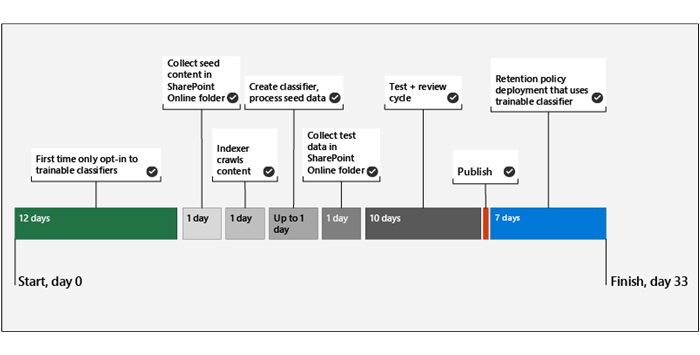
The question arises whether it would be possible to develop a set of classification terms that (a) map to the records class descriptions contained in a records retention schedule and (b) can accurately identify content that matches those descriptions across the Microsoft 365 ecosystem. This would certainly be an ideal goal.
The records management section includes a tab named ‘Dispositions’ as shown in the screenshot below (from the article ‘Disposition of content‘). This is currently the same for both E3 and E5 licences, but some functionality may be restricted to E5.

As noted in this article, ‘Items that are shown in the Disposed Items tab for record labels are kept for up to 7 years after the item was disposed, with a limit of one million items per record for that period.’ (It is not clear yet if this is for E5 only).
The data about records destroyed for each label can be exported.
The image below is from the same article and shows the limited amount of content provided for each item that is destroyed. It does not include any metadata from the original location and does not destroy the original document library. It is up to the organisation as to whether this simple form of disposition review will be suitable or if more details are required.

For most records of corporate value, the disposition review process is too limited in terms of the record it retains of what was destroyed. However, it does provide a heads-up for records managers (provided they can access it).
Most records that are of low value should never require a disposition review, however many organisations may be loathe to automatically delete content – even low-level content – that may be required beyond the minimum retention period.
The alternative to the options provided in the records management section are the labels and retention policies in the ‘information governance’ section of the Compliance portal. These options have been described in a separate post but in summary allow organisations to use one or both of the following options:
These policies can be combined on individual SharePoint sites for maximum effect.
It is assumed, but cannot be confirmed, that these options will continue to exist for some time.
The records management solution is not a solution to manage records across Microsoft 365. It has a specific purpose that would be more accurately described as ‘advanced information governance’.
The solution offers organisations with (more expensive) E5 licences a way to automatically identify (classify) and manage certain types of records through to the end of their retention period. It is designed to address the high volumes of both low-level digital content (‘ROT’ in particular) and specific high-value records in organisations.
- Published in Uncategorized
Microsoft employees love Figma, and it's testing the company's cozy relationship with Adobe – CNBC

- Published in Uncategorized
How Document Management and Content Management Differ – CMSWire

CMSWire's customer experience (CXM) channel gathers the latest news, advice and analysis about the evolving landscape of customer-first marketing, commerce and digital experience design.
Many companies look to streamline business processes by automating business information management. However, the number of management solutions can be confusing, especially when the boundaries between the solutions are not well defined. For example, consider document management systems (DMS) and content management systems (CMS): Some people use the terms DMS and CMS as synonyms, but that is not fully correct — though they have some similar features.
In general, a DMS is a system that helps businesses to create, track and store digitized documents. A DMS is used to classify, retain and protect electronic information. It also supports versioning, collaboration and workflows. Content management systems are used to create and manage various types of digital content besides documents in the traditional sense. For example, in addition to being used for PDFs, Word files or Excel files, a CMS could be used to manage things like images, web pages, records and flash files.
CMS and DMS applications have other similarities beyond the fact that both handle digital data, but there are important differences between the two as well. Let’s take a look at the similarities and differences.
Document management systems and content management systems both do the following:
Despite the similarities, DMS and CMS tools differ in a number of ways. Each has some key features that the other doesn’t have, and they deal with different types of data. Here are some examples:
As we can see from those differences, a CMS plays a broader role than a DMS does, though a CMS typically includes at least some of the features of a DMS, because documents account for much of the digital content a CMS handles.
At the small-business level, CMS and DMS functionality may look quite similar, because small businesses don’t tend to have complex content and document management needs, so they don’t need the full range of the features and functionality available in both types of systems. In contrast, large enterprises usually use content and document management functionality to the fullest, because they need to manage a lot of structured and unstructured data.
To make the differences between the two more clear, it’s better to look at CMS and DMS from the perspective of big businesses and consider enterprise document management (EDM) and enterprise content management (ECM) systems.
Related Article: 6 Ways Document Management and Records Management Differ
Enterprise document management systems are sets of technologies designed to handle creation, capture, indexing, storage, retrieval, routing and distribution of corporate documentation. Enterprise content management, on the other hand, is a term used to refer to a set of strategies, methods and tools used to capture, manage, store, preserve and deliver corporate digital data.
As is the case with DMS and CMS, EDM and ECM overlap. Sometimes, it’s difficult to say whether they are two different systems or one entity.
ECM requires functionality capable of the following:
1. Capturing information: Creating information by digitizing paper documents, or obtaining, organizing and structuring information in electronic formats.
2. Managing information: Connecting, modifying and employing information. Specific aspects of managing information include the following:
3. Storing information: Short-term storage of files in accessible folders to allow editing of files so frequently changing information can be updated.
4. Preserving information: Long-term retention of infrequently changing information as part of regulatory compliance efforts.
5. Delivering information: Providing clients, partners or auditors with required information upon request.
A company could deploy an EDM system as a stand-alone system that would perform those functions with documents only. On the other hand, EDM could be deployed as part of an integral ECM system, with its functions limited to the “managing information” component.
Related Article: Enterprise Content Management at the Crossroads
Because of their shared functionality, EDM and ECM systems are theoretically similar. But what about in practice? Let’s compare ECM and EDM systems that co-exist in one organization. We'll use the SharePoint platform as an example, because it is suitable for both purposes. For example, let's look at how a hospital with more than 1,000 employees would implement SharePoint ECM and EDM functionality.
SharePoint Enterprise Document Management
SharePoint can be used to scan various types of contracts (payer, employment, partnership, maintenance, equipment purchase), invoices, purchase orders, certificates, patient documents, etc. with automatic verification and coding of scanned documents. It also supports automated routing of medical, financial and human resources documents to relevant personnel for review and approval, and for real-time collaboration when creating and editing documents.
SharePoint offers versioning and audit trail tracking of documents required for HIPAA compliance, and provides a wide range of permission levels to restrict access to health records, prescriptions, lab results, etc.
SharePoint ensures long-term archiving of infrequently retrieved documents (e.g. expired contracts) in document repositories in accordance with regulatory mandates. For example, HIPAA requires retention of some documents for six years.
SharePoint Enterprise Content Management
SharePoint provides indexing and categorization of various types of content (contracts, invoices, pathology reports, lab results, X-rays, ultrasounds, physician notes on CDs or DVDs), thus making it possible for information to be accurately structured and stored in folders and lists.
To support easier retrieval of information from multiple sources, SharePoint supports ECM integration with medical imaging, patient registration, electronic health records (EHR), lab systems and more. It also supports the creation and publishing of research papers, analytic data, news and marketing materials, and employee handbooks on the medical center’s website, intranet and other applications and systems. Usually, the content is in web-focused formats, such as HTML or XHTML. In addition, SharePoint supports the creation of master pages and page layouts that can be reused by content authors afterward.
SharePoint has built-in video and audio players, so video and audio files can be played directly from the medical center’s intranet.
Based on this example, we see EDM and ECM focus on different things: While EDM involves digitizing files, complying with regulations and guiding structured information through the whole cycle from creation to distribution or archiving, ECM’s main purpose is proper organization of both structured and unstructured digital assets to support accurate storage, easy retrieval and publishing of digital content.
So rather than viewing document management and content management as the same, view them as complementary. Together or alone, they can help businesses effectively manage digital information.
Sergey Golubenko is team lead and solution architect at ScienceSoft. Sergey has over13 years experience in software development, including over 7 years of working with Microsoft SharePoint.
- Published in Uncategorized
OpenText bolsters secure file sharing with Teams integration – TechTarget

Getty Images/iStockphoto
Secure file sharing means more than encryption to protect from would-be outsider threats — it includes protecting employees from accidentally passing sensitive information to co-workers who don’t have privileges to see it.
That’s all more complicated in the era of cloud document sharing, when files can be uploaded to collaboration platforms such as Microsoft Teams. Where does a file go by default when someone shares it in Teams? SharePoint, unless the enterprise maps it elsewhere.
“Many customers have told us that’s not what they want,” said Muhi Majzoub, executive vice president and chief product officer at OpenText, discussing the latest output of his company’s partnership with Microsoft. “The goal of the partnership is to build connectivity so that OpenText Core Content, OpenText Documentum and the OpenText Content Suite become a storage option that users can set by default.”
OpenText joins competitors — such as Box — in releasing a Teams integration where its various document clouds can provide the backbone for Teams document sharing. All the compliance and access controls users set up in Core and other OpenText secure file sharing clouds remain in place as employees share docs across Teams channels.
Microsoft cooperating with competitors on Teams document sharing is good for business, despite its own competitive interests with OneDrive and SharePoint secure file-sharing tools, said Alan Pelz-Sharpe, founder of Deep Analysis. The document cloud market is so enormous, companies such as Box and OpenText — which respectively work with medium-to-large and the largest of companies — could “grow another billion dollars and not touch each other,” he added.
Majzoub said he has not yet heard any call from OpenText customers for similar integration of its enterprise document clouds with Slack, the biggest Teams competitor. That makes sense, Pelz-Sharpe said, because many people use Slack to collaborate and not as a content repository. But that may change quickly in the future as Slack and Salesforce meld their features and capabilities.
“A lot of people use Salesforce as their system of record; that’s reality,” Pelz-Sharpe said. “Salesforce, by default, is an enormous document management system.”
OpenText released its Teams integration as part of Cloud Editions (CE) 22.2, the quarterly update to its cloud-based enterprise information management application suite. CE 22.2 also kicks off Project Titanium, an internal code name for OpenText’s development efforts to catch up its public-cloud offerings — features-wise — with its private OpenText Cloud.
More data privacy compliance tools for the U.S., Canada and Europe will be coming to public-cloud users. That’s become more important as more OpenText customers move their enterprises to particular public-cloud environments. While OpenText continues to partner closely with Google Cloud, many customers also choose AWS and Azure for their cloud, Majzoub said.
Project Titanium also includes OpenText Cloud users, as well. OpenText has released new capabilities to more quickly open new OpenText Cloud data zones for customers, when needed, to achieve parity with public cloud providers.
Other features OpenText released in CE 22.2 include tools for healthcare customers to track devices and custom reports for Risk Guard, a tool that scans networks for user-defined offensive or prohibited content.
Also released was customer information lifecycle management tools that promote regulatory compliance for financial services users. That feature comes with integrations to CRMs such as Salesforce, to enforce compliance with user policies across sales applications outside of OpenText.
Don Fluckinger covers enterprise content management, CRM, marketing automation, e-commerce, customer service and enabling technologies for TechTarget.
The imaging and electronics firm is beginning to develop a data culture, but the BI vendor’s platform has already enabled …
Though legislation is before Congress that would address data privacy, it may not set clear enough guidelines or give individuals…
While healthcare and financial data are protected by federal legislation, individuals have little control over how consumer data …
Google is aiming to make it easier for users to migrate to its new AlloyDB database, as well as providing new support for …
The tech giant launched a new MySQL cloud database service running on AWS infrastructure that will support both analytical and …
The open source Apache Kafka streaming technology and commercial vendor Confluent have grown over the last decade as …
Analyst Vinnie Mirchandani, author of ‘SAP Nation 3.0,’ says adaptability, customer loyalty and periodic management shakeups are …
Both RFID and barcodes are valuable in the supply chain, but each is more useful for particular scenarios. Learn what to consider…
Lack of communication between a company’s finance and IT departments can cause problems with organizational goals and decisions. …
With its Cerner acquisition, Oracle sets its sights on creating a national, anonymized patient database — a road filled with …
Oracle plans to acquire Cerner in a deal valued at about $30B. The second-largest EHR vendor in the U.S. could inject new life …
The Supreme Court ruled 6-2 that Java APIs used in Android phones are not subject to American copyright law, ending a …
SAP Multi-Bank Connectivity has added Santander Bank to its partner list to help companies reduce the complexity of embedding …
Over its 50-year history, SAP rode business and technology trends to the top of the ERP industry, but it now is at a crossroads …
Third-party support providers make a pitch that they can provide greater flexibility at a lower cost, but customers should think …
All Rights Reserved, Copyright 2011 – 2022, TechTarget
Privacy Policy
Cookie Preferences
Do Not Sell My Personal Info
- Published in Uncategorized
Microsoft is a Leader in 2022 Gartner Magic Quadrant for Cloud AI Developer Services – Microsoft

This browser is no longer supported.
Upgrade to Microsoft Edge to take advantage of the latest features, security updates, and technical support.
Discover secure, future-ready cloud solutions—on-premises, hybrid, multicloud, or at the edge
Learn about sustainable, trusted cloud infrastructure with more regions than any other provider
Build your business case for the cloud with key financial and technical guidance from Azure
Plan a clear path forward for your cloud journey with proven tools, guidance, and resources
See examples of innovation from successful companies of all sizes and from all industries
Explore some of the most popular Azure products
Provision Windows and Linux VMs in seconds
Enable a secure, remote desktop experience from anywhere
Migrate, modernize, and innovate on the modern SQL family of cloud databases
Build or modernize scalable, high-performance apps
Deploy and scale containers on managed Kubernetes
Add cognitive capabilities to apps with APIs and AI services
Quickly create powerful cloud apps for web and mobile
Everything you need to build and operate a live game on one platform
Execute event-driven serverless code functions with an end-to-end development experience
Jump in and explore a diverse selection of today's quantum hardware, software, and solutions
Secure, develop, and operate infrastructure, apps, and Azure services anywhere
Create the next generation of applications using artificial intelligence capabilities for any developer and any scenario
Specialized services that enable organizations to accelerate time to value in applying AI to solve common scenarios
Add cognitive capabilities to apps with APIs and AI services
Accelerate information extraction from documents
Build, train, and deploy models from the cloud to the edge
Enterprise scale search for app development
Create bots and connect them across channels
Design AI with Apache Spark™-based analytics
Build for mixed reality using AI sensors
Apply advanced coding and language models to a variety of use cases
Gather, store, process, analyze, and visualize data of any variety, volume, or velocity
Limitless analytics with unmatched time to insight
Design AI with Apache Spark™-based analytics
Govern, protect, and manage your data estate
Hybrid data integration at enterprise scale, made easy
Provision cloud Hadoop, Spark, R Server, HBase, and Storm clusters
Real-time analytics on fast-moving streaming data
Build, train, and deploy models from the cloud to the edge
Enterprise-grade analytics engine as a service
Scalable, secure data lake for high-performance analytics
Fast and highly scalable data exploration service
Access cloud compute capacity and scale on demand—and only pay for the resources you use
Provision Windows and Linux VMs in seconds
Manage and scale up to thousands of Linux and Windows VMs
Deploy and scale containers on managed Kubernetes
Build and deploy Spring Boot applications with a fully managed service from Microsoft and VMware
Quickly create powerful cloud apps for web and mobile
Execute event-driven serverless code functions with an end-to-end development experience
A dedicated physical server to host your Azure VMs for Windows and Linux
Cloud-scale job scheduling and compute management
Migrate SQL Server workloads to the cloud at lower total cost of ownership (TCO)
Provision unused compute capacity at deep discounts to run interruptible workloads
Develop and manage your containerized applications faster with integrated tools
Deploy and scale containers on managed Kubernetes
Deploy and scale containers on managed Red Hat OpenShift
Build and deploy modern apps and microservices using serverless containers
Execute event-driven serverless code functions with an end-to-end development experience
Run containerized web apps on Windows and Linux
Launch containers with hypervisor isolation
Deploy and operate always-on, scalable, distributed apps
Build, store, secure, and replicate container images and artifacts
Support rapid growth and innovate faster with secure, enterprise-grade, and fully managed database services
Migrate, modernize, and innovate on the modern SQL family of cloud databases
Build or modernize scalable, high-performance apps
Build apps that scale with managed and intelligent SQL database in the cloud
Fully managed, intelligent, and scalable PostgreSQL
Modernize SQL Server applications with a managed, always-up-to-date SQL instance in the cloud
Fully managed, scalable MySQL Database
Migrate SQL Server workloads to the cloud at lower total cost of ownership (TCO)
Accelerate apps with high-throughput, low-latency data caching
Accelerate your data migration to Azure
Modernize Cassandra data clusters with a managed instance in the cloud
Deploy applications to the cloud with enterprise-ready, fully managed community MariaDB
Deliver innovation faster with simple, reliable tools for continuous delivery
Services for teams to share code, track work, and ship software
Continuously build, test, and deploy to any platform and cloud
Plan, track, and discuss work across your teams
Get unlimited, cloud-hosted private Git repos for your project
Create, host, and share packages with your team
Test and ship confidently with an exploratory test toolkit
Quickly create environments using reusable templates and artifacts
Use your favorite DevOps tools with Azure
Full observability into your applications, infrastructure, and network
Optimize app performance with high-scale load testing
Streamline development with secure, ready-to-code workstations in the cloud
Deploy Grafana dashboards as a fully managed Azure service
Build, manage, and continuously deliver cloud applications—using any platform or language
Powerful and flexible environment to develop apps in the cloud
A powerful, lightweight code editor for cloud development
World’s leading developer platform, seamlessly integrated with Azure
Comprehensive set of resources to create, deploy, and manage apps
A powerful, low-code platform for building apps quickly
Get the SDKs and command-line tools you need
Build, test, release, and monitor your mobile and desktop apps
Full observability into your applications, infrastructure, and network
Optimize app performance with high-scale load testing
Streamline development with secure, ready-to-code workstations in the cloud
Get Azure innovation everywhere—bring the agility and innovation of cloud computing to your on-premises workloads
Secure, develop, and operate infrastructure, apps, and Azure services anywhere
Cloud-native SIEM and intelligent security analytics
Build and run innovative hybrid apps across cloud boundaries
Extend threat protection to any infrastructure
Experience a fast, reliable, and private connection to Azure
Synchronize on-premises directories and enable single sign-on
Migrate, modernize, and innovate on the modern SQL family of cloud databases
Services for teams to share code, track work, and ship software
Fully managed, intelligent, and scalable PostgreSQL
Extend cloud intelligence and analytics to edge devices
Manage user identities and access to protect against advanced threats across devices, data, apps, and infrastructure
Synchronize on-premises directories and enable single sign-on
Consumer identity and access management in the cloud
Manage your domain controllers in the cloud
Seamlessly integrate on-premises and cloud-based applications, data, and processes across your enterprise
Automate the access and use of data across clouds
Connect across private and public cloud environments
Publish APIs to developers, partners, and employees securely and at scale
Reliable event delivery at massive scale
Connect assets or environments, discover insights, and drive informed actions to transform your business
Connect, monitor, and manage billions of IoT assets
Use IoT spatial intelligence to create models of physical environments
Extend cloud intelligence and analytics to edge devices
Go from proof of concept to proof of value
Create, connect, and maintain secured intelligent IoT devices from the edge to the cloud
Unified threat protection for all your IoT/OT devices
Build intelligent edge solutions with world-class developer tools, long-term support, and enterprise-grade security.
Making embedded IoT development and connectivity easy
Use an enterprise-grade service for the end-to-end machine learning lifecycle
Accelerate edge intelligence from silicon to service
Add location data and mapping visuals to business applications and solutions
Simplify, automate, and optimize the management and compliance of your cloud resources
Build, manage, and monitor all Azure products in a single, unified console
Govern, protect, and manage your data estate
Stay connected to your Azure resources—anytime, anywhere
Streamline Azure administration with a browser-based shell
Your personalized Azure best practices recommendation engine
Simplify data protection with built-in backup management at scale
Monitor, allocate, and optimize cloud costs with transparency, accuracy, and efficiency using Microsoft Cost Management
Implement corporate governance and standards at scale
Keep your business running with built-in disaster recovery service
Improve application resilience by introducing faults and simulating outages
Full observability into your applications, infrastructure, and network
Deploy Grafana dashboards as a fully managed Azure service
Deliver high-quality video content anywhere, any time, and on any device
Encode, store, and stream video and audio at scale
Studio grade encoding at cloud scale
A single player for all your playback needs
Deliver content to virtually all devices with ability to scale
Securely deliver content using AES, PlayReady, Widevine, and Fairplay
Fast, reliable content delivery network with global reach
Simplify and accelerate your migration to the cloud with guidance, tools, and resources
Simplify migration and modernization with a unified platform
Keep your business running with built-in disaster recovery service
Accelerate your data migration to Azure
Appliances and solutions for data transfer to Azure and edge compute
Monitor, allocate, and optimize cloud costs with transparency, accuracy, and efficiency using Microsoft Cost Management
Blend your physical and digital worlds to create immersive, collaborative experiences
Create multi-user, spatially aware mixed reality experiences
Render high-quality, interactive 3D content with real-time streaming
Use IoT spatial intelligence to create models of physical environments
Build for mixed reality using AI sensors
Automatically align and anchor 3D content to objects in the physical world
Build and deploy cross-platform and native apps for any mobile device
Send push notifications to any platform from any back end
Build, test, release, and monitor your mobile and desktop apps
Create cloud-powered mobile apps faster
Add location data and mapping visuals to business applications and solutions
Publish APIs to developers, partners, and employees securely and at scale
Enterprise scale search for app development
Add cognitive capabilities to apps with APIs and AI services
Create multi-user, spatially aware mixed reality experiences
Quickly create powerful cloud apps for web and mobile
Build rich communication experiences with the same secure platform used by Microsoft Teams
Connect cloud and on-premises infrastructure and services to provide your customers and users the best possible experience
Create your own private network infrastructure in the cloud
Deliver high availability and network performance to your apps
Build secure, scalable, highly available web front ends in Azure
Establish secure, cross-premises connectivity
Host your Domain Name System (DNS) domain in Azure
Fast, reliable content delivery network with global reach
Protect your Azure resources from distributed denial-of-service (DDoS) attacks
Rapidly ingest data from space into the cloud with a satellite ground station service
Experience a fast, reliable, and private connection to Azure
Extend Azure management for deploying 5G and SD-WAN network functions on edge devices
Centrally manage virtual networks in Azure from a single pane of glass
Private access to services hosted on the Azure platform, keeping your data on the Microsoft network
Protect your enterprise from advanced threats across hybrid cloud workloads
Cloud-native SIEM and intelligent security analytics
Extend threat protection to any infrastructure
Build secure, scalable, highly available web front ends in Azure
Safeguard and maintain control of keys and other secrets
Establish secure, cross-premises connectivity
Protect your Azure resources from distributed denial-of-service (DDoS) attacks
Fully managed service that helps secure remote access to your virtual machines
A cloud-native web application firewall (WAF) service that provides powerful protection for web apps
Protect your Azure Virtual Network resources with cloud-native network security
Central network security policy and route management for globally distributed, software-defined perimeters
Get secure, massively scalable cloud storage for your data, apps, and workloads
High-performance, highly durable block storage
Scalable, secure data lake for high-performance analytics
Simple, secure and serverless enterprise-grade cloud file shares
Enterprise-grade Azure file shares, powered by NetApp
Simplify data protection with built-in backup management at scale
Massively scalable and secure object storage
Appliances and solutions for data transfer to Azure and edge compute
Industry leading price point for storing rarely accessed data
Build, deploy, and scale powerful web applications quickly and efficiently
Quickly create and deploy mission-critical web apps at scale
Publish APIs to developers, partners, and employees securely and at scale
Fast, reliable content delivery network with global reach
Enterprise scale search for app development
Add real-time web functionalities easily
Easily build real-time messaging web applications using WebSockets and the publish-subscribe pattern
Add location data and mapping visuals to business applications and solutions
Streamlined full-stack development from source code to global high availability
Build rich communication experiences with the same secure platform used by Microsoft Teams
Optimize app performance with high-scale load testing
Easily add real-time collaborative experiences to your apps with Fluid Framework
Empower employees to work securely from anywhere with a cloud-based virtual desktop infrastructure
Enable a secure, remote desktop experience from anywhere
Provision Windows desktops and apps with VMware and Azure Virtual Desktop
Provision Windows desktops and apps on Azure with Citrix and Azure Virtual Desktop
Set up labs for education, training, and other related scenarios
Streamline development with secure, ready-to-code workstations in the cloud
Build, manage, and continuously deliver cloud apps—with any platform or language
Analyze images, comprehend speech, and make predictions using data
Simplify and accelerate your migration and modernization with guidance, tools, and resources
Gather, store, process, analyze, and visualize data of any variety, volume, or velocity
Bring the agility and innovation of the cloud to your on-premises workloads
Connect, monitor, and control devices with secure, scalable, and open edge-to-cloud solutions
Help protect data, apps, and infrastructure with trusted security services
Simplify and accelerate development and testing (dev/test) across any platform.
Bring together people, processes, and products to continuously deliver value to customers and coworkers.
Build secure apps on a trusted platform. Embed security in your developer workflow and foster collaboration with a DevSecOps framework.
Give customers what they want with a personalized, scalable, and secure shopping experience.
Turn your ideas into applications faster using the right tools for the job.
Create reliable apps and functionalities at scale and bring them to market faster.
Reach your customers everywhere, on any device, with a single mobile app build.
Respond to changes faster, optimize costs, and ship confidently.
Build apps faster by not having to manage infrastructure.
Connect modern applications with a comprehensive set of messaging services on Azure.
Accelerate time to market, deliver innovative experiences, and improve security with Azure application and data modernization.
Use business insights and intelligence from Azure to build software as a service (SaaS) apps
Move to a SaaS model faster with a kit of prebuilt code, templates, and modular resources.
Build mission-critical solutions to analyze images, comprehend speech, and make predictions using data.
Uncover latent insights from across all of your business data with AI.
Protect your data and code while the data is in use in the cloud.
Build machine learning models faster with Hugging Face on Azure.
Save money and improve efficiency by migrating and modernizing your workloads to Azure with proven tools and guidance.
Optimize costs, operate confidently, and ship features faster by migrating your ASP.NET web apps to Azure.
Simplify and accelerate development and testing (dev/test) across any platform.
Enhanced security and hybrid capabilities for your mission-critical Linux workloads.
Reduce infrastructure costs by moving your mainframe and midrange apps to Azure.
Bring the intelligence, security, and reliability of Azure to your SAP applications.
Move your SQL Server databases to Azure with few or no application code changes.
Run your Windows workloads on the trusted cloud for Windows Server.
Explore tools and resources for migrating open-source databases to Azure while reducing costs.
Protect your data and code while the data is in use in the cloud.
Accelerate time to market, deliver innovative experiences, and improve security with Azure application and data modernization.
Seamlessly integrate applications, systems, and data for your enterprise.
Run your Oracle® database and enterprise applications on Azure and Oracle Cloud.
Reduce fraud and accelerate verifications with immutable shared record keeping.
Drive faster, more efficient decision making by drawing deeper insights from your analytics.
Accelerate time to insights with an end-to-end cloud analytics solution.
Minimize disruption to your business with cost-effective backup and disaster recovery solutions.
Get fully managed, single tenancy supercomputers with high-performance storage and no data movement.
Bring innovation anywhere to your hybrid environment across on-premises, multicloud, and the edge.
Deliver ultra-low-latency networking, applications and services at the enterprise edge.
Run your mission-critical applications on Azure for increased operational agility and security.
Experience quantum impact today with the world's first full-stack, quantum computing cloud ecosystem.
Deliver ultra-low-latency networking, applications, and services at the mobile operator edge.
Connect devices, analyze data, and automate processes with secure, scalable, and open edge-to-cloud solutions.
Build open, interoperable IoT solutions that secure and modernize industrial systems.
Help safeguard physical work environments with scalable IoT solutions designed for rapid deployment.
Strengthen your security posture with end-to-end security for your IoT solutions.
Meet environmental sustainability goals and accelerate conservation projects with IoT technologies.
Ensure compliance using built-in cloud governance capabilities.
Minimize disruption to your business with cost-effective backup and disaster recovery solutions.
Protect your data and code while the data is in use in the cloud.
Cloud-native network security for protecting your applications, network, and workloads.
Modernize operations to speed response rates, boost efficiency, and reduce costs
Transform customer experience, build trust, and optimize risk management
Build, quickly launch, and reliably scale your games across platforms
Implement remote government access, empower collaboration, and deliver secure services
Boost patient engagement, empower provider collaboration, and improve operations
Improve operational efficiencies, reduce costs, and generate new revenue opportunities
Create content nimbly, collaborate remotely, and deliver seamless customer experiences
Personalize customer experiences, empower your employees, and optimize supply chains
Get started easily, run lean, stay agile, and grow fast with Azure for startups
Accelerate mission impact, increase innovation, and optimize efficiency—with world-class security
Find reference architectures, example scenarios, and solutions for common workloads on Azure
We're in this together—explore Azure resources and tools to help you navigate COVID-19
Search from a rich catalog of more than 17,000 certified apps and services
Plan a clear path forward for your cloud journey with proven tools, guidance, and resources
Get the best value at every stage of your cloud journey
See which services offer free monthly amounts
Only pay for what you use, plus get free services
Find the options that work best for you
Explore special offers, benefits, and incentives
Estimate the costs for Azure products and services
Estimate your total cost of ownership and cost savings
Learn how to manage and optimize your cloud spend
Understand the value and economics of moving to Azure
Find, try, and buy trusted apps and services
Get up and running in the cloud with help from an experienced partner
Find the latest content, news, and guidance to lead customers to the cloud
Build, extend, and scale your apps on a trusted cloud platform
Reach more customers—sell directly to over 4M users a month in the commercial marketplace
Posted on August 9, 2022
Gartner has recognized Microsoft as a Leader in the 2022 Gartner® Magic Quadrant™ for Cloud AI Developer Services, with Microsoft placed furthest in “Completeness of Vision”.
Gartner defines the market as “cloud-hosted or containerized services that enable development teams and business users who are not data science experts to use AI models via APIs, software development kits (SDKs), or applications.”
We are proud to be recognized for our Azure AI Platform. In this post, we’ll dig into the Gartner evaluation, what it means for developers, and provide access to the full reprint of the Gartner Magic Quadrant to learn more.
“Although ModelOps practices are maturing, most software engineering teams still need AI capabilities that do not demand advanced machine learning skills. For this reason, cloud AI developer services (CAIDS) are essential tools for software engineering teams.”—Gartner
A staggering 87 percent of AI projects never make it into production.¹ Beyond the complexity of data preprocessing and building AI models, organizations wrestle with scalability, security, governance, and more to make their model’s production ready. That’s why over 85 percent of Fortune 100 companies use Azure AI today, spanning industries and use cases.
More and more, we see developers accelerate time to value by using pre-built and customizable AI models as building blocks for intelligent solutions. Microsoft Research has made significant breakthroughs in AI over the years, being the first to achieve human parity across speech, vision, and language capabilities. Today, we’re pushing the boundaries of language model capabilities with large models like Turing, GPT-3, and Codex (the model powering GitHub Copilot) to help developers be more productive. Azure AI packages these innovations into production-ready general models known as Azure Cognitive Services and use case-specific models, Azure Applied AI Services for developers to integrate via API or an SDK, then continue to fine tune for greater accuracy.
For developers and data scientists looking to build production-ready machine learning models at scale, we support automated machine learning also known as autoML. AutoML in Azure Machine Learning is based on breakthrough Microsoft research focused on automating the time-consuming, iterative tasks of machine learning model development. This frees up data scientists, analysts, and developers to focus on value-add tasks outside operations and accelerate their time to production.
“As more developers use CAIDS to build machine learning models, the collaboration between developers and data scientists will become increasingly important.”—Gartner
As AI becomes more mainstream across organizations, it’s essential that employees have the tools they need to collaborate, build, manage, and deploy AI solutions effectively and responsibly. As Microsoft Chairman and CEO Satya Nadella shared at Microsoft Build, Microsoft is "building models as platforms in Azure" so that developers with different skills can take advantage of breakthrough AI research and embed them into their own applications. This ranges from professional developers building intelligent apps with APIs and SDKs to citizen developers using pre-built models via Microsoft Power Platform.
Azure AI empowers developers to build apps in their preferred language and deploy in the cloud, on-premises, or at the edge using containers. Recently we also announced the capability to use any Kubernetes cluster and extend machine learning to run close to where your data lives. These resources can be run through a single pane with the management, consistency, and reliability provided by Azure Arc.
“Vendors and customers alike are seeking more than just performance and accuracy from machine learning model. When selecting AutoML services, they should prioritize vendors that excel at providing explainable, transparent models with built-in bias detection and compensatory mechanisms.”—Gartner
At Microsoft, we apply our Responsible AI Standard to our product strategy and development lifecycle, and we’ve made it a priority to help customers do the same. We also provide tools and resources to help customers understand, protect, and control their AI solutions, including a Responsible AI Dashboard, bot development guidelines, and built-in tools to help them explain model behavior, test for fairness, and more. Providing a consistent toolset to your data science team not only supports responsible AI implementation but also helps provide greater transparency and enables more consistent, efficient model deployments.
Microsoft is proud to be recognized as a Leader in Cloud AI Developer Services, and we are excited by innovations happening at Microsoft and across the industry that empower developers to tackle real-world challenges with AI. You can read and learn from the complete Gartner Magic Quadrant now.
References
¹Why do 87 percent of data science projects never make it into production? Venture Beat.
Gartner Inc.: “Magic Quadrant for Cloud AI Developer Services,” Van Baker, Svetlana Sicular, Erick Brethenoux, Arun Batchu, Mike Fang, May 23, 2022.
Gartner and Magic Quadrant are registered trademarks and service marks of Gartner, Inc. and/or its affiliates in the U.S. and internationally and are used herein with permission. All rights reserved. This graphic was published by Gartner, Inc. as part of a larger research document and should be evaluated in the context of the entire document. The Gartner document is available upon request from Microsoft. Gartner does not endorse any vendor, product or service depicted in its research publications, and does not advise technology users to select only those vendors with the highest ratings or other designation. Gartner research publications consist of the opinions of Gartner’s research organization and should not be construed as statements of fact. Gartner disclaims all warranties, expressed or implied, with respect to this research, including any warranties of merchantability or fitness for a particular purpose.
Azure updates
Ask questions
- Published in Uncategorized
Strata Identity launches open-source project enabling multi-cloud access policy management for organizations – ITBusiness.ca

Canada’s first LGBTQ2S+ conference focused on the Canadian technology sector.
June 21, 2022
Strata Identity, U.S.-based identity orchestration provider for multi-cloud environments with a significant presence in Vancouver, has announced the availability of the Hexa open-source project that enables organizations to unify and consistently manage all of their access policies across multi-clouds, on-premises systems, and vendors.
Hexa enables this using the New Identity Query Language (IDQL) standard, which is a new common policy format used to define identity access policies in a declarative way.
Currently, each cloud platform (AWS, Google, Microsoft Azure, and others) uses a proprietary identity system with its own policy language, all of which are incompatible with each other. Meanwhile, each application must be hardcoded to work with a specific identity system. IDQL and Hexa enable any number of identity systems to work together as a unified whole, without making any changes to them or to applications, Strata Identity explains.

“Just as Kubernetes transformed computing by allowing applications to transparently move from one machine to another, IDQL enables access policies to move freely between proprietary identity systems,” said Eric Olden, chief executive officer of Strata Identity. “IDQL and Hexa eliminate identity silos in the cloud and on-premises, by creating an intelligent, distributed identity system with one brain.”
Together IDQL and Hexa provide the following capabilities:
IDQL and Hexa are managed under a vendor-neutral working group and an open-source, open governance model and will remain independent from any company or company-sponsored project. Interest in building open standards for cloud identity is being driven by global multi-cloud adoption and incompatibility between cloud identity systems. The authors of IDQL and Hexa include Strata Identity, Kroger, Versa Networks, S&P Global, Cummins, and MEF. Others interested in supporting the project can find more information here.
One working group member in particular understands the need to unify policy orchestration from the application to the network layer. “IDQL and Hexa provide the necessary framework for linking identity and policy to the Zero Trust standards being developed at MEF today,” said Pascal Menezes, chief technical officer of MEF. “MEF is proud to be an early supporter of IDQL and Hexa and we look forward to collaborating further in the future.”
IDQL and Hexa are public projects with code repos available on GitHub here. The two components of the project have been submitted as a sandbox project to the Cloud Native Computing Foundation (CNCF). More information about Hexa and IDQL can be found here.
Strata Identity is also hosting a panel webinar with other members of the working group entitled “The building of a new identity standard: Why the multi-cloud world needs IDQL and Hexa to unify policy” on May 25 at 10 am PT / 1 pm ET. Visit this link to register.
Our experienced team of journalists brings you engaging content targeted to IT professionals and line-of-business executives delivered directly to your inbox.
PRODUCED BY
- Published in Uncategorized
Transaction Cloud Launches Affiliate Marketing Feature for SaaS Businesses and Startups – Benzinga

Transaction Cloud is a US-based Fintech company that provides services to SaaS and digital product companies worldwide. The company recently launched new affiliate marketing management & automatic payout services with many other features.
Barrington, Rhode Island–(Newsfile Corp. – September 13, 2022) – Transaction Cloud is a US-based Fintech company. It provides services to SaaS and digital product companies worldwide. In the recent development, the newly emerged fintech company launched a new feature known as affiliate marketing. Affiliate Marketing functions as part of their payments, sales tax, and subscription platform.
Transaction Cloud’s affiliate marketing feature will help SaaS (software as a service) and digital product startup companies to rapidly scale their business by harnessing the power of affiliate marketing without the added administrative and accounting costs. The modern and fast checkout interface with the most number of payment methods has already helped various SaaS companies increase their conversion rates. The company offers solutions for global payment processing, affiliate marketing management & payouts, automated sales tax compliance, subscription management & billing, fraud prevention, and key data for business growth. Vendors using these services on Transaction Cloud’s platform, can go to market quickly and focus their efforts on improving their products and rapidly growing their business.
The addition of the affiliate marketing feature makes Transaction Cloud the fast-growing revenue stack platform for SaaS and digital products companies.
This feature solves three issues:
Eliminates the need to develop in-house or integrate a third-party affiliate marketing feature
Eliminates the administrative and accounting cost related to onboarding, tracking, managing, and paying out affiliates
Eliminates the corporate income tax nexus that is created by hiring affiliates in different tax jurisdictions
Additionally, some of the significant benefits of Transaction Cloud’s Affiliate Marketing feature are:
With Transaction Cloud’s insightful, easily available data SaaS companies spend less time data mining and more time in taking meaningful actions. With Transaction Cloud’s proprietary Singularity IntegrationTM architecture, a vendor can start tax-compliantly accepting payments within minutes. Similarly, an affiliate marketing campaign can be set up within minutes. Integration of the subscription management feature can be completed within an hour. In conclusion, integration with Transaction Cloud’s platform is quick and robust.
Transaction Cloud offers an all-in-one solution for global payments, affiliate marketing management & payouts, automated sales tax compliance, subscription management and recurring billing with one quick and robust integration.
In addition, Transaction CloudTM uses its innovative Singularity-IntegrationTM architecture, which combines One-Directional-APITM and One-Data-CloudTM. Vendors can quickly integrate Transaction Cloud’s platform with plug-in codes, ready to embed management tools and API calls. There are no webhooks to configure, test, monitor & maintain. It saves valuable development and testing time.
Moreover, there is no chance of missed or duplicate webhook calls; there is no synchronization issue due to conflicting data stored on vendors and Transaction Cloud servers. Additionally, the points of failure and maintenance costs over the long run are significantly reduced, resulting in a robust system.
Consequently, the company strives to be a trusted partner in growing its clients’ businesses by taking care of all these complexities so that its vendors’ employees can focus on essential things such as developing their product, acquiring customers, and increasing customer satisfaction.
About Transaction Cloud
Transaction Cloud (https://transaction.cloud) is a US-based fintech company. Transaction Cloud provides services to SaaS and digital product companies worldwide. Transaction Cloud focuses on simplifying payments, sales tax compliance, affiliate marketing, subscription management, and fraud prevention process for its vendors.
Transaction Cloud’s complete revenue stack covers complicated topics such as global payments, payment methods, currencies, affiliate payouts, recurring billing, standards, sales taxes (VAT, GST, HST, QST, PST), fraud detection, regulations, and consequential corporate income tax.
Transaction Cloud is the perfect solution for small to large sized SaaS businesses and the best partner for a startup for selling in a new global digital world. It helps SaaS and digital products companies to quickly launch and rapidly grow their business while reducing their software development, administrative, and accounting costs. SaaS and digital products companies can harness the power of Transaction Cloud’s proprietary Singularity IntegrationTM architecture, save costs, save resources, launch quickly, and rapidly scale their business.
For more information, potential clients and emerging business enthusiasts can visit https://transaction.cloud.
To view the source version of this press release, please visit https://www.newsfilecorp.com/release/136991
- Published in Uncategorized