



It’s hard to believe more than two years have passed since I began to write this monthly legal technology column. Despite the passage of time, my reason for writing this column has never changed: My goal has always been to help small-firm lawyers make educated and informed decisions about their legal software options.
This is all the more important in light of the current situation, where COVID-19 has forced lawyers across the country to shelter in place and work from home. Lawyers are becoming fully reliant on technology to ensure their businesses run smoothly and, now more than ever, count on cloud-based technologies to keep their law firms afloat despite the uncertain times.
One of the top challenges faced by law firms as they shifted to a remote workforce has been the ability to access case-related information. The accessibility of documents, in particular, has presented issues for law firms. This has become especially pressing in recent weeks as federal and state courts have begun to, out of necessity, mandate the e-filing of digital documents for most legal matters.
As law firms establish processes to create digital documents, they then need to be able to store them online in a location that is easily accessible by all firm employees. That’s where cloud-based document management software created with law firms in mind comes in.
Legal document management software provides a built-in organizational system for documents. Documents can be associated with case files or matters, and access can be limited to certain firm users. More robust systems often include document versioning, audit trails that track user access to documents and a host of other features.
Since I last wrote about legal document management software in February 2018, a notable trend in document management software has been to provide increased document functionality. So instead of simply allowing for the online storage and organization of documents, software companies are building in features that allow users to create, annotate and collaborate on legal documents as well.
For example, document collaboration and sharing features are included in some platforms, making it easy to securely share and collaborate on documents with clients, co-counsel, experts and more. Another feature included in some software products is the conversion of scanned documents into optical character recognition format, which creates searchable, indexed PDFs. Other useful features include annotation tools, e-signature and customized security capabilities.
Note that all of the different document management software tools discussed in this column are cloud-based. That means the software company you choose will be hosting your law firm’s confidential data. And because you have an ethical obligation to ensure client data remains confidential, you will need to ensure you understand how the data will be handled by that company. That ethical duty includes knowing where the servers on which the data will be stored are located, who will have access to the data, and how and when it will be backed up, among other things.
Also important when shopping for document management software or law practice management software with document management tools built in is to ensure that you have a full understanding of the costs associated with more robust features sets. You will find that some companies offer a single price for their software and build features into their software at no additional cost.
Other software companies offer tiered pricing, and certain features, such as e-signature tools, can be accessed only if you pay for the higher-priced tiers. Similarly, some software tools are only available via an integration. In that case, understand that depending on the company’s pricing scheme and how integrations are set up and priced, you may have to pay subscription fees for both the integration tool and the practice management software.
Another notable trend in recent years has been to provide law firms with increased security features. As you’ll learn below, some of the document management platforms now offer a number of different security features, which are customizable depending on a firm’s specific needs.
Which brings me to my next point: Your firm’s document management needs will depend, in large part, on the size of your law firm and the practice areas handled by your firm. Some practice areas are much more document-intensive and thus require more robust document management tools. Other firms may handle particularly sensitive matters or have clients that require increased levels of security and, as a result, will need a document management solution that includes more robust security features.
For most small-firm lawyers with practices that aren’t document-intensive—such as family lawyers, trust and estate lawyers, and criminal law attorneys—a stand-alone document management system is likely unnecessary. Instead, the document management features built into most law practice management systems such as Rocket Matter, Clio or MyCase (note that I am the legal technology evangelist with MyCase) will often be sufficient and more cost-effective than investing in both law practice management software and document management software.
That being said, the document management features offered by the law practice management software platforms aren’t going to be as robust as the feature sets of stand-alone document management software programs. Even so, you’ll find many of them offer an increasingly broad range of interactive document capabilities that can be particularly useful when working remotely, including collaboration features and e-signature tools.
Which brings us to the more complex stand-alone document management systems. Three leading stand-alone systems to consider are iManage, Worldox and NetDocuments. Worldox and iManage have been around for years as premise-based solutions, and now provide cloud-based versions of their software; NetDocuments, on the other hand, has always been a cloud-based solution.
All three platforms provide advanced document management features. In addition, they also include robust document versioning, audit trails, and OCR conversion from scans that permit document indexing and search features. Each also includes email management tools, knowledge management capabilities and other features specific to larger firms, including key integrations with Office 365, e-discovery platforms and more.
The trend of adding functionality to documents is increasingly evident in the stand-alone document management platforms as well. For example, NetDocuments has added a new “layer” to documents stored in its software that includes document collaboration tools, tasks, e-signature and annotation features. NetDocuments also offers a number of different types of security features for documents such as dual custody, where the encryption key is held by the firm and NetDocuments.
Another notable trend is that artificial intelligence (AI) tools are also being built into document management software. For example, iManage now offers iManage Ravn, a tool that uses AI and machine learning to search documents and provide insight into a firm’s documents, and provide the ability to easily locate and extract key information.
The bottom line: No matter which document management solution you choose, when your firm’s documents are stored in the cloud, they’re easily accessible by anyone from your firm with an internet connection, regardless of their location. While this has always been a convenient feature, of late it’s become a necessity in the work-from-home reality we now find ourselves in.
The good news is that in 2020, we have the technology we need to get the job done while working remotely. With the right tools, you can rebuild your brick-and-mortar law firm and turn it into a virtual one, and implementing cloud-based document management tools are the first step toward a fully functional remote law firm. And most important, they’re readily available, affordable and intuitive. So what are you waiting for? Put your firm’s documents in the cloud, and get back to work!
Nicole Black is a Rochester, New York attorney, author, journalist and the legal technology evangelist at MyCase, legal practice management software for small firms. She is the nationally recognized author of Cloud Computing for Lawyers and is co-author of Social Media for Lawyers: The Next Frontier, both published by the American Bar Association. She also is co-author of Criminal Law in New York, a Thomson Reuters treatise. She writes regular columns for ABAJournal.com, Above the Law and the Daily Record, has authored hundreds of articles for other publications, and regularly speaks at conferences regarding the intersection of law and emerging technologies. Follow her on Twitter @nikiblack, or she can be reached at [email protected].
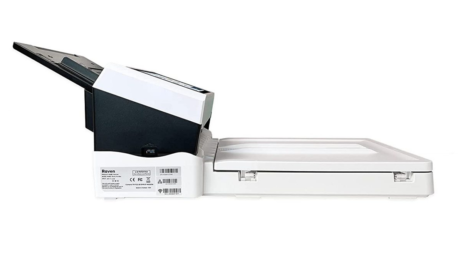
Ignoring those built into all-in-one printers and the occasional (but not very well-endowed) standalone model such as 2017’s Epson DS-1630 or 2019’s Xerox Duplex Combo Scanner, we haven’t seen many flatbed document scanners lately. (Nearly all, nowadays, are sheetfed designs.) And the flatbeds on the market aren’t updated frequently; HP, for instance, just recently refreshed its family of ScanJet Pro models from early 2016. That makes the Raven Pro Max Document Scanner ($999.85) seen here doubly interesting. A flatbed with the DNA of our recent Editors’ Choice award winner for sheetfeds (the Raven Pro Document Scanner), the Pro Max is much more robust and feature-rich than the lower-end scanners mentioned above. It easily earns its own Editors’ Choice trophy as our favorite midrange to high-volume flatbed document scanner.
Technically, the Pro Max is not an all-new machine. Instead of designing and building a whole new device, Raven designed a flatbed add-on and put the Raven Pro Document Scanner on top of it, as you see in the image below.
Most if not all other flatbed document scanners are simply flatbeds with automatic document feeders (ADF), as seen atop legions of all-in-one printer/copier/scanners.
A drawback to most flatbeds is that they take a fixed, fairly large amount of desk space, unlike most sheetfed scanners with paper trays that can fold up to about a third of their operational size when not in use. The Raven Pro Max is particularly lengthy because of the sheetfed scanner positioned next to the flatbed mechanism.
As you can see in the Raven diagram below, its footprint dimensions are 10.5 by 12.5 by 22.5 inches (HWD), compared to the Pro model’s 7 by 12.4 by 8.2 inches. On the positive side, it’s difficult to find flatbed models as potent as this Raven in terms of speed and capacity.
Some of its current competitors include the abovementioned Xerox and Epson models as well as the circa-2016 HP ScanJet Pro 3500 f1 and 2500 f1 (whose 3600 f1 and 2600 f1 replacements I’ll be reviewing soon). Among flatbed scanners, the seven-year-old Fujitsu fi-7260 is closest in capability to the Raven Pro Max, but it too has been recently replaced with the fi-8270. That scanner is also on tap at PC Labs for review shortly, and I suspect it’ll easily keep up with this Raven.
Like the Raven Pro and the Raven Original, the Pro Max has a control panel built around an 8-inch, Android-powered touch screen. The tablet-like interface not only helps you set up and execute scans, but it offers some basic document-management features such as saving documents to multiple destinations. To get a more complete archiving solution (with the ability to create and manage workflow profiles), you’ll need to use the bundled software, which we’ll discuss momentarily.
As for the flatbed itself, it’s straightforward and easy to operate. You simply lift the cover, place your content on the glass or platen, and let ‘er rip. Like most flatbeds, the Pro Max scans only one page side at a time; you must remove and replace content after each scan. To scan multiple pages, two-sided or otherwise, you’ll rely on the 100-sheet automatic document feeder (ADF). Like the Raven Pro, the Pro Max has a daily duty cycle of 6,000 pages.
None of the other machines mentioned here matches that capacity. The ScanJet Pro 2500, for instance, holds only 50 sheets, and the Xerox Combo’s ADF only 35. The Fujitsu fi-7280’s feeder holds 80 sheets, though the forthcoming fi-8270 holds 100. Except for the two Fujitsus, the other scanners cited are rated at well under 5,000 pages per day.
Between this Raven’s Ethernet, 802.11ac Wi-Fi support, and USB interfaces, it should connect to most types of computing devices. Ethernet is, of course, a wired networking protocol; Wi-Fi supports wireless office networking and also lets you connect to most mobile devices including Android and iOS phones and tablets. With USB, you can connect a single computer to the scanner; a second USB port allows scanning to thumb drives or other USB storage devices.
The other mobile options comprise a huge list, including Raven Cloud, Google Drive, Clio, DevonThink, Dropbox, Box, Evernote, SharePoint, OneDrive, OneNote, NeatFiles, NeatBooks, QuickBooks Online, email, fax, SMB network share folder, or FTP—in single or multiple simultaneous destinations.
You can set up and execute your scans from the control panel or select a workflow profile. Profiles typically contain all the configuration (resolution, file format, type, and so on) and destination properties (local drive, cloud site, FTP, email) of a scan job. To get the most in terms of document management and archiving, you should rely on the supplied Raven Desktop application.
The NeatFiles and NeatBooks formats, of course, export files compatible with Neat, a financial document-management program. NeatFiles is a small-business cloud-storage solution for archiving financial documents, and NeatBooks is a bookkeeping application along the lines of QuickBooks. You can also export to both image and searchable PDF, Microsoft Word and Excel, plain text, and a few other useful formats.
I should also point out that the scanner’s Raven Cloud online subscription is not only complimentary but also unlimited.
Since the Raven Pro Max is essentially the Raven Pro perched atop a flatbed apparatus, the two machines’ scanning speeds are all but identical. Both are rated at 60 one-sided pages per minute (ppm) and 120 two-sided images per minute (ipm, where each page side counts as an image). For comparison, the HP ScanJet Pro 2500 and 3500 are rated at 20ppm/40ipm and 25ppm/50ipm respectively. The Xerox Combo and Epson DS-1630 are rated at 25ppm and 50ipm, as well.
I tested the Pro Max over a USB connection to our standard Intel Core i5 testbed running Windows 10 Pro and Raven Desktop. (I also performed several scans from the control panel, with similar results.) First, I clocked the Pro Max and Raven Desktop as they scanned our 25-page one-sided and 25-page two-sided (50 sides) documents and saved them as image PDFs.
The device scanned, converted, and saved the single-sided document at an average of 62.5ppm, and it scanned and processed our two-sided document at 124.2ipm. Only the Raven Pro came close to this speed, with the Epson and Xerox less than half as fast. (The two HP ScanJet Pros and the Fujitsu fi-7260 were reviewed long ago under different benchmark routines and test documents, making direct comparisons impossible.)
Next, I timed the Pro Max as it scanned and saved our two-sided 25-page document to the much more versatile searchable PDF format. The job took 24 seconds, matching the Raven Pro and coming in, again, at least twice as fast as the Xerox and Epson scanners.
As for accuracy, I’ll start by saying that it’s been quite some time since I’ve had to report poor optical text recognition (OCR) from a document scanner. Like its Pro sibling, the Raven Pro Max converted our Arial font pages to editable text without errors down to 5-point type and our Times New Roman pages down to 6 points. Both the Xerox and Epson flatbeds were mistake-free down to 6 points for Arial and 8 points for Times New Roman, which is more than acceptable (and I’m confident that software updates have boosted both products since our reviews).
I also scanned a couple of stacks of business cards and financial documents to see how well the Pro Max and its software captured, gleaned, and populated the proper fields with accurate data. As expected, the Neat financial software handled receipts, invoices, and the like with grace, and Raven Desktop did an impressive job of scanning and sorting business contact data.
To be sure, the Raven Pro Max costs more than most of the flatbed document scanners you’ll find for sale, but it’s at least twice as fast as its lower-priced rivals. The Fujitsu fi-7260 and its replacement match the Raven’s robustness, but they cost considerably more. (In fact, Fujitsu recently released three flatbed scanners, all of which cost at least twice as much as this one.)
Getting a flatbed with a sheetfed portion that holds 100 pages and scans at 60ppm/120ipm for a thousand bucks is a bargain. So the Raven Pro Max’s value and strong performance are more than enough to position it as our new favorite midrange to high-volume flatbed/sheetfed document scanner.
PCMag.com is a leading authority on technology, delivering lab-based, independent reviews of the latest products and services. Our expert industry analysis and practical solutions help you make better buying decisions and get more from technology.
PCMag is obsessed with culture and tech, offering smart, spirited coverage of the products and innovations that shape our connected lives and the digital trends that keep us talking.

Getty Images/iStockphoto
The increased adoption of cloud-based storage and software, coupled with the rise in remote work, is motivating organizations to research and implement paperless office software.
Depending on what’s needed, there are some critical features that organizations need to look for when shopping for paperless office technology. If there are plans to use the software to digitize documents, it needs to have strong scanning and optical character recognition capabilities, according to Will Cannon, CEO of Uplead. Ideally, the tool can work with various scanning hardware to maintain and index documents, integrate with ERP and customer experience management software, and employ a content management system to let users design their workflows and access documents.
Overall, a tool should be easy for employees to learn and use, integrate with other technology in the office and include security features to protect data.
Despite the wide variety to choose from, five paperless office software options have risen to become the most recommended and popular among organizations and featured on review sites such as G2 and Capterra. Particularly noteworthy is that each of these tools is available in a SaaS model, making it easy for employees to access remotely from any device.
The Microsoft 365 suite has several plans to choose from that feature Word, Excel, PowerPoint, Outlook and collaboration tools for meetings, file sharing and document management. It offers calendar management, commenting and notes, document generation, reporting and analytics, and templates for different documents and tasks.
Users have called out two features as particularly helpful: the ability to access files remotely and the streamlined collaboration tools. However, users also cite the mobile apps as needing improvement and that the suite is challenging to use without an internet connection.
Pricing starts at $6 per user, per month for Microsoft 365 Business Basic. The other tiers include Microsoft 365 Apps for business, Microsoft 365 Business Standard and Microsoft 365 Business Premium.
Another highly recommended tool is Google Workspace, which includes features to share calendars, notes and documents, as well as the ability to hold meetings and store and manage documents. Google Workspace also lets organizations add custom branding to their workspaces and includes workflow automation tools, reporting and analytics, and customizable templates.
Pricing is divided across four tiers and starts at $6 per user, per month. The tiers are Business Starter, Business Standard, Business Plus and Enterprise.
Dropbox is a great option for companies that primarily need a place to store and collaborate on files, whether in the cloud — such as those in Google Docs or Microsoft Office — or files stored on a hard drive. Dropbox also includes calendar, contact and task management features and offers offline access to documents.
Users often cite the process for sharing and organizing files, the ability to work on files without downloading them and automatic file syncing after saving as standout features. However, others caution that there can be sync conflicts and that finding older versions of files can be difficult.
For team plans, Dropbox Business Standard pricing is $15 per user, per month, but goes up to $24 per user, per month for Dropbox Business Advanced. Dropbox Enterprise pricing can only be accessed by contacting the sales department.
Notion is a project management tool that includes functionality for note taking, document management and collaboration. Some of its specialized tools include document classification, file recovery, task management and version control for documents. And while it lacks an offline mode, Notion can guide users to create custom workflows and workspaces so that teams can personalize how they handle projects.
Team pricing for Notion is $8 per user, per month, although an Enterprise plan exists with pricing available by contacting the sales team.
For paperless HR departments, ADP Workforce Now includes applicant tracking, benefits management, time and attendance, payroll and performance management. There is also a marketplace for APIs and integrations so that users can employ third-party applications alongside Workforce Now to create a personalized tool to fit their needs.
The benefits tracking has a simplified view to see what’s available to employees, and there are several customization options for reports. However, some users have noted that the interface for requesting paid time off or for other small tasks isn’t intuitive.
Pricing is available upon request.
Before an organization can choose a paperless office software, they need to know what problem they’re trying to solve, said Duniya Moore, CEO of Helastel. That driving force will help guide organizations through the other deciding factors.
The first is mapping the desired user experience and comparing that to the main focus of the software — its features and capabilities. “Let’s say you need to streamline your HR enrollment system to accommodate an increased workload. It may be best to simplify the admin process through integration, or you could look for a system that automates tasks like document reminders,” Moore said. “Once you’ve mapped the user experience, you can use it to work out the key capabilities you need.”
Next is examining the price of paperless office software options. According to Moore, companies need to look at the cost of the software against the amount of improved efficiency. “For example, purchasing an HR software subscription could cost the company $850/month. However, the efficiency savings gained from moving to a paper-free system might free up 16 hours a month from your HR Manager — which could be worth twice that.”
Finally, if the feature list and price of the software match expectations, the IT team will need to weigh in on how it integrates with the existing technology stack. Many companies are moving toward fully integrated software to eliminate siloes and create a single data repository that’s open across the company.
While paperless office software is already part of the technology stack for many companies, organizations can, and should, continue to look for ways to eliminate paper and make it easier for their employees to do their jobs from anywhere.
Coming after the addition of natural language processing capabilities, the new embedded analytics tool strengthens the BI …
The startup aims to augment human decision-making with automation, and its new tools find and explain changes in data, analyze …
Self-service BI tools benefit organizations in four major ways, including improved decision-making, organizational efficiency, …
The Facebook parent company, along with multiple contributors, including Ahana, Voltron Data and Intel, are developing a new open…
The vendor launched the Alation Cloud Service for Snowflake designed to enable Snowflake users to more easily use Alation’s data …
The vendor raised new money to continue to grow its database technology as the applications for analytics databases have expanded…
Both RFID and barcodes are valuable in the supply chain, but each is more useful for particular scenarios. Learn what to consider…
Lack of communication between a company’s finance and IT departments can cause problems with organizational goals and decisions. …
Navrina Singh, CEO of Credo AI, discusses the limits of MLOps and algorithmic auditing in providing governance for responsible AI.
With its Cerner acquisition, Oracle sets its sights on creating a national, anonymized patient database — a road filled with …
Oracle plans to acquire Cerner in a deal valued at about $30B. The second-largest EHR vendor in the U.S. could inject new life …
The Supreme Court ruled 6-2 that Java APIs used in Android phones are not subject to American copyright law, ending a …
Over its 50-year history, SAP rode business and technology trends to the top of the ERP industry, but it now is at a crossroads …
Third-party support providers make a pitch that they can provide greater flexibility at a lower cost, but customers should think …
SAP’s Thomas Saueressig explains the future of multi-tenant cloud ERP for SAP customers and why it will take some large companies…
All Rights Reserved, Copyright 2011 – 2022, TechTarget
Privacy Policy
Cookie Preferences
Do Not Sell My Personal Info

Register for your free TechRepublic membership or if you are already a member, sign in using your preferred method below.
We recently updated our Terms and Conditions for TechRepublic Premium. By clicking continue, you agree to these updated terms.
Invalid email/username and password combination supplied.
An email has been sent to you with instructions on how to reset your password.
By registering, you agree to the Terms of Use and acknowledge the data practices outlined in the Privacy Policy.
You will also receive a complimentary subscription to TechRepublic’s News and Special Offers newsletter and the Top Story of the Day newsletter. You may unsubscribe from these newsletters at any time.
All fields are required. Username must be unique. Password must be a minimum of 6 characters and have any 3 of the 4 items: a number (0 through 9), a special character (such as !, $, #, %), an uppercase character (A through Z) or a lowercase (a through z) character (no spaces).
How to use the Files app to scan documents to your iPhone or iPad
Your email has been sent
Learn how to scan files directly to your iPhone or iPad by using the Files app.
If you need to scan a document to your iPhone or iPad while you’re on the go, you’ll find different apps and options that can scan files to your mobile device, though one easy approach is to use the built-in Files app. With iOS 13 or iPadOS 13, the Files app supports document scanning. You can scan a document by taking a picture of it with your device and then saving it to any of your online storage sites or other locations set up through the Files app.
SEE: Apple iOS 13: A cheat sheet (free PDF) (TechRepublic)
First, you must be running iOS 13.1 or higher on your iPhone and iPadOS 13.1 or higher on your iPad. On your device, go to Settings and tap General. In the General section, tap Software Updates. You’ll either be told that your software is up to date, or the latest update will appear for download and installation (Figure A).
Figure A
Next, open the Files app. Through this app, you can connect to online services such as OneDrive and Google Drive, network servers and NAS devices, and other locations. You can then access and manage any files stored in those spots. If you’ve already set up online services and other locations through the Files app, then you’re set; if not, follow the steps in our TechRepublic story on How to use the Files app in iOS 11 on iPhones and iPads: 4 productivity tips. Once you’ve set up the locations you wish to access, you can then scan a document to any of them.
In the Files app, tap the ellipsis icon at the top of the Browse pane and select the command to Scan Documents (Figure B).
Figure B
Next, position the document you wish to scan so that it’s within the framing of your device’s camera. At the camera screen, wait until the area you wish to scan is highlighted in blue. You can then leave the Auto option enabled, in which case the camera will automatically capture the scan when the document is lined up properly. Alternatively, you can change the option to Manual, in which case you need to tap the shutter button to take the scan (Figure C).
Figure C
After the scan has been taken, you may see a page asking you to crop the image by dragging the handles at the corners; if so, you can resize the scan. You can also choose the option to Retake the scan if you’re unhappy with the result or tap the option to Keep Scan if you’re satisfied with it (Figure D).
Figure D
At the next screen, tap the button to Save your scanned image. At the next screen, tap the name Scanned Document to change the name of the scanned image. Tap Done (Figure E).
Figure E
Tap the location where you want to save your scan. Depending on which services and locations you’ve set up in the Files app, you can opt to save the file on OneDrive, Google Drive, Box, Dropbox, iCloud Drive, on your iPhone or iPad, or on a network drive or NAS. Choose the location and then tap Save (Figure F).
Figure F
Whether you want iPhone and Mac tips or the latest enterprise-specific Apple news, we’ve got you covered.
How to use the Files app to scan documents to your iPhone or iPad
Your email has been sent
Your message has been sent
TechRepublic Premium content helps you solve your toughest IT issues and jump-start your career or next project.
The technologies could enable immersive experiences, accelerated AI automation and optimized technologist delivery in the next two to 10 years, according to the firm.
Are you an IT manager or executive trying to make the case for a new ERP vendor? Compare the top ERP software solutions with our list today.
Learn about the new features available with macOS 13 and how to download and install the latest version of Apple’s flagship operating system.
Get great deals on developer and Linux training courses, Microsoft Office licenses and more through these TechRepublic Academy offerings.
This comprehensive guide covers the use of services from multiple cloud vendors, including the benefits businesses gain and the challenges IT teams face when using multicloud.
Recruiting a Scrum Master with the right combination of technical expertise and experience will require a comprehensive screening process. This hiring kit provides a customizable framework your business can use to find, recruit and ultimately hire the right person for the job. This hiring kit from TechRepublic Premium includes a job description, sample interview questions …
Knowing the terminology associated with Web 3.0 is going to be vital to every IT administrator, developer, network engineer, manager and decision maker in business. This quick glossary will introduce and explain concepts and terms vital to understanding Web 3.0 and the technology that drives and supports it.
While the perfect color palette or the most sublime button shading or myriad of other design features play an important role in any product’s success, user interface design is not enough. Customer engagement and retention requires a strategic plan that attempts to measure, quantify and ultimately create a complete satisfying user experience on both an …
IIoT software assists manufacturers and other industrial operations with configuring, managing and monitoring connected devices. A good IoT solution requires capabilities ranging from designing and delivering connected products to collecting and analyzing system data once in the field. Each IIoT use case has its own diverse set of requirements, but there are key capabilities and …