


In a paperless era increasingly devoid of carbon copies and other hard copy documents, homes and businesses still use a lot of paper. Though paper is still necessary for signatures or some legal documents, its storage and retrieval require significant space and human resources. Many businesses opt to digitize their paper records for easy administration. You can accomplish this faster by investing in a few key resources.
You need a scanner in order to convert your documents to digital, but flatbed scanners, through versatile, require you to lift a lid and replace or flip over each page of a document. Furthermore, flatbed scanners are limited by the speed of a bulb moving across the glass bed. A better option for using a scanner with multi-page documents is a scanner with an Automatic Document Feeder. Though ADF implementations vary, they have a paper tray from which individual sheets are pulled across a lamp. In this way, they can automatically pull a full stack of papers one-by-one.
Traditional ADF trays are convenient for one-sided documents. Many documents, however, are printed on both sides. In order to accommodate double-sided documents, purchase an ADF scanner with duplexing abilities. A duplexer pulls the document one way and then a series of rollers flips it and pushes it back over the lamp.
In addition to the hardware, quick scanning also comes down to the program that controls it. Though many scanners come with scanning software, these programs are generally inefficient at sorting, processing and naming clusters of documents. Advanced programs, such as Adobe Acrobat, provide additional services to make automation and indexing easier. Acrobat, for example, can perform optical character recognition, or OCR, making the scanned documents easily searchable.
Scanning large documents requires a storage solution. Initially, the scanner stores the document on the hard drive of the computer to which it’s connected. This location, however, prevents file sharing and leaves the digitized document vulnerable to hard drive failure — if the hard drive on which the files are stored dies, then all the documents are lost. Use a cloud-based storage system for archiving the documents quickly and making them accessible to others. A service such as Microsoft’s SkyDrive or Apple’s iCloud quickly makes your scanned documents available on any of your compatible devices. If you need to share the documents between users, you’ll need services such as Google Drive that allow sharing of files with other Google users. Large volumes of documents require scalable solutions, such as Rackspace’s 10-cents-per-GB Cloud Service or Amazon’s $500-per-year, 1 TB storage upgrade to Cloud Drive.
References
Resources
Writer Bio
Jacob Andrew previously worked as an A+ and CCNA-certified technology specialist. After receiving his BA in journalism from the University of Wisconsin, Madison in 2012, he turned his focus towards writing about travel, politics and current technology.
© 2022 Hearst

You are here: Influencer Marketing Hub » Influencer Marketing » The 9 Most Notable Digital Marketing Trends
Digital marketing is continually changing to meet the needs of its users. The arrival of Covid in 2020 turned the digital marketplace on its head, with lockdowns and changing shopping patterns. Allied with this has been the breakdown of many shipping chains and a virtual collapse of just-in-time delivery. These changes have made digital marketing more critical than ever, making clear digital marketing trends evident in this post-Covid world and beyond.
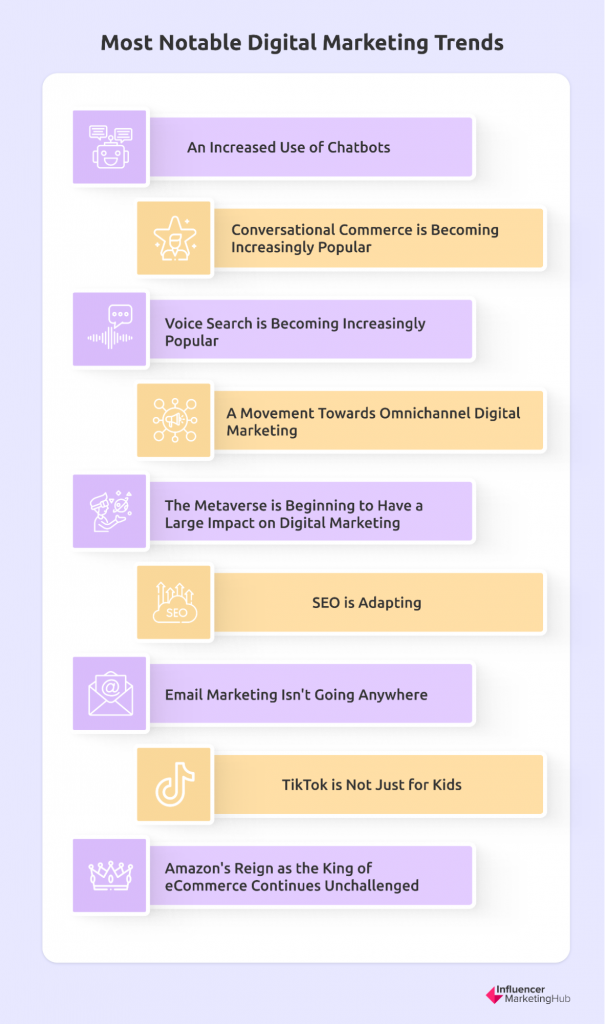
- 1. An Increased Use of Chatbots
- 2. Conversational Commerce is Becoming Increasingly Popular
- 3. Voice Search is Becoming Increasingly Popular
- 4. A Movement Towards Omnichannel Digital Marketing
- 5. The Metaverse is Beginning to Have a Large Impact on Digital Marketing
- 6. SEO is Adapting
- 7. Email Marketing Isn’t Going Anywhere
- 8. TikTok is Not Just for Kids
- 9. Amazon’s Reign as the King of eCommerce Continues Unchallenged
With more people doing their research online, combined with a reluctance by many to go in-store, there has been a notable increase in the use of Chatbots over the last couple of years.
Of course, this isn’t just due to increased demand. Chatbots have become more realistic and lifelike in recent years, giving people a much-improved user experience. In addition, advances in artificial intelligence (AI), machine learning (ML), natural language processing (NLP), and customer sentiment analysis have all improved the ability of chatbots to interact in a more human-like manner. As a result, firms are enhancing their customer service experience for customers without a sizable increase in investment.
Tidio reported that 88% of customers had at least one conversation with a chatbot during 2021. Their survey found that in addition to customer service and marketing, chatbots are used in other areas such as data collection, human resources, and operations. They are now an attractive option for eCommerce stores, B2B companies, real estate, and even healthcare.
Customer experience (CX) is becoming increasingly more important. Many consumers are willing to pay more for goods and services if they receive a quality experience than merely paying firms selling at the lowest price. Conversational commerce can help improve the customer experience.
Conversational commerce (aka conversational marketing or chat commerce) uses communication platforms and messaging apps, for example, WhatsApp and Facebook Messenger, to market products, communicate with consumers and offer support at each stage of the sales funnel.
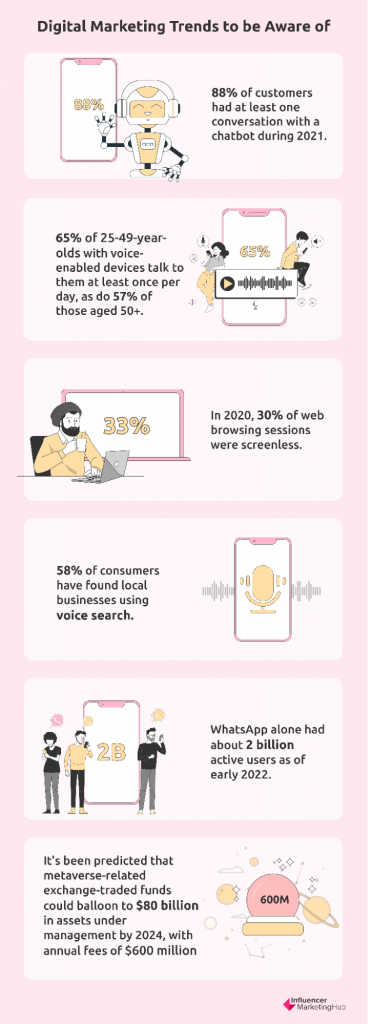
Businesses are discovering how much their customers use messaging apps. Many people consider it a natural evolution to communicate with brands this way, just as they do many of their personal conversations. WhatsApp alone had about 2 billion active users as of early 2022.
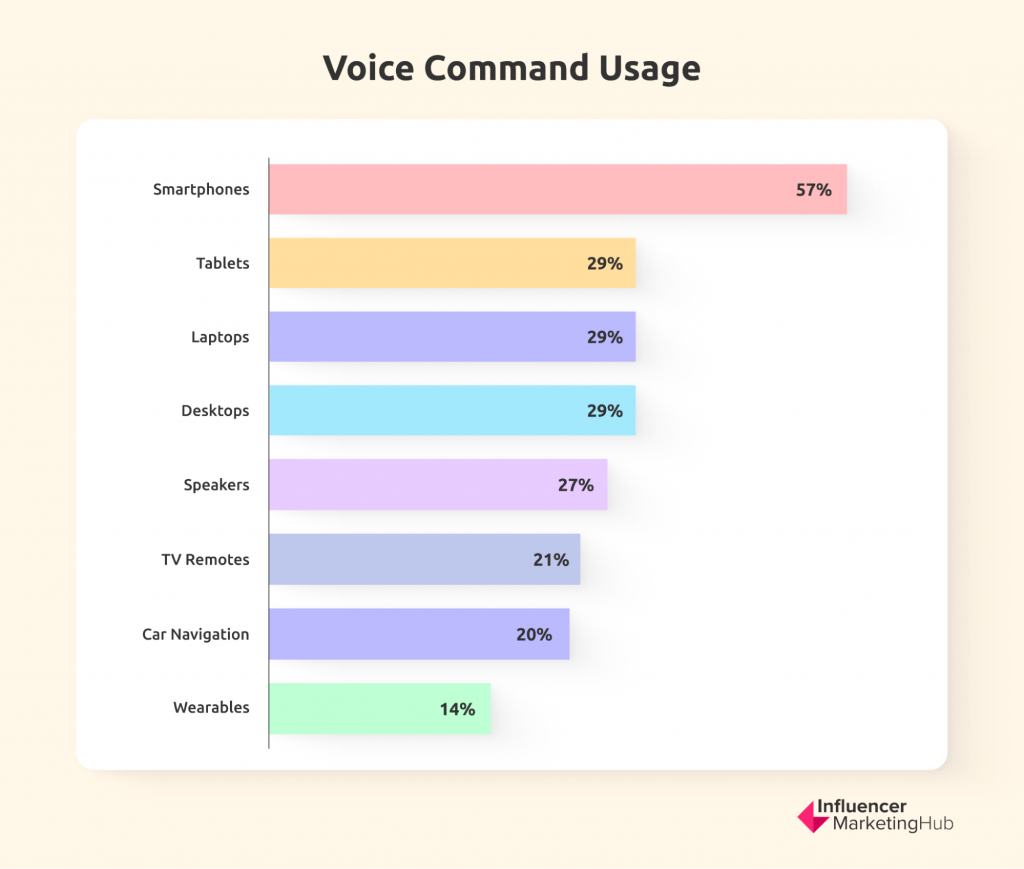
Generation Z, in particular, has never been huge fans of typing. Sure, they have grown up using digital devices, but if they can avoid using a keyboard, they will. Voice search capabilities are increasing to the point that this is now the preferred input method for many. Amazon’s Alexa, Google Assistant, and Apple Siri have increasingly become part of everyday life. As far back as 2018, PWC found that people used voice commands on their smartphones (57%), tablets (29%), laptops (29%), desktops (29%), speakers (27%), TV remotes (21%), car navigation (20%), and wearables (14%). And voice search has undoubtedly increased significantly since then.
Surprisingly, it isn’t just the younger generations discovering the ease of voice search. For example, 65% of 25-49-year-olds with voice-enabled devices talk to them at least once per day, as do 57% of those aged 50+.
Gartner discovered that in 2020, 30% of web browsing sessions were screenless. This clearly indicates a shift in how consumers interact with brands online.
Voice search users are increasingly searching for local results. According to Google, searches for “near me” business have increased dramatically over the past few years. Google reports that 58% of consumers have found local businesses using voice search.
Therefore, firms need to adjust their SEO to optimize for voice search. Methods include using natural language with direct answers to specific questions, schema markup and rich snippets, keeping My Business listing and eCommerce store data up-to-date, and ensuring all content is optimized and current.
Brands are discovering the benefits of creating campaigns that cover a range of digital marketing channels. This helps them reach a wider audience. In addition, most people don’t restrict themselves to a single digital channel, and omnichannel marketing allows brands to utilize the strengths of multiple channels.
The key to omnichannel marketing is to use all your channels to create a unified experience for each customer. Indeed, true omnichannel marketing doesn’t restrict itself to digital marketing. Instead, it includes some traditional marketing channels in its mix, recognizing that people aren’t 100% digital yet. Each channel interacts to create a unified voice and message for the brand.
Omnichannel marketing recognizes that consumers use a variety of channels at different stages of their day. For example, they may begin their day looking at Facebook before shifting to Instagram. Then they may check their emails. By this point, it’s time to go to work, with the radio playing as they go. On the way home, they may stop at the supermarket, see point-of-sale advertising, and listen to Spotify on their travels. Finally, they may stream a TV program or surf the net on their phone or tablet in the evening. This gives many potential touchpoints for a brand to reach consumers, delivering a unified but not identical message.
Note that omnichannel marketing subtly varies from multichannel marketing. Omnichannel marketing requires a transparent integration of your marketing efforts between your channels. For example, you’re not going to use identical PPC ads on all your social platforms, boring consumers with repetition. Yet nor are your messages so different that they may as well be separate campaigns. All marketing by a brand to a customer coordinates and tells part of a larger story in a seamless, unified way.
In 2021 Facebook (the company) rebranded to Meta. Considering the size and influence of Facebook’s assets that weren’t Facebook (the platform), separating the naming of the platform and the company made sense. At the time of the rebranding, Mark Zuckerberg announced that the company would be placing its future on its metaverse.
Bloomberg predicts that metaverse-related exchange-traded funds could balloon to $80 billion in assets under management by 2024, with annual fees of $600 million.
The metaverse includes live entertainment, social networks, hardware, user-generated content, and technology infrastructure. It’s a shared virtual space where megatrends converge. It incorporates a multitude of virtual and augmented experiences. In the metaverse, users create avatars and move through a 3D world, interacting with others and the environment around them. The metaverse includes platforms such as Roblox, Minecraft, and Fortnite.
As people spend more time in the metaverse, the line between the real and virtual world is increasingly blurred. As a result, people are beginning to experience brands and even buy virtual products. For example, Vans collaborated with Roblox to create a virtual skate park. Here, they could practice their virtual skateboarding skills and then buy Vans products without leaving the metaverse.
Google rolled out a significant Page Experience update in 2021. This update integrated a new set of metrics known as Core Web Vitals into what Google traditionally referred to as “page experience.” Core Web Vitals are the baseline requirements for a site’s technical health. They effectively measure the user experience (UX) of a webpage, covering three main areas: loading, interactivity, and visual stability. These metrics measure how long it takes a user to get to your page, how easily the user initially interacts with it, and whether the user becomes disoriented due to inconsistencies in your page design.
The Page Experience update combined core web vitals with more traditional factors such as being mobile-friendly, safe browsing, HTTPS (as compared to merely HTTP), and having no intrusive interstitials.
Google has also highlighted the importance of the “People also ask” part of its search results. Indeed, it now shows up in about 48.6% of searches, often prominently placed above position one in a search. Therefore, as a marketer, you should include answers to common questions in your content.
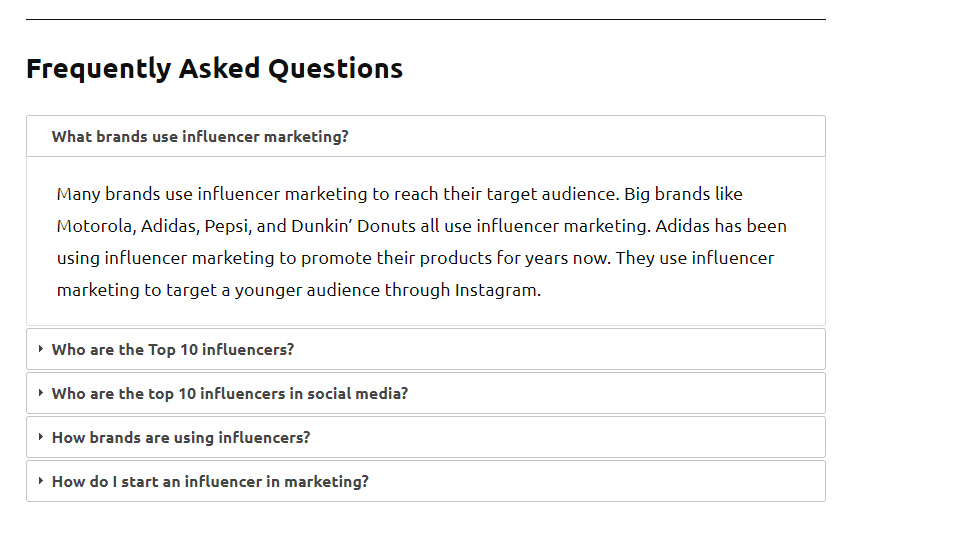
You might notice that quite a few of the more established pages on the Influencer Marketing Hub include FAQs. And Google is smart enough to select appropriate answers, even if the wording of what people ask is different from the exact wording on the page. So, for example, at the time of writing, if you search for “influencer marketing,” our Ultimate Guide tops the list.
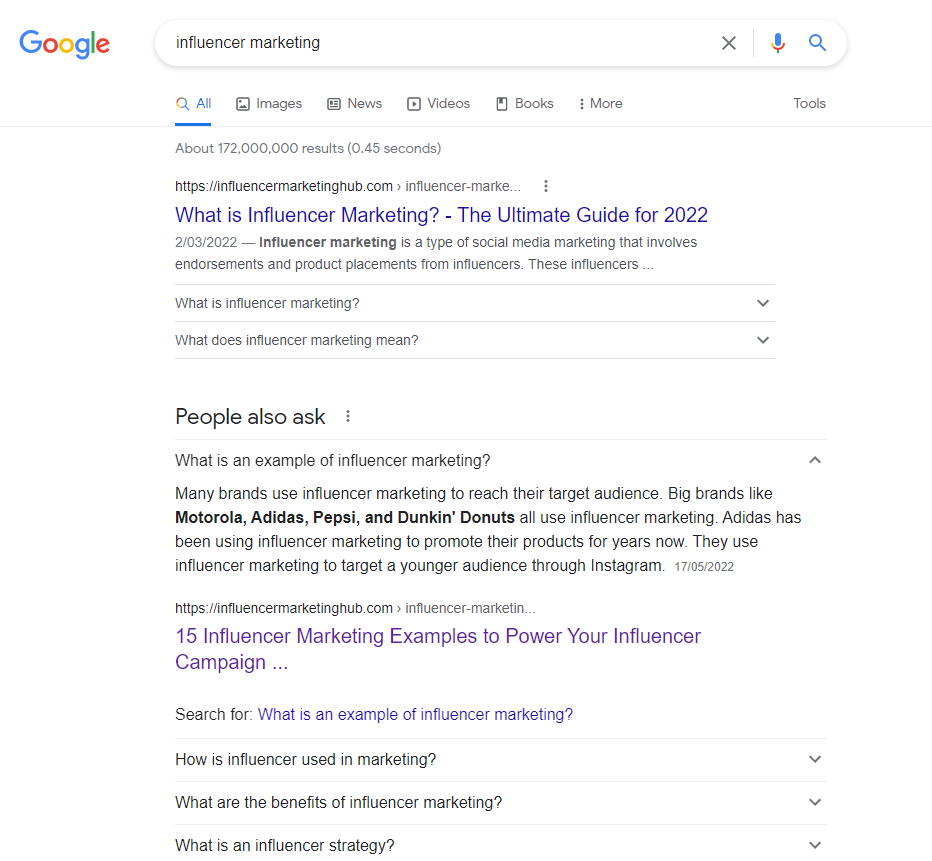
However, you will notice that Google has also included a “People Also Ask section,” and the first question is “What is an example of influencer marketing?” Google has selected a section from the FAQ in our 15 Influencer Marketing Examples to Power Your Influencer Campaign Planning post as the best answer for this question. However, when you look closely at the post, you can see that the actual question in the FAQ is “What brands use influencer marketing?” Despite being worded differently, Google’s algorithm is clever enough to recognize the similarity between the two questions.
In 2022, Google is all about user intent, rather than relying too closely on the words they use in their search.
With email marketing being one of the oldest forms of digital marketing, it is perhaps inevitable that people have been predicting its demise for some years. Yet email marketing isn’t going anywhere in a hurry.
According to The Radicati Group, the total number of business and consumer emails sent and received per day exceeded 293 billion in 2019 and is forecast to grow to over 347 billion by year-end 2023. Worldwide email users are expected to reach 4.3 billion by that time. In addition, Litmus reports that email drives an ROI of $36 for every dollar spent, higher than any other channel.
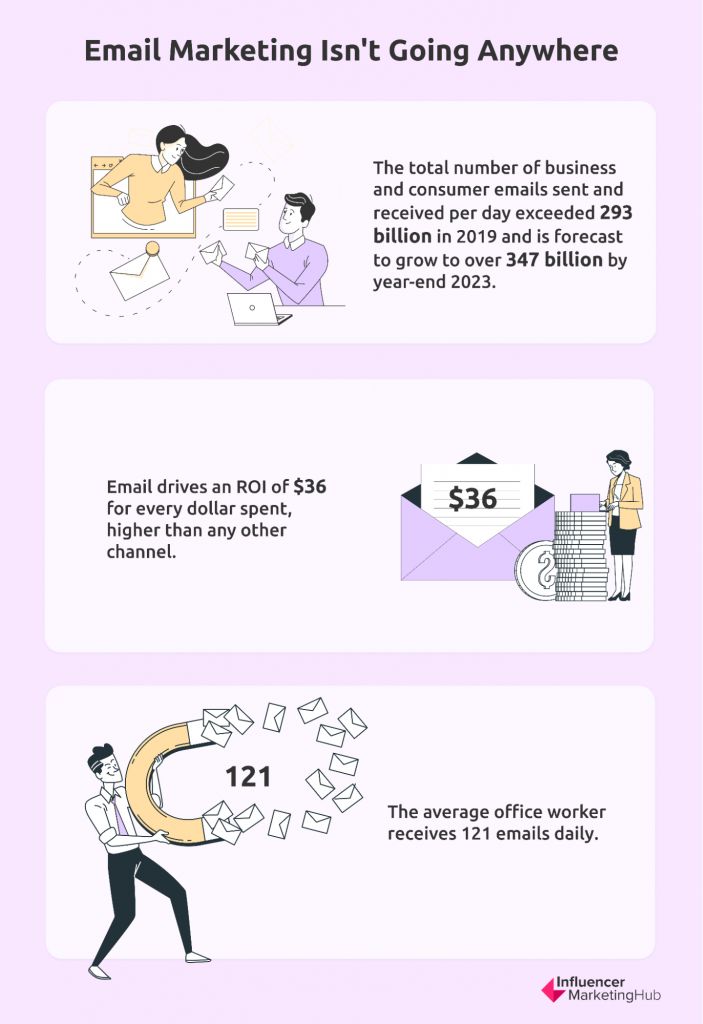
However, personalization is now vital for successful email marketing. People have to opt-in for email marketing and are very conscious about their privacy. Therefore, they don’t take kindly to generic, irrelevant emails. They receive many emails each day – indeed, DMR reports show that the average office worker receives 121 emails daily – so it takes something special to entice somebody to open your emails. Personalizing your marketing emails helps you to improve their effectiveness. Some businesses are now using AI to create custom and tailored emails for specific clients.
We have been covering the rise of TikTok since the days when Musical.ly still existed as a stand-alone platform. However, it has sometimes been difficult to convince brands that it is a serious social media platform. We regularly update our TikTok Statistics article and have noticed how rapidly TikTok has grown in popularity.
If you still doubt TikTok’s worthiness for serious digital marketing, consider some of these figures:
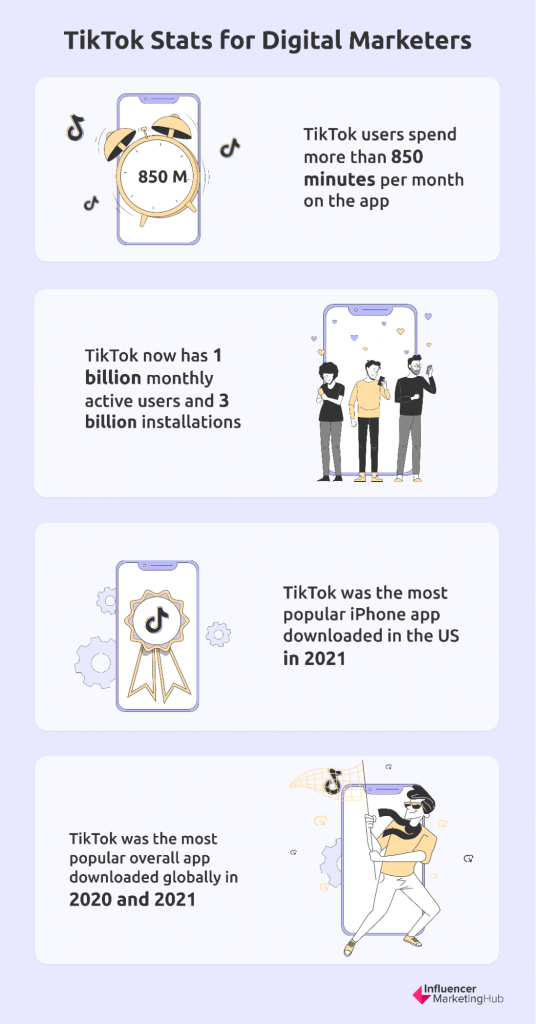
Like Facebook (and Instagram), TikTok now has a formal advertising marketplace, making it easy for brands to advertise on the platform.
And yes, TikTok is still most popular with the younger generations, with 32.5% of its US users aged 10-19, but its audience is gradually aging. TikTok users don’t appear to be “growing out” of the platform any more than Facebook users have grown out of that app.
Amazon continues to reign supreme as eCommerce’s leader. Although visitors to Amazon.com fell to 2.2 billion in February 2022, this really just reflected fewer Covid-related lockdowns around the world, increasing shoppers’ choices.
However, Amazon is not loyal to any brand other than its own. Virtually anybody can sell on Amazon, giving many opportunities for brands wishing to market online. Amazon Advertising continues to grow and is essential to the company’s revenue. Amazon’s ad revenue was more than $31 billion in 2021, three times its 2018 ad revenue. Amazon continues to refine its ads platform to give more options and data to improve your Advertising Cost of Sales (ACoS).
If you’re not yet selling on Amazon, we have a Complete Guide to Amazon Advertising to help you get started on the platform and an A to Z Guide to Selling on Amazon.
Over 30.000 marketing professionals rely on us for their news. Shouldn’t you?
Subscribe to the world’s #1 influencer marketing newsletter, delivered bi-weekly on a Thursday.
There’s a misconception that you have to choose between email and SMS marketing…
The number of active email users is expected to reach 4.6 billion by 2025, proving that…
In today’s highly competitive business landscape, marketing is strenuous. The challenge…

October 25, 2021 03:09 ET | Source: Fortune Business Insights Fortune Business Insights
Pune INDIA
Pune, India, Oct. 25, 2021 (GLOBE NEWSWIRE) — The global document management services market is likely to reach USD 57.56 billion by 2027 owing to rapid adoption of cloud-based technologies. Besides, the market will register a CAGR of 6.9% between 2020 and 2027 according to Fortune Business Insights, latest report, titled “Document Management Services Market Size, Share, Growth, Insights & COVID-19 IMPACT Analysis, By Services (Archiving and Storage, Imaging and Scanning, Printing, Mailroom Services and Others), By End-user (Medical, Financial, Government, Audit & Consulting, Corporate, Telecommunication, and Insurance & Re-insurance) and Regional Forecast, 2020-2027”
The emergence of COVID-19 has brought the world to a standstill. We understand that this health crisis has brought an unprecedented impact on businesses across industries. However, this too shall pass. Rising support from governments and several companies can help in the fight against this highly contagious disease. There are some industries that are struggling and some are thriving. Overall, almost every sector is anticipated to be impacted by the pandemic.
We are taking continuous efforts to help your business sustain and grow during COVID-19 pandemics. Based on our experience and expertise, we will offer you an impact analysis of coronavirus outbreak across industries to help you prepare for the future.
Request Sample PDF Brochure: https://www.fortunebusinessinsights.com/enquiry/request-sample-pdf/document-management-services-market-102848
List of the Companies Operating in the Document Management Services Market:
Document Management Services Market Share Report Scope and segmentation:
Document management services are vital to organize all the important document and data in one place. In addition to this, these services efficiently keep a track on all the important documents, while speeding up the performance of an organization. Furthermore, it is accurate and provides access to the documents at any given time from any part of the globe. Today, there has been a paradigm shift towards digitalization that is propelling the companies to move beyond paper document and adopt electronic document management systems (EDMS). Moreover, the electronic system has automated the complete work process, thereby, saving time and effort.
Have Any Query? Speak To Analyst: https://www.fortunebusinessinsights.com/enquiry/speak-to-analyst/document-management-services-market-102848
Regional Analysis:
Presence of Major Companies in North America to Bolster Growth
Geographically, the market comprises of several regions affecting the market growth during the forecast period. They are:
North America: The region held the largest share at USD 13.76 Billion in 2019 and is expected to dominate the market during the projected horizon. This is ascribable to factors such as presence of major companies such as Oracle Corporation and Access. Furthermore, rising adoption of the services by the end-user industries such as healthcare and BFSI is expected to propel North America to hold highest document management services market revenue between 2020 and 2027.
Asia-Pacific: The market in this region is likely to rise significantly during the forecast period. This is attributable to factors such as improved IT infrastructures in countries such as China, and India. Furthermore, advancement in business process services in Asia-Pacific will positively affect the market growth in the forthcoming years.
Europe: On the other hand, Europe is anticipated to register augmented growth owing to adoption of strategies such as collaboration by the companies to expand their business during the forecast period.
Drivers and Restraints:
Adoption of Technology Such as Cloud-Based amid COVIID-19 to Spur Demand
Technological advancement has led to emergence of efficient and reliable services such as cloud-based management. Additionally, cloud-based applications provide a seamless user experience and provides high-level flexibility to manage work for the organizations across the globe. The global pandemic, COVID-19 has gripped the whole world with widespread effects over several economies. Several governments around the world have called for lockdown to contain the disease and majority of people are working remotely. This has surged the demand for cloud-based services manifold in this testing times. Major companies are adopting the services that are robust and reliable to keep continuing the operational activities of their businesses. For instance, in May 2020, King & Wood Mallesons, a global international law firm, announced its adoption of iManage Cloud for its offices in Europe, Middle East, and United States. Darren Brown, IT Head of the company, said on the sidelines of the development, “Our firm is a strong believer of the future belonging to cloud, and are impressed with iManage cloud’s tremendous impact on our productivity, significant reduction in operational overheads, and its ability to access remotely.”
Ask For Customization: https://www.fortunebusinessinsights.com/enquiry/customization/document-management-services-market-102848
What does the Report Include?
The Document Management Services Market report includes an exhaustive study of several factors such as drivers, restraints, challenges, and opportunities that will affect the growth of the market in the forthcoming years. The report covers regional demographics that include qualitative and quantitative information about the regions that are further divided into nations that are contributing to the growth of the market between 2019 and 2026. Furthermore, the competitive landscape has been discussed in-depth that include information of several players operating in the market. Moreover, information on the adoption of strategies such as merger and acquisition, collaboration, partnerships, and joint ventures by the companies that will drive the growth of the market has been included during the projected horizon.
Competitive Landscape:
Merger and Acquisition by the Companies to Stoke Demand
According to the report, there are several companies operating in the market striving to gain major market share and outshine their rivals in the competitive marketplace. They are doing so by adopting strategies such as merger and acquisition, collaboration, and joint ventures, among others and maintain market stronghold in the forthcoming years. For instance, in April 2018, Exela Technologies Inc., a U.S.-based automation provider, announced its acquisition of the German-based document management company, Asterion International Group. This acquisition is expected to expand the company’s operation and product offering across Europe. Furthermore, it will enable access to Asterion’s consumers to Exela’s document management solutions.
Quick Buy – Document Management Services Market: https://www.fortunebusinessinsights.com/checkout-page/102848
Table Of Content:
TOC Continued…!
Have a Look at Related Research Insights:
Email Marketing Software Market Size, Share and Industry Analysis, By Channel (Business-to-Business (B2B) and Business-to-Customers (B2C)), Deployment (On-Premise and Cloud), By Enterprise Size (Large Enterprises, Small & Medium Enterprises), By Application (Email Lead Generation, Sales Reporting, Customer Management), By Industry (Banking, Finance, Security and Insurance (BFSI), IT and Telecommunications) and Regional Forecast, 2020-2027
Mobile Security Market Size, Share and Industry Analysis, By Component (Solutions and Services), By Operating System (iOS and MacOS, Android, Windows, and Others), By Vertical (BFSI, IT & Telecom, Healthcare, Manufacturing, Retail, Education, Government, Others), and Regional Forecast, 2020-2027
Linux Operating System Market Size, Share & Covid-19 Impact Analysis, By Distribution (Virtual Machines, Servers and Desktops), By End-use (Commercial/Enterprise and Individual), and Regional Forecast, 2020-2027
Web Conferencing Market Size, Share & COVID-19 Impact Analysis, By Component (Solution and Services), By Deployment (Hosted Web Conferencing, On-Premises Web Conferencing, Managed Web Conferencing and Software-as-a-Service (SaaS)), By End-use (Education, Government, Healthcare, IT and Telecommunication, BFSI, Manufacturing, Media & Entertainment, and Others), and Regional Forecast, 2020-2027
Risk Analytics Market Size, Share and Covid-19 Impact Analysis, By Component (Software, Services), By Risk Type Application (Financial Risk, Operational Risk, Compliance Risk, Strategic Risks), By Deployment (Cloud, On-Premise), By Enterprise Size (Small and Medium-sized Enterprises (SMEs), Large Enterprises) By Industry (Banking, Financial Services and Insurance (BFSI), IT and Telecommunications, Healthcare) and Regional Forecast, 2020-2027
About Us:
Fortune Business Insights™ delivers accurate data and innovative corporate analysis, helping organizations of all sizes make appropriate decisions. We tailor novel solutions for our clients, assisting them to address various challenges distinct to their businesses. Our aim is to empower them with holistic market intelligence, providing a granular overview of the market they are operating in.
Contact Us:
Fortune Business Insights™ Pvt. Ltd.
308, Supreme Headquarters,
Survey No. 36, Baner,
Pune-Bangalore Highway,
Pune – 411045, Maharashtra, India.
Phone:
US :+1 424 253 0390
UK : +44 2071 939123
APAC : +91 744 740 1245
Email: sales@fortunebusinessinsights.com
LinkedIn: https://www.linkedin.com/company/fortune-business-insights
Facebook: https://www.facebook.com/FortuneBusinessInsightsPvtLtd
Twitter: https://twitter.com/FBInsightPvtLtd
Press Release: https://www.fortunebusinessinsights.com/press-release/document-management-services-market-9977

The Microsoft Threat Intelligence Center (MSTIC) has observed and taken actions to disrupt campaigns launched by SEABORGIUM, an actor Microsoft has tracked since 2017. SEABORGIUM is a threat actor that originates from Russia, with objectives and victimology that align closely with Russian state interests. Its campaigns involve persistent phishing and credential theft campaigns leading to intrusions and data theft. SEABORGIUM intrusions have also been linked to hack-and-leak campaigns, where stolen and leaked data is used to shape narratives in targeted countries. While we cannot rule out that supporting elements of the group may have current or prior affiliations with criminal or other nonstate ecosystems, MSTIC assesses that information collected during SEABORGIUM intrusions likely supports traditional espionage objectives and information operations as opposed to financial motivations.
This blog provides insights into SEABORGIUM’s activities and technical methods, with the goal of sharing context and raising awareness about a significant threat to Microsoft customers. MSTIC would like to acknowledge the Google Threat Analysis Group (TAG) and the Proofpoint Threat Research Team for their collaboration on tracking and disrupting this actor. Microsoft’s ability to detect and track SEABORGIUM’s abuse of Microsoft services, particularly OneDrive, has provided MSTIC sustained visibility into the actor’s activities and enabled us to notify impacted customers. As an outcome of these service abuse investigations, MSTIC partnered with abuse teams in Microsoft to disable accounts used by the actor for reconnaissance, phishing, and email collection. Microsoft Defender SmartScreen has also implemented detections against the phishing domains represented in SEABORGIUM’s activities.
SEABORGIUM is a highly persistent threat actor, frequently targeting the same organizations over long periods of time. Once successful, it slowly infiltrates targeted organizations’ social networks through constant impersonation, rapport building, and phishing to deepen their intrusion. SEABORGIUM has successfully compromised organizations and people of interest in consistent campaigns for several years, rarely changing methodologies or tactics. Based on known indicators of compromise and actor tactics, SEABORGIUM overlaps with the threat groups tracked as Callisto Group (F-Secure), TA446 (Proofpoint) and COLDRIVER (Google). Security Service of Ukraine (SSU) has associated Callisto with Gamaredon Group (tracked by Microsoft as ACTINIUM); however, MSTIC has not observed technical intrusion links to support the association.
Since the beginning of 2022, Microsoft has observed SEABORGIUM campaigns targeting over 30 organizations, in addition to personal accounts of people of interest. SEABORGIUM primarily targets NATO countries, particularly the US and the UK, with occasional targeting of other countries in the Baltics, the Nordics, and Eastern Europe. Such targeting has included the government sector of Ukraine in the months leading up to the invasion by Russia, and organizations involved in supporting roles for the war in Ukraine. Despite some targeting of these organizations, Microsoft assesses that Ukraine is likely not a primary focus for this actor; however, it is most likely a reactive focus area for the actor and one of many diverse targets.
Within the target countries, SEABORGIUM primarily focuses operations on defense and intelligence consulting companies, non-governmental organizations (NGOs) and intergovernmental organizations (IGOs), think tanks, and higher education. SEABORGIUM has a high interest in targeting individuals as well, with 30% of Microsoft’s nation-state notifications related to SEABORGIUM activity being delivered to Microsoft consumer email accounts. SEABORGIUM has been observed targeting former intelligence officials, experts in Russian affairs, and Russian citizens abroad. As with any observed nation-state actor activity, Microsoft directly notifies customers of Microsoft services that have been targeted or compromised, providing them with the information they need to secure their accounts.
Over many years of tracking, Microsoft has observed a consistent methodology from SEABORGIUM with only slight deviations in their social engineering approaches and in how they deliver the initial malicious URL to their targets. In this section, we provide detailed analysis of SEABORBIUM’s operational tactics as well as several examples of their campaigns.
Before starting a campaign, SEABORGIUM often conducts reconnaissance of target individuals, with a focus on identifying legitimate contacts in the targets’ distant social network or sphere of influence. Based on some of the impersonation and targeting observed, we suspect that the threat actor uses social media platforms, personal directories, and general open-source intelligence (OSINT) to supplement their reconnaissance efforts. MSTIC, in partnership with LinkedIn, has observed fraudulent profiles attributed to SEABORGIUM being used sporadically for conducting reconnaissance of employees from specific organizations of interest. In accordance with their policies, LinkedIn terminated any account (including the one shown below) identified as conducting inauthentic or fraudulent behavior.
SEABORGIUM also registers new email accounts at various consumer email providers, with the email address or alias configured to match legitimate aliases or names of impersonated individuals. While the creation of new consumer accounts is common, we have also observed SEABORGIUM returning to and reusing historical accounts that match the industry of the ultimate target. In one case, we observed SEABORGIUM returning to an account it had not used in a year, indicating potential tracking and reusing of accounts if relevant to targets’ verticals.
After registering new accounts, SEABORGIUM proceeds to establish contact with their target. In cases of personal or consumer targeting, MSTIC has mostly observed the actor starting the conversation with a benign email message, typically exchanging pleasantries before referencing a non-existent attachment while highlighting a topic of interest to the target. It’s likely that this additional step helps the actor establish rapport and avoid suspicion, resulting in further interaction. If the target replies, SEABORGIUM proceeds to send a weaponized email.
MSTIC has also documented several cases where the actor focuses on a more organizational approach to phishing. In these cases, the actor uses an authoritative approach in their social engineering and typically goes to directly sending malicious content.
These examples serve to demonstrate the actors’ capability to be dynamic and to adapt their social engineering approach to gain the trust of their victims.
Microsoft has identified several variations in the way that SEABORGIUM delivers a link that directs targets to their credential stealing infrastructure.
URL in body of email
In the simplest case, SEABORGIUM directly adds a URL to the body of their phishing email. Occasionally, the actor leverages URL shorteners and open redirects to obfuscate their URL from the target and inline protection platforms. The email varies between fake personal correspondence with a hyperlinked text and fake file sharing emails that imitate a range of platforms.
PDF file attachment that contains a URL
MSTIC has observed an increase in the use of attachments in SEABORGIUM campaigns. These attachments typically imitate a file or document hosting service, including OneDrive, and request the user to open the document by clicking a button.
OneDrive link to PDF file that contains a URL
SEABORGIUM also abuses OneDrive to host PDF files that contain a link to the malicious URL. This activity does not represent any security issues or vulnerabilities on the OneDrive platform. The actors include a OneDrive link in the body of the email that when clicked directs the user to a PDF file hosted within a SEABORGIUM-controlled OneDrive account. As seen in the previous example, the victim is presented with what appears to be a failed preview message, enticing the target to click the link to be directed to the credential-stealing infrastructure. Occasionally, SEABORGIUM makes use of open redirects within the PDF file to further disguise their operational infrastructure. In the example below, SEABORGIUM uses a Google URL for redirection.
Regardless of the method of delivery, when the target clicks the URL, the target is directed to an actor-controlled server hosting a phishing framework, most often EvilGinx. On occasion, Microsoft has observed attempts by the actor to evade automated browsing and detonation by fingerprinting browsing behavior. Once the target is redirected to the final page, the framework prompts the target for authentication, mirroring the sign-in page for a legitimate provider and intercepting any credentials. After credentials are captured, the target is redirected to a website or document to complete the interaction.
SEABORGIUM has been observed to use stolen credentials and directly sign in to victim email accounts. Based on our experience responding to intrusions from this actor on behalf of our customers, we have confirmed that the following activities are common:
Based on the specific victimology, documents stolen, conversations fostered, and sustained collection observed, we assess that espionage is likely a key motivation of the actor.
In May 2021, MSTIC attributed an information operation to SEABORGIUM based on observations and technical overlaps with known phishing campaigns. The operation involved documents allegedly stolen from a political organization in the UK that were uploaded to a public PDF file-sharing site. The documents were later amplified on social media via known SEABORGIUM accounts, however MSTIC observed minimal engagement or further amplification. Microsoft was unable to validate the authenticity of the material.
In late May 2022, Reuters along with Google TAG disclosed details about an information operation, specifically using hack and leak, that they attributed to COLDRIVER/SEABORGIUM. Microsoft independently linked SEABORGIUM to the campaign through technical indicators and agrees with the assessment by TAG on the actor responsible for the operation. In the said operation, the actors leaked emails/documents from 2018 to 2022, allegedly stolen from consumer Protonmail accounts belonging to high-level proponents of Brexit, to build a narrative that the participants were planning a coup. The narrative was amplified using social media and through specific politically themed media sources that garnered quite a bit of reach.
While we have only observed two cases of direct involvement, MSTIC is not able to rule out that SEABORGIUM’s intrusion operations have yielded data used through other information outlets. As with any information operation, Microsoft urges caution in distributing or amplifying direct narratives, and urges readers to be critical that the malicious actors could have intentionally inserted misinformation or disinformation to assist their narrative. With this in mind, Microsoft will not be releasing the specific domain or content to avoid amplification.
The techniques used by the actor and described in the “Observed actor activity” section can be mitigated by adopting the security considerations provided below:
For Microsoft Defender for Office 365 Customers:
The below list provides IOCs observed during our investigation. We encourage our customers to investigate these indicators in their environments and implement detections and protections to identify past related activity and prevent future attacks against their systems.
NOTE: These indicators should not be considered exhaustive for this observed activity.
Intelligence gathered by the Microsoft Threat Intelligence Center (MSTIC) is used within Microsoft security products to provide protection against associated actor activity.
Microsoft Defender for Office offers enhanced solutions for blocking and identifying malicious emails. Signals from Microsoft Defender for Office inform Microsoft 365 Defender, which correlate cross-domain threat intelligence to deliver coordinated defense, when this threat has been detected. These alerts, however, can be triggered by unrelated threat activity. Example alerts:
Aside from the Microsoft Defender for Office 365 alerts above, customers can also monitor for the following Microsoft 365 Defender alerts for this attack. Note that these alerts can also be triggered by unrelated threat activity. Example alerts:
Microsoft 365 Defender customers should also investigate any “Stolen session cookie was used” alerts that would betriggered for adversary-in-the-middle (AiTM) attacks.
Microsoft Defender SmartScreen has implemented detections against the phishing domains represented in the IOC section above.
Microsoft Sentinel customers can run the following advanced hunting queries to locate IOCs and related malicious activity in their environments.
The query below identifies matches based on domain IOCs related to SEABORGIUM actor across a range of common Microsoft Sentinel data sets:
https://github.com/Azure/Azure-Sentinel/blob/master/Detections/MultipleDataSources/SEABORGIUMDomainsAugust2022.yaml
Microsoft 365 Defender customers can run the following advanced hunting queries to locate IOCs and related malicious activity in their environments.
This query identifies matches based on domain IOCs related to SEABORGIUM against Microsoft Defender for Endpoint device network connections
https://github.com/Azure/Azure-Sentinel/blob/master/Hunting%20Queries/Microsoft%20365%20Defender/Campaigns/SEABORGIUMDomainIOCsAug2022.yaml
Microsoft is a leader in cybersecurity, and we embrace our responsibility to make the world a safer place.