


Last November, the document management company NetDocuments acquired Afterpattern, a no-code toolkit that law firms and legal teams can use to build apps and automate legal documents and workflows, promising at the time that it would be natively integrated into the NetDocuments platform.
Today, that promise comes to fruition, as NetDocuments releases PatternBuilder, a document and workflow automation tool that enables law firms, legal teams, and the public sector to automate their expertise and processes so they can be repeated predictably.
While PatternBuilder’s functionality is much the same as the Afterpattern product, the significant difference is that it is native to the NetDocuments platform, meaning that it is directly available for NetDocuments’ customers to use directly within the platform in which they are already working.
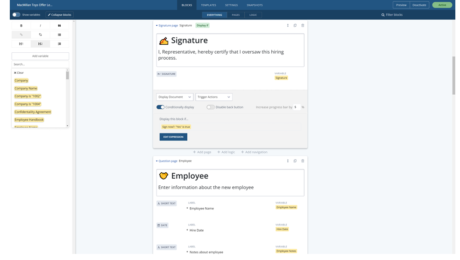
PatternBuilder’s App Builder provides several built Page Blocks to choose from, making it easier to build apps while also enabling users to create the complex interactions needed in legal document automation such as looping and iterations.
“Built directly into the NetDocuments platform, organizations of all sizes will be able to leverage this new capability while inheriting all of the security, governance and accessibility benefits of being in the cloud,” said Josh Baxter, NetDocuments CEO.
The core use case for PatternBuilder is to enable legal professionals to replicate and automate their unique templates and processes so that they are done consistently every time.
With the product built natively into NetDocuments, it enables firms to embed document assembly directly within the document management system, populating user inputs into Word and PDF documents and then automatically saving those documents into the folder or workspace the user chooses.
PatternBuilder Global Apps Page enables apps to be run from within the NetDocuments browser interface. All menu options shown are rights dependent and fully configurable at a granular level.
NetDocuments says that PatternBuilder has several unique features that make it easy for its customers to get started with automation:
“Being able to automate both simple and complex documents and tasks, as well as manage and implement these new applications, is critical for legal professionals and their support teams,” said Dan Hauck, NetDocuments chief product officer. “PatternBuilder gives organizations the ability to scale their expertise and consistently deliver their best work.”
PatternBuilder is officially launching today in the United States and will be rolled out to other regions during September, the company said.
It is being sold as an add-on product with the NetDocuments’ DELIVER solution, which consists of tools and features designed to enable legal organizations to safely organize, package and share content with clients, customers, outside counsel, and other internal and external groups.
NetDocuments says it plans to continue to enhance and add features to PatternBuilder. Over the next few months, it said, it will release the ability for users to:
Current Afterpattern customers will be able to continue using the product. However, Afterpattern will no longer accept new customers.
Bob is a lawyer, veteran legal journalist, and award-winning blogger and podcaster. In 2011, he was named to the inaugural Fastcase 50, honoring “the law’s smartest, most courageous innovators, techies, visionaries and leaders.” Earlier in his career, he was editor-in-chief of several legal publications, including The National Law Journal, and editorial director of ALM’s Litigation Services Division.

Bob Ambrogi is a lawyer and journalist who has been writing and speaking about legal technology and innovation for more than two decades. He writes the award-winning blog LawSites, is a columnist for Above the Law, hosts the podcast about legal innovation, LawNext, and hosts the weekly legal tech journalists’ roundtable, Legaltech Week.


Receive a weekly digest of all new content.
You have successfully joined our subscriber list.
ABOUT LAW SITES
LawSites is a blog covering legal technology and innovation. It is written by Robert Ambrogi, a lawyer and journalist who has been writing and speaking about legal technology, legal practice and legal ethics for more than two decades.

Review your content’s performance and reach.
Become your target audience’s go-to resource for today’s hottest topics.
Understand your clients’ strategies and the most pressing issues they are facing.
Keep a step ahead of your key competitors and benchmark against them.
add to folder:
Questions? Please contact [email protected]
The guide below provides some useful information on acceptable descriptions of metaverse-related goods and services in Canada, the United States (U.S.), The United Arab Emirates (U.A.E.), the European Union (EU), and Singapore.
Given the emergence of virtual worlds and the metaverse, brand owners may wish to assess their own trademark portfolios with a view to expanding coverage to encompass this developing space. Virtual worlds permit the movement of digital goods themselves, and trademarks designed for real life goods may not necessarily extend to those digital worlds, depending on their application. In addition to considering potential enforcement mechanisms in the metaverse, brands can consider a proactive approach, with a view to creating protection strategies and potential language for filing trademark applications with respect to virtual worlds and digital elements.
As more creative metaverse-related uses emerge, goods and services will continue to be defined, more guidance will be issued, and the list of acceptable terms should further proliferate. In the meantime, we invite you to contact us for guidance in drafting potential new descriptions including, in some instances, strategizing with respect to populating the listing in the Canadian Manual of Goods and Services with proposed descriptions.
Descriptions of goods and services for the virtual/digital world field in:
Canada
We invite you to consider the goods and services currently recognized by the Canadian Trademarks Office and have listed a few examples in this article. While descriptions of goods and services that are not included in the Canadian Trademarks Office’s Manual of Goods and Services may still be acceptable if described in ordinary commercial terms (terms commonly used in the relevant industry to describe the goods and services), filing applications in Canada using goods and services descriptions that are listed in said Manual will allow applications to reach the examination stage faster and will avoid Examiner’s reports based on goods and services descriptions.
Virtual goods and cryptoassets including NFTs
Brands have begun experimenting with Non-fungible-tokens (NFTs) which have recently dominated headlines. The Canadian Trademarks Office recognizes a number of descriptions of goods (G) and services (S) with respect to NFTs and other cryptoassets encompassing generally classes 9 goods and 42 services.
Acceptable descriptions for NFTs and other cryptoassets in Canada include the NFTs themselves or software for an action related to the NFTs. Examples are goods that generally fall in Class 9 as follows:
Services related to cryptoassets including NFTs
In an alternative, acceptable descriptions can include services for cryptoassets including NFTs, such as platforms that provide an action with respect to NFTs. Examples are services that generally fall in Class 42 as follows:
Electronic transfer of cryptoassets
The electronic transfer of these cryptoassets can fall within Class 36:
Software for use in the metaverse
Examples of metaverse applications may take the form of software, games, digital goods (including “skins”), or avatars or the like for use in the metaverse that generally fall within Class 9.
Metaverse-enabling hardware
These metaverse applications may also take the form of hardware, such as head-sets, which enable virtual reality platforms. Pre-approved terms generally fall in Class 9:
Unsurprisingly, the sale of these goods may fall into Class 35:
Marketplace for virtual goods
When the service being described is a marketplace for virtual or digital goods, the description will typically fall into Class 35.
Services for provision of virtual content
In some instances, Class 41 may also be appropriate for services with respect to the provision of virtual content. For example, the Canadian Trademarks Office has pre-approved the following language, generally in Class 41:
United States
Goods and services in the United States Trademarks Office
The United States Trademarks Office similarly has approved language with respect to NFTs, virtual goods and related services. Examples include:
Goods
Virtual Goods and Cryptoassets including NFTs
Downloadable audio and video recordings featuring {specify subject matter, e.g., sports highlights, movie clips, memes, etc.} authenticated by non-fungible tokens (NFTs) Downloadable audio recordings featuring {specify subject matter, e.g., music, poetry, etc.} authenticated by non-fungible tokens (NFTs) Downloadable computer game software featuring virtual goods, namely, {indicate goods, e.g., furniture, jewelry, sunglasses, etc.} for use in online virtual worlds Downloadable computer software for accessing, reading, and tracking information in the field of {indicate subject matter of information, e.g., patient medical records, financial transactions, etc.} on a blockchain Downloadable computer software for use as a digital wallet Downloadable image files containing {indicate subject matter or field, e.g., trading cards, artwork, memes, sneakers, etc.} authenticated by non-fungible tokens (NFTs) Downloadable multimedia file containing artwork relating to {indicate field or subject matter of file} authenticated by non-fungible tokens (NFTs) Downloadable multimedia file containing artwork, text, audio, and video relating to {indicate field or subject matter of file} authenticated by non-fungible tokens (NFTs) Downloadable multimedia file containing audio relating to {indicate field or subject matter of file} authenticated by non-fungible tokens (NFTs) Downloadable multimedia file containing text relating to {indicate field or subject matter of file} authenticated by non-fungible tokens (NFTs) Downloadable multimedia file containing video relating to {indicate field or subject matter of file} authenticated by non-fungible tokens (NFTs) Downloadable music files authenticated by non-fungible tokens (NFTs) Downloadable software for generating cryptographic keys for receiving and spending crypto assets Downloadable video recordings featuring {specify subject matter, e.g., sports highlights, movie clips, memes, etc.} authenticated by non-fungible tokens (NFTs) Downloadable virtual goods, namely, computer programs featuring {specify nature, type, e.g., articles of clothing} for use in online virtual worlds
Of course, other classes should not be overlooked when the good may primarily fulfill one purpose with the incorporation of a digital sensor that could have use in the metaverse, for example, for goods related to scanned objects to be incorporated into the metaverse with metadata and use of Internet of Things (IoT) sensors. For example, the United States Trademarks Office provides for various goods incorporating digital sensors:
Compression sleeves incorporating digital sensors (G, Class 10) Socks incorporating digital sensors (G, Class 25) T-shirts incorporating digital sensors (G, Class 25) Yoga pants incorporating digital sensors (G, Class 25)
Services
Metaverse-related retail store services in Class 35
Online retail store services rendered in a virtual environment featuring physical goods, namely, {specify type, e.g., furniture, jewelry, sunglasses, etc.} Online retail store services featuring virtual goods, namely, {specify type, e.g., furniture, jewelry, sunglasses, etc.} for use in online virtual worlds Online retail store services featuring digital goods, namely, {specify type, e.g., furniture, jewelry, sunglasses, etc.} for use in online virtual worlds Online retail store services rendered in a virtual environment featuring virtual goods, namely, {specify type, e.g., furniture, jewelry, sunglasses, etc.} Online retail store services rendered in a virtual environment featuring physical goods and virtual goods, namely, {specify type, e.g., furniture, jewelry, sunglasses, etc.}
Some of the virtual services descriptions listed in the Acceptable Identification of Goods and Services Manual (ID Manual) of the United States Trademarks Office are not currently included in the Canadian Manual of Goods and Services. Some examples are:
Authentication of data in the field of {indicate field, e.g., works of art, financial transactions, medical records, etc.} using blockchain technology (S, Class 42) Computer services, namely, creating an on-line virtual environment for {indicate purpose, e.g., off-track betting, trading stocks, etc.} (S, Class 42) Electronic storage of crypto tokens for others (S, Class 42) Entertainment services, namely, providing virtual environments in which users can interact for recreational, leisure or entertainment purposes (S, Class 41) Financial exchange of crypto assets (S, Class 36) Organizing, arranging, and conducting virtual {specify type of sport, e.g., triathlon, cycling, running, etc.} events (S, Class 41) Providing an on-line forum for trading virtual real estate (S, Class 38) Providing on-line non-downloadable software for generating cryptographic keys for receiving and spending crypto assets (S, Class 42) Providing temporary use of on-line non-downloadable computer software for use as a digital wallet (S, Class 42) Providing temporary use of on-line non-downloadable software for accessing, reading, and tracking information in the field of {indicate subject matter of information, e.g., patient medical records, financial transactions, etc.} on a blockchain (S, Class 42) Provision of an online marketplace for buyers and sellers of downloadable digital {indicate type of downloadable digital goods, e.g., art images, music, video clips, etc.} authenticated by non-fungible tokens (NFTs) (S, Class 35) Provision of an online marketplace for buyers and sellers of downloadable digital art images authenticated by non-fungible tokens (NFTs) (S, Class 35) User authentication services using blockchain technology for {specify the application of the services, e.g., cryptocurrency transactions, online software applications, etc.} (S, Class 42)
UAE
Building on the 2017 launch of its Strategy for the Fourth Industrial Revolution (4IR), the UAE recently introduced a National Digital Economy Strategy. This announcement is in line with its generally supportive approach to crypto-related activities of the region. With a desire to establish itself as a leader in the metaverse economy in the region and among the top 10 cities globally, Dubai has created the Virtual Assets Regulatory Authority (VARA), which provides a legal framework for digital assets such as NFTs.
The region has also taken concrete steps in the digital economy with the UAE Ministry of Economy announcing the installation of official departments in the metaverse, allowing users to access services entirely virtually. Once launched, metaverse users will be able to visit the virtual office rather than the existing physical offices to provide signatures on legally binding documents. In October 2022, the Government of Dubai's Legal Affairs Department announced that from early 2023, it will move its "Continuing Legal Professional Development" training for Dubai-based legal consultants into the metaverse. The intention is to run interactive CLPD sessions in the metaverse, using AI to identify areas of further development.
These actions are in addition to other digital friendly initiatives including: the introduction of the world’s first virtual megacity in 2021 – Metaverse Dubai – based on the city’s real topography and geography; hosting of the world’s first economic summit in the metaverse – Investopia; launch of the Middle East’s first metaverse incubator – MetaIncubator among others. The UAE Trademarks Office has not, to date, issued any formal practice direction or notice in relation to goods and services relating to the metaverse, crypto assets or the like. However, the UAE officials have accepted applications in these areas.
Goods and services in the UAE Trademarks Office
We have seen trademark metaverse-related applications accepted for the following terms segmented by the following Classes:
Class 9:
Class 35:
Class 36:
Class 41:
Class 42:
EU
Guidance provided by the European Office
The EUIPO stated in a guidance document published on its website, that virtual goods should be registered in Class 9 because they are treated as digital content or images. The Office, however, specified that the mere term “virtual goods” on its own lacks clarity and precision and must therefore “be further specified by stating the content to which the virtual goods relate (e.g. downloadable virtual goods, namely, virtual clothing)”.
Similarly, the term non fungible tokens on its own is not acceptable. The specific type of digital item authenticated by the NFT must be included. This is because NTFs are treated as unique digital certificates registered in a blockchain, which authenticate digital items but are distinct from those digital items.
Furthermore, “services relating to virtual goods and NFTs will be classified in line with the established principles of classification for services”.
Singapore
The Intellectual Property Office of Singapore ("IPOS") has similarly approved language with respect to NFTs, virtual goods and related services, although no formal practice directions for the same have been issued. Key classes for metaverse-related marks include Classes 9, 35 and 41, amongst others.
We provide several examples below that have been accepted by IPOS or can be found in the IPOS database of accepted specifications segmented by Class.
Class 9
Class 35
Class 36
Class 41
Class 42
add to folder:
If you would like to learn how Lexology can drive your content marketing strategy forward, please email [email protected].
© Copyright 2006 – 2022 Law Business Research

Most Popular
The National Security Agency (NSA) is urging developers to shift to memory safe languages – such as C#, Go, Java, Ruby, Rust, and Swift – to protect their code from remote code execution or other hacker attacks.
Of the languages mentioned above, Java is the most widely used across enterprise and Android app development, while Swift is a top 10 language, thanks in part to iOS app development. And there’s growing interest in Rust as a replacement for C and C++ in systems programming.
“NSA advises organizations to consider making a strategic shift from programming languages that provide little or no inherent memory protection, such as C/C++, to a memory safe language when possible. Some examples of memory safe languages are C#, Go, Java, Ruby, and Swift,” the NSA said.
The spy agency cites recent research from Google and Microsoft that 70% of their security issues, respectively in Chrome and Windows, were memory-related and many of them were the result of using C and C++, which are more prone to memory-based vulnerabilities.
Also: Cybersecurity, cloud and coding: Why these three skills will lead demand in 2023
“Malicious cyber actors can exploit these vulnerabilities for remote code execution or other adverse effects, which can often compromise a device and be the first step in large-scale network intrusions,” the NSA notes in the “Software Memory Safety” Cybersecurity Information Sheet.
“Commonly used languages, such as C and C++, provide a lot of freedom and flexibility in memory management while relying heavily on the programmer to perform the needed checks on memory references.”
So, the agency recommends using a memory safe language where possible, whether its for application development or systems programming.
“NSA recommends using a memory safe language when possible,” it notes.
While most infosec professionals are familiar with this debate over memory safe languages, perhaps not all developers are. Though, perhaps they should be, given it’s a decades-old problem, as Java creator James Gosling recently pointed out in a discussion about how and why Java was created.
If anything, the NSA document offers developers a clear, plain-language explanation of the technical reasons behind moving towards memory safe languages. Probably the most discussed language in terms of memory safety has been Rust, which is the main candidate as a ‘replacement’ for C and C++.
The Linux kernel recently introduced Rust as the second language to C, following the Android Open Source Project. These projects won’t replace old C/C++ code, but will prefer Rust for new code. Also, Microsoft Azure CTO Mark Russinovich recently called on all developers to use Rust over C and C++ for all new projects.
“By exploiting these types of memory issues, malicious actors – who are not bound by normal expectations of software use – may find that they can enter unusual inputs into the program, causing memory to be accessed, written, allocated, or deallocated in unexpected ways,” the NSA explains.
But – as experts have noted in debates over Rust and C/C++ – the NSA warns that simply using a memory safe language doesn’t by default preclude introducing memory bugs to software. Additionally, languages often allow libraries that aren’t written in memory safe languages.
“Even with a memory safe language, memory management is not entirely memory safe. Most memory safe languages recognize that software sometimes needs to perform an unsafe memory management function to accomplish certain tasks. As a result, classes or functions are available that are recognized as non-memory safe and allow the programmer to perform a potentially unsafe memory management task,” the NSA said.
“Some languages require anything memory unsafe to be explicitly annotated as such to make the programmer and any reviewers of the program aware that it is unsafe. Memory safe languages can also use libraries written in non-memory safe languages and thus can contain unsafe memory functionality. Although these ways of including memory unsafe mechanisms subvert the inherent memory safety, they help to localize where memory problems could exist, allowing for extra scrutiny on those sections of code.”
Also: Cybersecurity: These are the new things to worry about in 2023
The NSA notes that some memory safe languages can come at a performance cost, which requires developers to learn a new language. It also points out there are measures developers can take to harden non-memory safe languages. Google’s Chrome team, for example, is exploring multiple methods to harden C++, but these approaches also come with performance overheads. C++ will remain in Chrome’s codebase for the foreseeable future.
The NSA recommends static and dynamic application security testing to spot memory issues. It also recommends exploring memory hardening methods, such as Control Flow Guard (CFG), which will place restrictions on where code can be executed. Similarly, Address Space Layout Randomization (ASLR) and Data Execution Prevention (DEP) are recommended.

(Reuters) -Thomson Reuters Corp said on Friday it would buy SurePrep LLC, a U.S.-based provider of tax automation software and services, for $500 million in cash.
The information company has been partnering since April with 20-year-old SurePrep, whose products and solutions are used by more than 23,000 tax professionals.
SurePrep is projected to generate about $60 million in revenue in 2022 and is expected to grow more than 20% annually in the next few years.
"This transaction builds on our existing partnership/reseller arrangement to deliver our vision of end-to-end tax automation that solves our customers' biggest pain points," said Dave Wyle, Chief Executive of SurePrep.
Thomson Reuters, which is the parent of Reuters News, expects the deal to close in the first quarter of 2023.
(Reporting by Aditya Soni in Bengaluru; Editing by Arun Koyyur)
Shopify is a TSX tech stock that is trading at a depressed multiple compared to historical valuations. Is SHOP stock a buy right now? The post Down 80%, Is Shopify Stock Finally Bottoming Out? appeared first on The Motley Fool Canada.
As one of the fastest-growing renewable energy sources in mitigation of climate change, solar PV is playing a major role in the future global electricity generation mix.
The S&P 500 and Nasdaq jumped on Thursday, racking up their biggest daily percentage gains in over 2-1/2 years as a sign of slowing inflation in October sparked speculation the Federal Reserve might become less aggressive with interest rate hikes. Stocks in sectors across the board surged as the latest consumer price data cheered investors worried that ongoing interest rate hikes could hobble the U.S. economy. One-time Wall Street darlings tarnished in 2022's bear market were among Thursday's strongest performers, with Nvidia jumping about 14%, Meta Platforms climbing 10% and Alphabet rising 7.6%.
The cities of the 21st century have adapted to cars just as much as they have to humans. But a new international survey by Ipsos for the mobility brand Lynk & Co shows that the common wish amongst Europeans is to use vehicles more efficiently and free up urban space for more greenery. With the average car in use only 4% of the time, Lynk & Co is challenging the industry to take a new approach to disruptive mobility.
There are plenty of great discounted stocks to buy right now, like Bank of Nova Scotia (TSX:BNS). Here's why you should invest in Scotiabank The post Should You Invest in Scotiabank Right Now? appeared first on The Motley Fool Canada.
"The concern is that more Canadians are reaching their breaking point financially," said one expert.
DETROIT (AP) — General Motors is recalling nearly 340,000 big SUVs in the U.S. because their daytime running lights may not shut off when the regular headlights are on. The National Highway Traffic Safety Administration says in documents poste on its website Thursday that having both lights on at the same time could cause glare for oncoming drivers, increasing the risk of a crash. The recall covers certain 2021 Chevrolet Tahoes and Suburbans, as well as some GMC Yukons and Cadillac Escalades. GM
Juul Labs Inc has secured an investment from some of its early investors that will keep the e-cigarette maker in business, the company said on Thursday, adding that it will also undertake job cuts as part of a reorganization. The once red-hot vaping company plans to lay off about 400 people and reduce its operating budget by 30% to 40%. The company said the investment would help Juul run its business operations, while it goes ahead with its administrative appeal of the U.S. Food and Drug Administration's marketing denial order related to its e-cigarettes.
The Canadian dollar strengthened to a seven-week high against its U.S. counterpart on Thursday as U.S. inflation pressures cooled and Bank of Canada Governor Tiff Macklem said the economy could avoid a major rise in the unemployment rate. "The U.S. dollar fell sharply in a broad-based way and the loonie has benefited from that," said Rahim Madhavji, president at KnightsbridgeFX.com. The greenback fell sharply against a basket of major currencies, bond yields tumbled and Wall Street rallied after U.S. consumer prices rose less than expected last month, data that may allow the Federal Reserve to ease up on aggressively hiking interest rates.
FRANKFURT (Reuters) -The European Central Bank is examining the use of derivatives by energy companies to make huge bets on future power and fuel prices, to see if such activity poses a wider risk to financial stability, three people familiar with the matter said. Two of the people said the inquiry was prompted by Germany's rescue of top gas importer Uniper, which like other energy firms hedged its exposures with derivatives worth tens of billions of euros, far outstripping the value of the energy it sold. The ECB's move is the first major effort in Europe to identify whether the use of derivatives by power companies poses a wider financial threat, and exposes the largely unregulated trading, which totals trillions of euros, to rare scrutiny.
The movie theatre company on Thursday reported a profit of $30.9 million in Q3, up from a loss of $33.6 million last year.
Kansas City Federal Reserve President Esther George on Thursday reiterated her support for a slower pace of U.S. interest rate increases, calling for a "more measured" approach that allows the central bank time to judge how the rises in borrowing costs are affecting the economy. "I continue to see several advantages for a steady and deliberate approach to raising the policy rate," George said in remarks prepared for delivery to an energy conference co-hosted by her regional bank and the Dallas Fed. The Fed has lifted short-term borrowing costs at an extraordinarily fast pace this year, including four straight 75-basis-point hikes that have brought the central bank's benchmark overnight interest rate from near zero in March to the current 3.75%-4.00% range.
LJUBLJANA (Reuters) -Three of the European Central Bank's most outspoken policy hawks called on Thursday for raising interest rates to a level that weakens growth in order to curb high inflation, which they said was at a growing risk of taking hold in the euro zone. With euro zone inflation running in double digits, the ECB has been raising rates at a record pace even as the euro zone economy heads for recession. This has prompted some policymakers to weigh the benefits of future increases against the risk to growth.
Qatar Airways is suing Airbus over damage to the painted surface and underlying anti-lightning system of A350 jets, which has prompted Qatar's Civil Aviation Authority (QCAA) to ground 29 of the planes over its concerns of a potential safety risk. Backed by European regulators, the world's largest planemaker acknowledges quality flaws in part of the worldwide A350 fleet but maintains its premier long-haul jet is safe. Qatar Airways said Airbus had sought to exert influence over the European Union Aviation Safety Agency (EASA) by providing the agency with a "Line to Take" document.
Roger Ng, the former Goldman Sachs banker convicted for helping loot Malaysia's 1MDB sovereign wealth fund, on Friday sued the government's star witness Tim Leissner for more than $130 million, alleging fraud. In a complaint filed in a New York state court in Manhattan, Ng accused his former boss of repeatedly lying in order to steal his investments in energy drink maker Celsius Holdings and artificial intelligence company Sentient Technologies. The complaint said Leissner, a former Goldman partner, stole Ng's money to cover his own defense costs in a related criminal case where he pleaded guilty in 2018, while depriving Ng of funds to defend himself and appeal his conviction.
Competition commissioner is challenging the deal
OTTAWA — Air Canada violated federal law by not keeping its maintenance centres in Montreal, Winnipeg and Mississauga operational during the collapse of Aveos a decade ago, the Quebec Superior Court ruled Thursday in favour of thousands of former workers. "Air Canada did not take reasonably serious steps to comply with the law after the closure of Aveos," wrote Judge Marie-Christine Hivon, who concluded that there was a "continuous violation" of the law from March 2012 to June 2016. Nearly 2,200
Loss for the three months ending Sept. 30 was US$195.2 million, compared with a loss of US$27.9 million in the same quarter last year.
Systemic vulnerabilities in investment funds and other "non-banks" that make up almost half the world's financial system will be addressed by tweaking existing rules before assessing whether more radical action was needed, a G20 watchdog said on Thursday. Central banks had to inject liquidity when money market funds ran into difficulties as economies went into lockdown in March 2020. There was also central bank intervention in Britain in September when liability-driven investment funds struggled to meet collateral calls, prompting the Bank of England to consider unilateral action in non-banks until global efforts catch up.
FRANKFURT (Reuters) -Germany's Merck KGaA reported better-than-expected quarterly earnings on higher revenues from drugs and biotech lab equipment, but signalled that growth of its semiconductor chemicals unit could lose momentum next year. The diversified group narrowed on Thursday its full-year target range for adjusted EBITDA to between 6.80 billion and 7.20 billion euros, against a previous forecast of 6.75 billion to 7.25 billion. Merck said the outlook for its life science unit, which makes substances and gear for drugmakers, had brightened further after cost cuts and as drugmakers upgrade their lab equipment to pursue new technologies.