



October 12, 2022 | Microsoft News Center
STUTTGART, Germany, and REDMOND, Wash. — Oct. 12, 2022 — Mercedes-Benz and Microsoft Corp. collaborate to make vehicle production more efficient, resilient and sustainable. With the new MO360 Data Platform, Mercedes-Benz is connecting its around 30 passenger car plants worldwide to the Microsoft Cloud, enhancing transparency and predictability across its digital production and supply chain. The MO360 Data Platform is the evolution of Mercedes-Benz’ digital production ecosystem MO360 and allows teams to identify potential supply chain bottlenecks faster and enable a dynamic prioritization of production resources toward electric and Top-End vehicles. This unified data platform is standardized on Microsoft Azure, providing Mercedes-Benz with flexibility and cloud computing power to run artificial intelligence (AI) and analytics at global scale while addressing cybersecurity and compliance standards across regions. The platform is already available to teams in EMEA and will be deployed in the United States and China.
“This new partnership between Microsoft and Mercedes-Benz will make our global production network more intelligent, sustainable and resilient in an era of increased geopolitical and macroeconomic challenges. The ability to predict and prevent problems in production and logistics will become a key competitive advantage as we go all electric,” said Joerg Burzer, Member of the Board of Management of Mercedes-Benz Group AG, Production & Supply Chain Management.
“Mercedes-Benz’ partnership with Microsoft is a testament to the power of the industrial metaverse,” said Judson Althoff, executive vice president and chief commercial officer at Microsoft. “Together, we are merging the physical and digital worlds to accelerate value creation. Mercedes-Benz can simulate and refine manufacturing processes infinitely in the Microsoft Cloud before bringing them to the shop floor to enhance efficiency and minimize its environmental impact amid constant change and uncertainty.”
“With the MO360 data platform, we democratize technology and data in manufacturing. As we are moving toward a 100% digital enterprise, data is becoming everyone’s business at Mercedes-Benz. Our colleagues on the shop floor have access to production and management-related real-time data. They are able to work with drill-down dashboards and make data-based decisions,” said Jan Brecht, Chief Information Officer, Mercedes-Benz Group AG.
Redefine production excellence with a unified data platform
With the MO360 Data Platform, the Stuttgart-based carmaker can create a virtual replica of its vehicle manufacturing process, combining insights from assembly, production planning, shop floor logistics, supply chain and quality management. The virtual simulation and optimization of processes before running them on the shop floor helps accelerate operational efficiency and unlock energy savings. For example, managers can optimize operational patterns to reduce CO2 emissions in production.
Mercedes-Benz is also exploring the integration of the MO360 Data Platform with data sources from other departments to enable a digital feedback loop that will spur continuous learning and innovation across the Group.
The recently opened Mercedes-Benz Digital Factory Campus Berlin is the home base for the MO360 Data Platform engineering teams and will become the MO360 training and qualification center for implementing digital approaches globally.
Increase supply chain resilience and efficiency
With the new centralized data platform, teams can instantly analyze and visualize production data, to faster optimize production processes and identify potential supply chain bottlenecks. This enables a dynamic allocation of operational resources within and across plants to prioritize the manufacturing of low-emission and Top-End Luxury vehicles.
The Mercedes-Benz Operations Logistics team will be able to solve supply chain bottlenecks much faster. They can compare the availability of components, including semiconductors, with production orders and position this data against production parameters including operational running plans. As a result, plant managers can keep the production running and prioritize relevant vehicles even if supply chain challenges occur.
Move at full speed toward an all-electric future
The MO360 Data Platform will make it easier to maintain production of both electric and combustion-engine vehicles on a single production line as the market demand gradually shifts toward an all-electric future.
To tackle shortages in components and prevent delivery delays, the MO360 Data Platform will enable teams to explore a variety of production scenarios depending on the availability of components like semiconductors, based on real-time data about the quality of parts and equipment. This is expected to result in productivity gains of 20% in passenger car production by 2025 and help avoid unplanned downtimes and schedule maintenance work in a timely and CO2-friendly fashion.
Reduce ecological footprint from water and energy use to waste management
As part of the MO360 Data Platform, Mercedes-Benz has implemented an analytics tool to monitor and reduce its ecological footprint during vehicle production, a crucial milestone toward the company’s Ambition 2039 initiative to become carbon neutral by 2039. With the data analytics tool, teams can track and forecast carbon emissions, energy and water usage as well as waste management and roll out best practices across the production network. Mercedes-Benz plans to cover more than 70% of its energy needs through renewable sources by 2030 by expanding solar and wind power at its own sites and through Power Purchase Agreements and plans to cut its use of water by 35%1 through the reuse of water in production.
Democratize data to enhance workforce productivity and distributed teamwork
Mercedes-Benz production staff gets access to the MO360 Data Platform via a self-service portal available on any company device including tablets, smartphones and laptops. Its visualization with Microsoft Power BI provides a what-you-see-is-what-you-get experience, allowing employees to become data workers with the ability to model and correlate data. The Teams Walkie Talkie app provides workers with an instant push-to-talk (PTT) communication on their business phones — no extra device needed.
With the MO360 Data Platform, teams at Factory 56 have shortened their daily shop floor meeting by 30%. In addition, they identify priority tasks to optimize production workflows within two minutes, which took up to four hours prior to the introduction of the platform. From team leads and process engineers to shop and plant managers, employees are encouraged to contribute new use cases to drive process innovation with Microsoft Power Platform.
Working with a global community of internal and external developers, Mercedes-Benz’ process software engineers are committed to open collaboration. They use Free and Open Source Software (FOSS) including GitHub to improve the quality of the software and the speed of delivery. They benefit from Azure Data Lake, Azure Databricks and Azure Purview to process and govern huge amounts of data and run AI and analytics using their preferred development frameworks. For software deployment and operations, they work with Azure DevOps.
About Microsoft
Microsoft (Nasdaq “MSFT” @microsoft) enables digital transformation for the era of an intelligent cloud and an intelligent edge. Its mission is to empower every person and every organization on the planet to achieve more.
Mercedes-Benz Group at a glance
Mercedes-Benz Group AG is one of the world’s most successful automotive companies. With Mercedes-Benz AG, the Group is one of the leading global suppliers of premium and luxury cars and vans. Mercedes-Benz Mobility AG offers financing, leasing, car subscription and car rental, fleet management, digital services for charging and payment, insurance brokerage, as well as innovative mobility services. The company founders, Gottlieb Daimler and Carl Benz, made history by inventing the automobile in 1886. As a pioneer of automotive engineering, Mercedes-Benz sees shaping the future of mobility in a safe and sustainable way as both a motivation and obligation. The company’s focus therefore remains on innovative and green technologies as well as on safe and superior vehicles that both captivate and inspire. Mercedes-Benz continues to invest systematically in the development of efficient powertrains and sets the course for an all-electric future: The brand with the three-pointed star pursues the goal to go all-electric, where market conditions allow. Shifting from electric-first to electric-only, the world’s pre-eminent luxury car company is accelerating toward an emissions-free and software-driven future. The company’s efforts are also focused on the intelligent connectivity of its vehicles, autonomous driving and new mobility concepts as Mercedes-Benz regards it as its aspiration and obligation to live up to its responsibility to society and the environment. Mercedes-Benz sells its vehicles and services in nearly every country of the world and has production facilities in Europe, North and Latin America, Asia and Africa. In addition to Mercedes-Benz, the world’s most valuable luxury automotive brand (source: Interbrand study, 20 Oct. 2021), Mercedes-AMG, Mercedes-Maybach, Mercedes-EQ and Mercedes me as well as the brands of Mercedes-Benz Mobility: Mercedes-Benz Bank, Mercedes-Benz Financial Services and Athlon. The company is listed on the Frankfurt and Stuttgart stock exchanges (ticker symbol MBG). In 2021, the Group had a workforce of around 172,000 and sold 2.3 million vehicles. Group revenues amounted to €168.0 billion and Group EBIT to €29.1 billion.
Further information on Mercedes-Benz Group is available at group-media.mercedes-benz.com and group.mercedes-benz.com.
1 In production compared to average 2013/14
For more information, press only:
Microsoft Media Relations, WE Communications for Microsoft, (425) 638-7777, [email protected]
Edward Taylor for Mercedes-Benz, +49 176 30 94 1776, [email protected]
Birgit Zaiser for Mercedes-Benz, +49 160 86 14 753, [email protected]
Katja Liesenfeld for Mercedes-Benz, +49 160 8621488, [email protected]
Note to editors: For more information, news and perspectives from Microsoft, please visit the Microsoft News Center at http://news.microsoft.com. Web links, telephone numbers and titles were correct at time of publication but may have changed. For additional assistance, journalists and analysts may contact Microsoft’s Rapid Response Team or other appropriate contacts listed at https://news.microsoft.com/microsoft-public-relations-contacts.
Forward-looking statements:
This document contains forward-looking statements that reflect our current views about future events. The words “anticipate,” “assume,” “believe,” “estimate,” “expect,” “intend,” “may,” ”can,” “could,” “plan,” “project,” “should” and similar expressions are used to identify forward-looking statements. These statements are subject to many risks and uncertainties, including an adverse development of global economic conditions, in particular a decline of demand in our most important markets; a deterioration of our refinancing possibilities on the credit and financial markets; events of force majeure including natural disasters, pandemics, acts of terrorism, political unrest, armed conflicts, industrial accidents and their effects on our sales, purchasing, production or financial services activities; changes in currency exchange rates, customs and foreign trade provisions; a shift in consumer preferences towards smaller, lower-margin vehicles; a possible lack of acceptance of our products or services which limits our ability to achieve prices and adequately utilize our production capacities; price increases for fuel, raw materials or energy; disruption of production due to shortages of materials or energy, labour strikes or supplier insolvencies; a decline in resale prices of used vehicles; the effective implementation of cost-reduction and efficiency-optimization measures; the business outlook for companies in which we hold a significant equity interest; the successful implementation of strategic cooperations and joint ventures; changes in laws, regulations and government policies, particularly those relating to vehicle emissions, fuel economy and safety; the resolution of pending governmental investigations or of investigations requested by governments and the outcome of pending or threatened future legal proceedings; and other risks and uncertainties, some of which are described under the heading “Risk and Opportunity Report” in the current Annual Report or in the current Interim Report. If any of these risks and uncertainties materializes or if the assumptions underlying any of our forward-looking statements prove to be incorrect, the actual results may be materially different from those we express or imply by such statements. We do not intend or assume any obligation to update these forward-looking statements since they are based solely on the circumstances at the date of publication.
Follow us:
Share this page:

These top contract management software tools will make your contracting process easier and more efficient.
Whether you're a small business owner or a freelancer, managing your contracts is a vital part of any organization. Each step in the contract process can be time-consuming, and the chances of data entry errors are high.
Regardless of the contract management software you choose, you will benefit from efficiencies. It can help you and any team members on the same page about any changes to the document. Most of the software platforms mentioned below can ensure you don't miss any contract renewals, so you don't lose out on any revenue.
Trackado stores all your contracts in one spot, so you can instantly access them from anywhere. You get automatically notified of critical tasks and dates and discover insights about the financial health of your contracts.
With automatic reminders of contract milestones and important dates and the ability to monitor activity, you can manage your contracts more efficiently. You also get full financial transparency over your contract financials, with all the contract billing details in one spot.
Trackado keeps your data safe and private with TSL/SSL and file encryption to guarantee what's yours remains yours. Since the platform is cloud-based, you can access it with a web browser from anywhere without downloading complex programs.
You don't have to worry about extensive training for yourself or any team members because the software is easy to use. You can sign up for free, and if you have questions, you can contact Trackado's support team.
The free option includes one user, 15 contracts, and two custom fields. If you need more, the paid options start with three users, 60 contracts, and five custom fields. If you're a freelancer, you might want to learn the reasons why freelancers should create contracts for work.
PandaDoc is a full-service contract management platform. You can negotiate, customize, e-sign complicated contracts, and keep communication moving with a platform that works at the same speed as you do.
You can create templates and use pre-approved clause choices to customize, build, and fill in error-free contracts quickly. PandaDoc has CRM integrations that allow you to allow your chosen CRM platform to do the hard work and input customer data into your agreements.
PandaDoc allows you to make your sales process more efficient with a simple approval system, signing, order, and customizable user permissions to help keep your stream organized and automate tedious tasks. You might be interested in the things to include in your freelance contract if you are currently creating one.
You can collaborate easily, allowing everyone to remain on the same page as contract changes occur. You can redline parts of a contract and comment on certain document sections. You can also use the general chat feature to collaborate or negotiate quickly.
PandaDoc's other features include reminders about contract renewals. The platform will let you know when it's time for a contract renewal, so you can avoid any issues before the contract renewal by setting up renewal notification emails.
You can store and manage all your contracts in one place with the PandaDocs document repository. You can keep and organize your contracts and other documents in one convenient location and take advantage of the powerful filter and search capabilities.
ContractSafe allows you to store and manage all your contracts. With ContractSafe, you can quickly search for anything, including scanned documents, and stop losing your contracts and folders in shared drives.
ContractSafe takes the safety of your contracts seriously. The company's cloud-based contract management software is SOC2-certified and stores your data in Amazon's AMS ISO 27001-certified data centers with encryption to keep your documents secure.
The platform's permission capabilities enable you to ensure the right people can access each contract. ContractSafe ensures you don't miss any contract deadlines by providing a feature that sends you an alert when a contract deadline is approaching, so you can prepare ahead of renewal time.
There is a free trial, and monthly plans start at $299 per month. The basic plan includes 500 contracts, unlimited users, date reminders, attachments, archives, amendment tracking, fast contract search speed, and OCR bank-level security. If you're unsure where to start with contracts, you may be interested in learning how to write a freelance contract (with templates).
ContractHound allows you to set reminders, so you won't lose track of another contract. You can easily store and organize your arrangements, and you won't have to worry about finding a file again.
Like other contract management software, you can set automatic reminders to receive an email reminder when a contract is approaching its expiry date. If you need to manage and sign documents, ContractHound has a contract tracking and workflow system that helps you manage your agreements. You can use its DocuSign integration to create legally binding signatures.
ContractHound is easy to understand, so you don't have to spend much money on training. The company's support team can help if you have any questions. There isn't a fee to add additional users to the platform, and ContractHound believes it offers its platform at a reasonable price. The company believes its software does the job without the extra bells, whistles, and complex features you don't need.
You can test the software for free with ten contracts, and monthly subscriptions start at $95 a month for 50 contracts. If you're on the fence about investing in the software, you may want to learn the benefits of using contract management software in remote work.
Concord makes managing and signing contracts easy. You can manage your contract lifecycle in the platform since you can create drafts, manage approvals, allow e-signatures, and store documents in one spot.
The platform offers you an all-in-one solution, so you don't have to switch back and forth between programs to handle your contracts. Concord eliminates the need to work on contracts using Microsoft Word, Google Docs, Adobe Acrobat, DocuSign, or other electronic signature platforms.
If you work with a team, you can collaborate in Concord, giving editing permissions to fellow team members or third parties. Concord makes the approval process more efficient because it automatically routes documents to the right person according to your settings, improving speed and compliance.
Like other contract management software mentioned in this article, Concord has features that ensure you'll never miss a deadline or renewal with automated email alerts. The platform also offers reports to help you manage upcoming renewals and terminations proactively.
You can try Concord for free, and pricing starts at $17 per month. You receive unlimited signatures, documents, guest collaborations, unrestricted views, and templates at that subscription level. You also receive negotiation tools, deadline reminders, bulk sending, amendment management, custom rules, and teams.
Being organized is one of the essential elements of personal and professional success. You know what it's like to need a document fast and waste time looking for it. It may even have cost you business in the past.
Contract management software can help you get organized, regardless of your business size. The reviewers of each software mentioned above celebrate the time they've saved using the respective software. You may want to learn about contract proposals if you're starting a business.
Staff writer at MUO, self-published author, and former loyal Blackberry user. She started a personal blog at the end of 2009 and published her first book in 2013. Freelance writing since 2020, she is a Master Certified Life Coach and has her MBA specializing in Entrepreneurship and business sustainability.
JHVEPhoto
JHVEPhoto
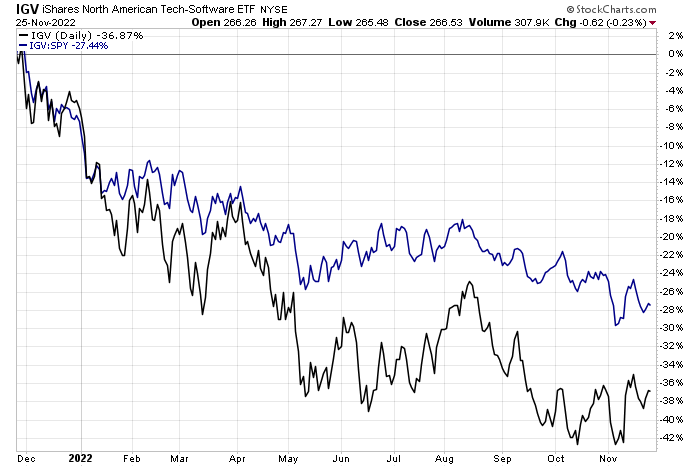
Are software stocks finding their footing? The iShares North American Tech-Software ETF (IGV) made new lows earlier this month, but relative to the S&P 500, a double bottom was notched, and a higher high was put in two weeks ago. There is still a lot of work for the bulls to do here, but one name rallied on big volume following its Q3 earnings beat and job layoff announcement.
Stockcharts.com
Stockcharts.com
According to Bank of America Global Research, RingCentral (NYSE:RNG) offers a cloud-based solution for business communications that replaces legacy and expensive on-premises communications systems. It is delivered as an application that follows the user regardless of device (office phone, smartphone, desktop, tablet). Features include team collaboration, voice, text, fax, audio conferencing, and integration with document and customer relationship management systems.
The California-based $3.4 billion market cap Software industry company within the Information Technology sector has negative trailing 12-month GAAP earnings and does not pay a dividend, according to The Wall Street Journal.
The embattled firm recently announced it would slash 10% of its workforce amid ongoing challenges in the tech sector. Interestingly, the stock traded higher following that news along with reporting a Q3 earnings beat, according to Seeking Alpha. That kind of price action, when it occurs on high volume, makes for an interesting long-side case. We will dive into the technicals later.
RNG provides cloud-based software solutions for the corporate world as a replacement for more cumbersome communications systems. The company generally benefits from the flexible work environment world, but a return to the office in a loosening job market could be a risk. Still, operating earnings are positive, and margins remain solid.
Downside risks include strategic partnerships taking longer to create cost savings and profits versus expectations. The management team must also carefully execute growth plans in what could be a particularly challenging 2023. Finally, its small and mid-sized business target market will feel macro pressures next year along with competitor offerings from Microsoft and Zoom Phone causing possible profitability issues.
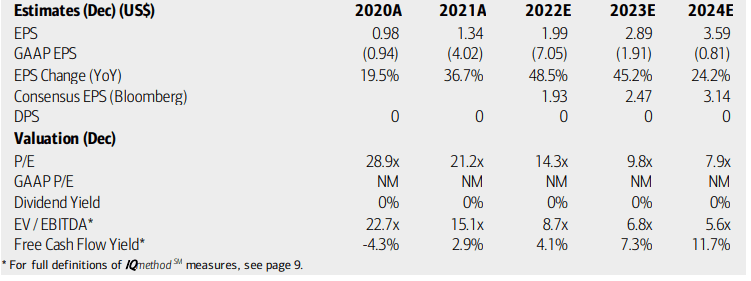
On valuation, analysts at BofA see earnings continuing to grow sharply in the years ahead. While the Bloomberg consensus EPS forecast is not quite as sanguine as BofA’s outlook, it still shows robust growth. GAAP per-share profits are seen as being sharply negative, though.
Using non-GAAP numbers, the P/E ratio turns very cheap given the growth forecast. Moreover, its EV/EBITDA on a look-ahead basis looks more attractive than it did a few quarters ago. What I also like is that RNG is free cash flow positive.
Overall, I like the GARP valuation now versus my bearish take during the summer. Seeking Alpha has an A rating on RingCentral’s forward PEG ratio – a good metric for this growth stock.
BofA Global Research
BofA Global Research
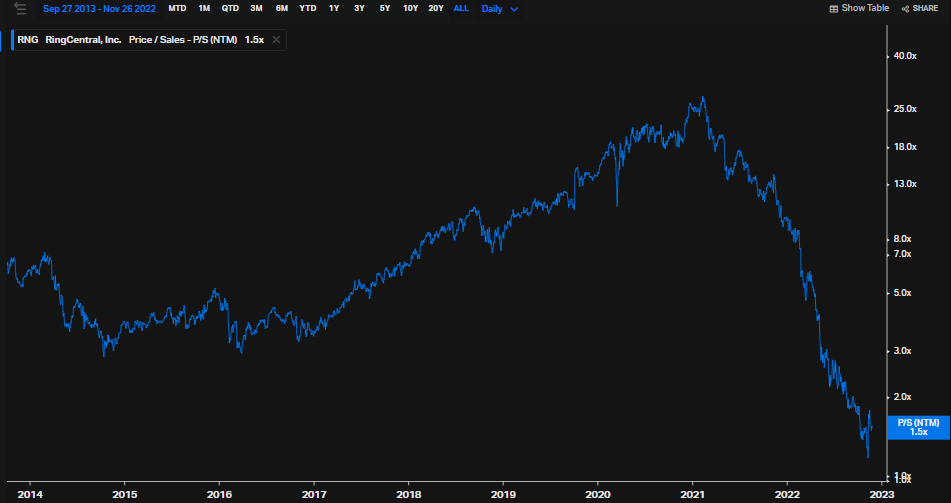
Another interesting look is RNG’s forward price-to-sales ratio, which is near 1.5, per Koyfin Charts. Seeking Alpha has it at 2.5. Either way, it is a far cry from the nosebleed-level 5-year average of 14.2.
Koyfin Charts
Koyfin Charts
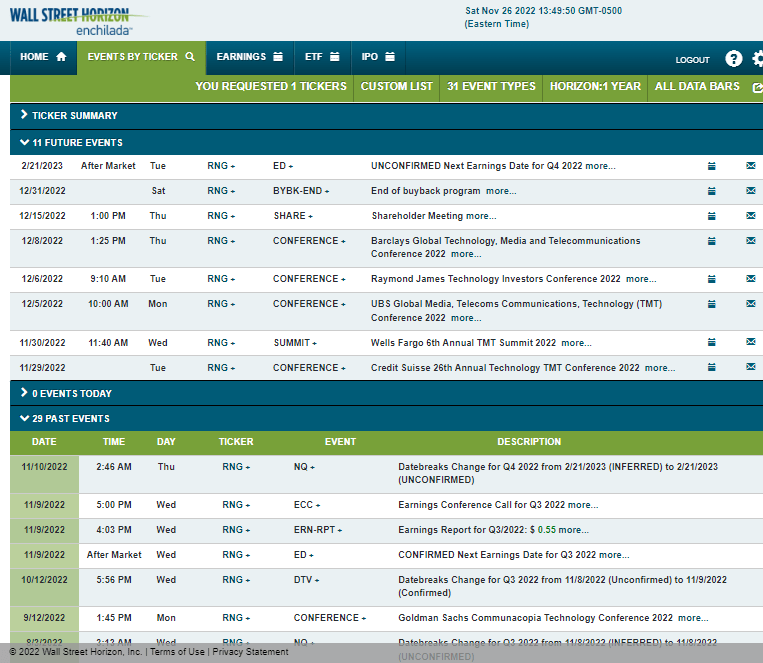
Looking ahead, there are several volatility catalysts in the coming weeks when looking at corporate event data from Wall Street Horizon. RNG’s management team presents at a pair of conferences this week and three more during the first full week of December. Then comes a shareholder meeting on December 14 before its share buyback program ends. Finally, RingCentral’s Q4 2022 earnings report is unconfirmed to take place on Tuesday, February 21 AMC. There are many volatility catalysts upcoming.
Wall Street Horizon
Wall Street Horizon
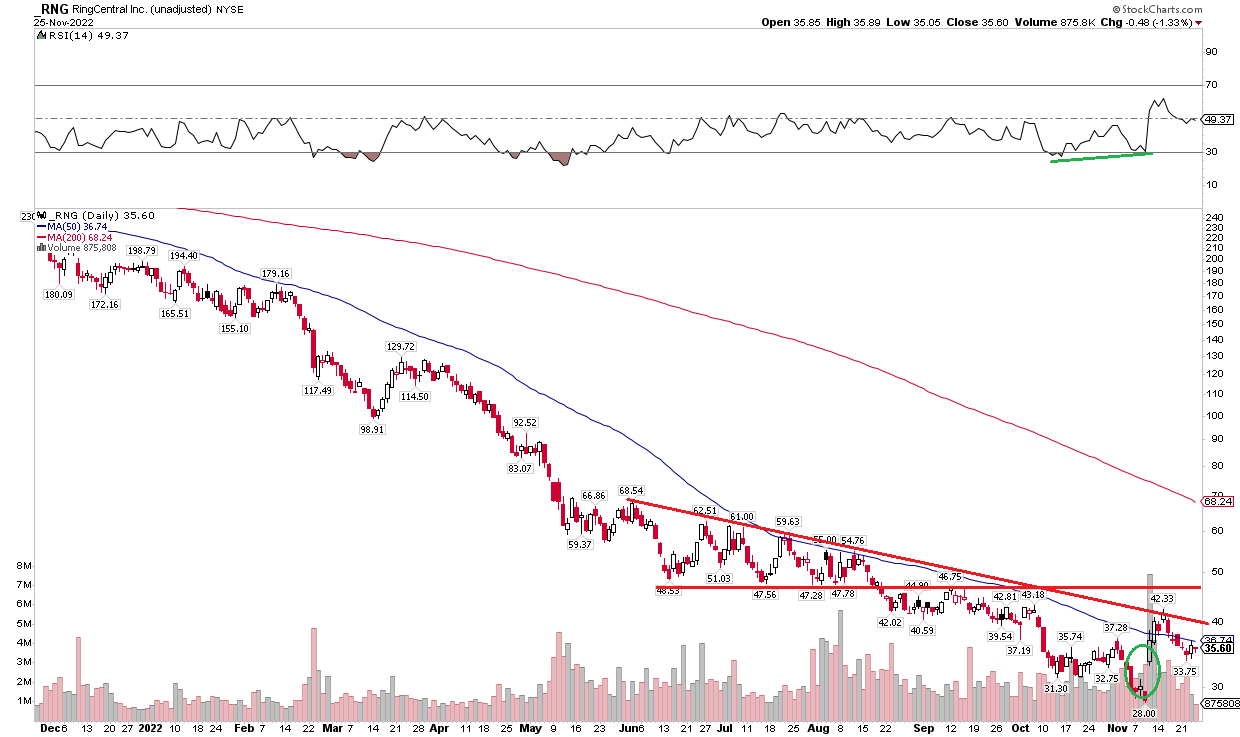
Back in August, I was bearish on RNG’s fundamentals and technicals. The situation has improved on both fronts. We have gone through how much better the valuation looks, but also notice some signs of life in the technical view below. Shares gapped higher post-earnings and after the job cut news in October. Now, the stock is going through what appears to be a bull flag pattern.
I see resistance in the $46 to $49 range, which would be an impressive gain from here. Also, take note of a broader downtrend resistance line that was first probed in October – that is still in play, but a bullish RSI divergence suggests it could be taken out before long as the sellers might be giving up their stranglehold on RingCentral. Overall, I think a tradeable low is in, but the bulls still have some work to do.
Stockcharts.com
Stockcharts.com
RNG has a much better valuation look now versus many months ago now that shares are down and better earnings are expected, at least according to BofA. I think the stock is at least a hold today. I will revisit later on to see if the stars are aligning for a buy call.
This article was written by
Disclosure: I/we have no stock, option or similar derivative position in any of the companies mentioned, and no plans to initiate any such positions within the next 72 hours. I wrote this article myself, and it expresses my own opinions. I am not receiving compensation for it (other than from Seeking Alpha). I have no business relationship with any company whose stock is mentioned in this article.

Deque Systems, Inc., a small business of Herndon, Virginia, protests the award of a contract to IronArch Technology, LLC, a small business of McLean, Virginia, under request for proposals (RFP) No. 36C10B22R0002, issued by the Department of Veterans Affairs (VA) for accessibility compliance software services. The protester challenges the agency’s evaluation of offerors’ proposals and alleges that the agency made an unreasonable best-value determination.
DOCUMENT FOR PUBLIC RELEASE
The decision issued on the date below was subject to a GAO Protective Order. This redacted version has been approved for public release.
Decision
Matter of: Deque Systems, Inc.
File: B‑420969; B‑420969.2
Date: November 21, 2022
Amy Laderberg O’Sullivan, Esq., James G. Peyster, Esq., and William B. O’Reilly, Esq., Crowell & Moring LLP, for the protester.
Alexander B. Ginsberg, Esq., and Michael J. Anstett, Esq., Fried, Frank, Harris, Shriver & Jacobson LLP, for IronArch Technology, LLC, the intervenor.
Mary G. Courtney, Esq., Annemarie Drazenovich, Esq., and Reza Behinia, Esq., Department of Veterans Affairs, for the agency.
David A. Edelstein, Esq., and Alexander O. Levine, Esq., Office of the General Counsel, GAO, participated in the preparation of the decision.
DIGEST
1. Protest of agency’s evaluation of awardee’s technical proposal is denied where protester has not demonstrated that the agency’s evaluation was unreasonable.
2. Protest of agency’s evaluation of offerors’ past performance is denied where solicitation did not require agency to compare the relevance of past performance examples and protester has not demonstrated that the evaluation was otherwise unreasonable.
3. Protest that agency did not evaluate transition risk is dismissed where solicitation did not require such an evaluation.
DECISION
Deque Systems, Inc., a small business of Herndon, Virginia, protests the award of a contract to IronArch Technology, LLC, a small business of McLean, Virginia, under request for proposals (RFP) No. 36C10B22R0002, issued by the Department of Veterans Affairs (VA) for accessibility compliance software services. The protester challenges the agency’s evaluation of offerors’ proposals and alleges that the agency made an unreasonable best‑value determination.
We deny the protest.
BACKGROUND
The VA’s Section 508 Program Office provides accessibility services, conformance testing solutions, and innovative strategies for implementing the goals and objectives of section 508 of the Rehabilitation Act of 1973, 29 U.S.C. § 794d (section 508). Contracting Officer’s Statement (COS) at 1. This includes assessing the accessibility compliance levels of various VA information and communications technology products, such as websites, Adobe PDF documents, and eLearning courses. Id.
On February 3, 2022, the agency issued the solicitation as a small business set‑aside, seeking automated and manual testing, reporting, help desk activities, and training in support of the Section 508 Program Office’s accessibility compliance assessments. Id. The agency intended to award a single fixed‑price contract for a 12‑month base period and two 12‑month option periods. Agency Report (AR), Tab 5, RFP[1] at 7, 25.
Deque previously provided similar services to the Section 508 Program Office. COS at 11. Deque’s prior contract ended on November 7, 2021. Id.
The RFP included a performance work statement (PWS) describing the tasks the contractor would be expected to perform. RFP at 20‑78. Of relevance to this protest, the PWS included section 5.3, “section 508 accessibility compliance scanning tool,” which required the contractor to provide a commercial off‑the‑shelf[2] section 508 compliance tool, and which set forth a list of 91 requirements that the contractor’s tool would have to meet. Id. at 30‑39.
The RFP provided that award would be made on a best‑value tradeoff basis, considering four evaluation factors: technical, price, past performance, and veterans involvement. RFP at 116. The technical factor was significantly more important than price, price was slightly more important than past performance, and past performance was slightly more important than veterans involvement. Id.
With respect to the technical factor, the solicitation instructed offerors to “propose a detailed approach that addresses . . . [t]he [o]fferor’s technical approach to provide a commercial off‑the‑shelf [s]ection 508 accessibility compliance tool in accordance with [PWS] section 5.3 upon contract award.” Id. at 120‑21. Offerors were also required to address their approaches to the PWS’s required auditing services and help desk support, as well as their management methodology. Id.
The RFP stated that the agency would evaluate the technical factor as follows:
a. Understanding of the Problem–The proposal will be evaluated to determine the extent to which it demonstrates a clear understanding of all features involved in solving the problems and meeting and/or exceeding the requirements presented in the solicitation and the extent to which uncertainties are identified and resolutions proposed.
b. Feasibility of Approach–The proposal will be evaluated to determine the extent to which the proposed approach is workable and the end results achievable. The proposal will be evaluated to determine the level of confidence provided the [g]overnment with respect to the [o]fferor’s methods and approach in successfully meeting and/or exceeding the requirements in a timely manner.
Id. at 116‑17.
With respect to the evaluation of past performance, the RFP stated that the agency would “assess the relative risks associated with an [o]fferor’s likelihood of success in fulfilling the solicitation’s requirements as indicated by that [o]fferor’s record of past performance.” Id. at 117. The RFP stated: “[t]he [g]overnment will conduct a performance risk assessment based on the quality, relevancy, and recency of the [o]fferor’s past performance, as well as that of its major subcontractor(s), as it relates to the probability of successful accomplishment of the required effort.” Id.
The agency received three timely proposals, including proposals from Deque and IronArch.[3] COS at 6. The agency convened a source selection evaluation board (SSEB), consisting of a technical evaluation team (TET) and separate evaluation teams for price, past performance, and veterans involvement. See AR, Tab 14, SSEB Briefing Slides at 1. The TET performed an initial evaluation of offerors’ technical proposals. COS at 6. After this initial evaluation, the agency engaged in discussions with Deque and IronArch via notices referred to as “items for negotiation” (IFNs), and the TET evaluated the offerors’ revised proposals. Id.
The final ratings[4] and prices for Deque’s and IronArch’s proposals were as follows:
Evaluation Factor
Deque
IronArch
Technical
Good
Outstanding
Significant Strengths
1
3
Strengths
5
3
Price
$12,702,500
$13,812,341
Past Performance
Low Risk
Low Risk
Veterans Involvement
Some Consideration
Full Credit
Id.; AR, Tab 15, Source Selection Decision Document (SSDD) at 4‑7.
On June 29, the source selection authority (SSA) met with the SSEB to discuss its findings. AR, Tab 15, SSDD at 3; AR, Tab 14, SSEB Briefing Slides. The SSA concurred with the SSEB’s ratings and determined that IronArch’s proposal represented the best value to the government. AR, Tab 15, SSDD at 3‑4. In making this determination, the SSA first separately reviewed the strengths and weaknesses in Deque’s and IronArch’s proposals, then performed and documented a detailed comparison of the relative merit of the two proposals. Id. at 4‑9.
In evaluating proposals under the technical factor, the SSA identified specific “additional functionality” of IronArch’s section 508 scanning tool as compared to Deque’s tool. Id. at 8. This included the ability of IronArch’s tool to test a broader number of platforms than Deque’s tool, which “allows [the agency] to provide wider coverage without having to seek outside resources.” Id. The SSA found that “[IronArch]’s proposed scanning tool presented substantial additional benefits to the [g]overnment in comparison to [Deque]’s scanning tool and approach and warrants payment of a price premium.” Id. at 8.
The SSA found that Deque’s approach to the help desk requirement “presented some additional benefits” as compared to IronArch’s approach, because Deque proposed a highly capable team and a service-level achievement tracking system. Id.
With respect to management approach‑-also part of the technical factor‑-the SSA found that Deque’s proposal contained only “generalities,” whereas IronArch’s proposal “received a significant strength for its very detailed approach.” Id. at 9. The SSA considered this “a key difference in the proposals,” and determined that IronArch’s “approach to project management presented additional benefits to the [g]overnment in comparison to [Deque]’s project management approach and warrants payment of a price premium.” Id.
Ultimately, the SSA determined that IronArch presented a superior proposal to Deque on the technical factor as a whole. Id. The SSA wrote: “Although [Deque] proposed a help desk approach with some additional benefits, the combined benefits from [IronArch’s] proposed tool and its proposed project management approach is determined to provide more value and benefit to the Government.” Id.
With respect to the past performance evaluation factor, the SSA considered Deque and IronArch to be essentially equal. He wrote:
[Deque] and [IronArch] each received a rating of [l]ow [r]isk in the [p]ast [p]erformance [f]actor; however, [Deque] had three recent and relevant past performance instances whereas [IronArch] had a total of four recent and relevant instances. Furthermore, [Deque] received [DELETED] assessments indicating its performance was exceptional and [DELETED] assessments indicating its performance was satisfactory; whereas [IronArch] received [DELETED] assessments indicating its performance was exceptional and [DELETED] assessments indicating its performance satisfactory. While [Deque] has more [e]xceptional questionnaire responses, there is not a discernible difference, therefore, I considered [Deque and IronArch]’s [p]ast [p]erformance essentially equal in this factor.
Id. The SSA also noted that IronArch received “full credit” for the veterans involvement factor, whereas Deque received only “some consideration.” Id.
Considering price and the three non‑price evaluation factors, the SSA determined that IronArch’s technically superior proposal merited payment of IronArch’s price premium of 8.74%. Id. at 9‑10. The SSA stated:
[Deque and IronArch] are essentially equal in the past performance factor and [IronArch] is higher rated in the [v]eterans [i]nvolvement [f]actor. [IronArch] proposed a superior technical proposal and technical is the most significant factor. It is my opinion that [IronArch]’s superior technical proposal as discussed above justifies the premium the [g]overnment will have to pay to receive the superior technical benefits associated with [IronArch]’s proposal when compared to that of [Deque].
Id.
On July 21, the agency awarded the contract to IronArch. COS at 7. Deque requested and received a debriefing. Id. at 8; AR, Tab 17, Deque Debriefing. This protest followed.
DISCUSSION
Deque alleges that the agency unreasonably evaluated offerors’ proposals under the technical and past performance factors, did not evaluate the risk inherent in a transition from Deque’s scanning tool to IronArch’s scanning tool, and made a flawed tradeoff decision.[5] We have reviewed all of the protester’s allegations, and, as set forth below, find no basis to sustain the protest.
Technical Evaluation of IronArch’s Proposal
Deque contends that IronArch’s proposal did not meet several requirements of the solicitation, such that the agency should have found IronArch’s proposal to be unacceptable or, at a minimum, evaluated it less favorably under the technical factor.
The evaluation of technical proposals is generally a matter within the agency’s discretion, which our Office will not disturb unless it is shown to be unreasonable or inconsistent with the solicitation’s evaluation criteria. American Systems Corp., B‑413952.3, B‑413952.4, June 23, 2017, 2017 CPD ¶ 204 at 6‑7; NCI Information Systems, Inc., B‑412680, B‑412680.2, May 5, 2016, 2016 CPD ¶ 125 at 7. This includes determinations regarding the acceptability of an offeror’s proposed item or service; the procuring agency has primary responsibility for such determinations and we will not disturb them unless they are shown to be unreasonable. Knowlogy Corp., B‑416208.3, Dec. 20, 2018, 2019 CPD ¶ 47 at 6; TransAtlantic Lines, LLC, B‑411242, B‑411242.2, June 23, 2015, 2015 CPD ¶ 204 at 5.
Deque contends that IronArch’s proposal failed to meet the solicitation requirement that the section 508 compliance tool be available “24 hours a day, 7 days a week to all users, [g]overnment employees, and contractors.” RFP at 33. In this respect, IronArch’s proposal stated that its tool would be “available 24 by 7 except for planned downtime. [Service‑level agreement] shall include update authorization before any contractor updates take place and include coordinated support for VA patches.” AR, Tab 8, IronArch Technical Proposal at 6. Deque contends that IronArch’s stated intent to schedule downtime for updates and patches means that IronArch will not meet the solicitation’s availability requirements.
The agency counters that it is reasonable to assume that occasional downtime for maintenance purposes is allowable if coordinated with the agency. COS at 10. The contracting officer states that this is an industry standard practice, and that it is common to allow for security patches and routine maintenance activities that may require a tool to be offline during an authorized period of time. Id. The contracting officer also notes that, during performance of its prior contract, Deque received approved downtime to perform similar activities. Id. Deque does not challenge this assertion. Moreover, Deque’s proposal contained language allowing for “patches and updates” to its tool with “approv[al] in writing by the VA [program manager] prior to deployment.” AR, Tab 7, Deque Technical Proposal at 15. Under these circumstances, we find the agency’s interpretation of the solicitation, and its resultant determination that IronArch’s proposal met the PWS’s availability requirements, to be reasonable.[6]
Deque also challenges the agency’s technical evaluation based on the statement in IronArch’s proposal that its tool would need to be configured during deployment to comply with certain PWS requirements. Deque contends that this demonstrates noncompliance with the solicitation’s requirement for a section 508 tool that meets each of the PWS requirements “without any customizations.” RFP at 31.
Here, the contracting officer explains that “configuration” is not the same as “customization.” Supp. Memorandum of Law (MOL) at 11‑13. In this respect, the RFP specifically allowed for offerors’ tools to be “configurable out of the box” at the time of award, which the RFP defined as “accessible without further development.” RFP at 31. The agency explains that this PWS language was intended to clarify the agency’s requirement for a commercial off‑the‑shelf product rather than a customizable commercial item. Supp. MOL at 12. But, the RFP recognized that a commercial off‑the‑shelf product would require post‑award configuration and integration to work with VA’s systems. The PWS therefore required the contractor to develop a plan of approach, after award, that “identif[ied] methods for installation and configuration of the [t]ool as well as integration of [t]ools into business processes of the [g]overnment.” RFP at 29. The RFP allowed the contractor to obtain VA approval for its tool after award, and required the contractor to “conduct installation, configuration, and process integration of the [t]ool and any other required software” after receipt of these post‑award approvals. Id. at 29‑30.
Based on the text of the RFP, we agree with the agency that the RFP did not require a tool that met each and every one of the PWS requirements without configuration at the time of award. While Deque has pointed to statements in IronArch’s proposal that use words such as “design,” Supp. Comments at 9, we view these statements as consistent with the RFP’s allowances for‑-and explicit anticipation of‑-post‑award configuration and integration. Deque has not demonstrated that the agency unreasonably evaluated whether IronArch’s proposed tool violated the PWS’s prohibition on customization after award.
In addition to the downtime and customization issues, Deque identifies several technical requirements of section 5.3 of the PWS that IronArch’s proposal did not explicitly commit to meeting. These requirements include reporting metrics to two decimal places, restoring compromised data from backups within two days, and indicating whether specific Adobe PDF files were included in a scan. Deque contends that the agency considered all of the section 5.3 requirements to be material, and that the agency should have viewed IronArch’s failure to mention each of the requirements negatively. In support of this argument, Deque notes that its own proposal recited each of the 91 requirements of PWS section 5.3, and stated that Deque met (or exceeded) each requirement. See AR, Tab 7, Deque Technical Proposal at 13‑22. Deque also points to comments that the agency made to Deque during discussions, where the agency indicated concerns with Deque’s approach to certain section 5.3 requirements. See Protest, exh. 6, Agency IFN to Deque.
The agency responds that the RFP did not require offerors to list each of the 91 PWS section 5.3 requirements and confirm an intent to comply; rather, the RFP required offerors to describe their “approach to provide” a tool that meets these requirements. RFP at 120‑21. We agree. Where a proposal does not affirmatively demonstrate compliance with each and every requirement of the solicitation, but also does not take exception to any of those requirements, an agency may reasonably determine that a proposal demonstrates an adequate understanding of, and approach to, the agency’s needs. See Novartis Pharmaceuticals Corp., B‑285038.4, B‑285038.5, Feb. 1, 2002, 2002 CPD ¶ 33 at 7‑9; see also Caddell‑Nova, JV, B‑420892, B‑420892.2, Oct. 20, 2022, 2022 CPD ¶ 263 at 6‑7 n.4 (where “solicitation required offerors to explain their ‘approach’ [to solicitation requirements] we do not think it required offerors to affirmatively certify an intent to comply with each and every one of the . . . requirements, particularly where nothing on the face of the offeror’s proposal suggests an intent not to comply”).
Deque does not contend that anything in IronArch’s proposal indicated that IronArch took exception to or would not comply with the PWS section 5.3 requirements that IronArch’s proposal did not address; the protester merely alleges that IronArch’s proposal was “completely silent regarding” these requirements.[7] Comments & Supp. Protest at 7. Accordingly, Deque has not demonstrated that the agency’s evaluation of IronArch’s approach to providing a section 508 tool was unreasonable.
In sum, we have considered all of the protester’s challenges to the agency’s evaluation of IronArch’s technical proposal and see no basis to conclude that the evaluation was unreasonable or inconsistent with the RFP’s stated evaluation criteria. We therefore deny this aspect of the protest. American Systems, supra at 6‑7.
Adjectival Ratings
Deque also challenges the agency’s technical evaluation on the basis that the agency acted unreasonably when it in assigned Deque a rating of “good” rather than “outstanding” under the technical factor.[8] Protest at 16‑17. The protester contends that the agency has not explained why Deque‑-assessed five strengths and one significant strength‑-was rated “good” while IronArch‑-with three strengths and three significant strengths‑-was rated “outstanding.” Comments & Supp. Protest at 12.
We need not decide the merits of Deque’s challenge to the assigned adjectival ratings because the protester has failed to demonstrate that it was competitively prejudiced by the errors alleged. ICI Services Corp., B‑418255.5, B‑418255.6, Oct. 13, 2021, 2021 CPD ¶ 342 at 13. In this regard, the record reflects that the SSA did not rely on the offerors’ adjectival ratings when he found IronArch to be superior to Deque under the technical factor. Rather, the SSA found IronArch to be technically superior to Deque on this factor because of qualitative differences between the offerors’ proposals. Specifically, the SSA explained that IronArch’s advantages with respect to its proposed compliance tool and its project management approach outweighed Deque’s advantage with respect to its help desk approach. AR, Tab 15, SSDD at 9. This qualitative analysis is in accord with our consistently stated guidance that evaluation ratings, be they adjectival, numerical, or color, are but a guide to, and not a substitute for, intelligent decision‑making. See, e.g., NCI Info. Sys., Inc., B‑412680, B‑412680.2, May 5, 2016, 2016 CPD ¶ 125 at 9; Shumaker Trucking and Excavating Contractors, Inc., B‑290732, Sept. 25, 2002, 2002 CPD ¶ 169 at 8.
In sum, even assuming Deque had been assigned a rating of outstanding under the technical factor (or, conversely, had IronArch been assigned a rating of good), it would have had no impact on the agency’s best‑value determination. ICI Servs., supra at 13‑14. Competitive prejudice is an essential element of a viable protest, and we will sustain a protest only where the protester demonstrates that, but for the agency’s improper actions, it would have had a substantial chance of receiving the award. Technology & Telecomms. Consultants, Inc., B‑413301, B‑413301.2, Sept. 28, 2016, 2016 CPD ¶ 276 at 14. Consequently, we deny this allegation.
Past Performance Evaluation
Deque also protests the agency’s evaluation of offerors’ past performance.
An agency’s evaluation of past performance, which includes its consideration of the relevance, scope, and significance of an offeror’s performance history, is a matter of agency discretion which we will not disturb unless the agency’s assessments are unreasonable, inconsistent with the evaluation criteria, or undocumented. Protection Strategies, Inc., B‑416635, Nov. 1, 2018, 2019 CPD ¶ 33 at 9.
Deque contends that the agency failed to meaningfully consider and weigh the comparative relevancy of Deque’s past performance references against IronArch’s references. Protest at 18.
The agency counters that the RFP did not require it to compare the degree of relevance of each offerors’ past performance examples. We agree. Where, as here, the solicitation provides for an assessment of performance risk on the basis of past performance information, an agency is not required to further differentiate between past performance ratings based on a more refined assessment of the relative relevance of the offeror’s prior contracts, unless specifically required by the RFP. See Pro‑Sphere Tek, Inc., B‑410898.11, July 1, 2016, 2016 CPD ¶ 201 at 7.[9]
In Pro‑Sphere Tek, our Office found that the agency reasonably assigned performance risk ratings on the basis of its review of the relevance, recency, and quality of past performance references, and that the RFP “simply did not require the agency to conduct the type of comparative relevance analysis desired by the protester.” Id. at 6‑7.
The protester argues that Pro‑Sphere Tek is inapposite because the RFP in that protest provided an explicit definition of relevance, whereas the RFP here did not. Comments & Supp. Protest at 16. We do not find this argument accurate or persuasive. First, the RFP here defines specific “[a]reas of relevance” to which offerors’ past performance examples were required to relate. RFP at 122. Further, our Office’s decision in Pro‑Sphere Tek did not turn on the solicitation’s explicit definitions of relevance, but rather on the fact that the solicitation “did not advise [offerors] that the agency would consider various degrees of relevance on a comparative basis or that ‘more relevant’ past performance would be accorded more weight or evaluated more favorably.” Pro‑Sphere Tek, supra at 6. The same is true of the RFP here, and we similarly conclude that the agency was not required to comparatively assess the relevance of offerors’ past performance references.
The record here demonstrates that‑-with respect to both IronArch and Deque‑-the past performance evaluation team reviewed each past performance reference in detail, including the areas of relevance and periods of performance, to determine whether the reference was recent and relevant. See AR, Tab 11, Deque Past Performance Evaluation; AR, Tab 12, IronArch Past Performance Evaluation. The record further reflects that the SSA also reviewed the relevance, recency, and quality of both offeror’s past performance examples, ultimately concluding that there was “not a discernible difference” between the offerors. Deque has not established that this conclusion was unreasonable. Protection Strategies, supra at 9.
Evaluation of Transition Risk
In addition, Deque argues that the agency failed to evaluate the risk inherent in deploying IronArch’s proposed compliance scanning tool as opposed to continuing to use “Deque’s already‑deployed tool.” Protest at 15. Deque argues that the agency was required to evaluate the risk inherent in the installation and deployment of each offeror’s tool. We disagree.
We note that the RFP did not obligate the agency to evaluate the risks associated with the transition to a new contractor’s tool. In this respect, the RFP’s description of the technical evaluation factor does not mention installation or deployment, nor does it require an analysis of transition risk. RFP at 116‑17.
We also agree with the agency that the solicitation viewed installation and deployment as a contract administration matter, not an evaluation factor for award. See COS at 11. Specifically, while the RFP required technical proposals to address offerors’ approaches to complying with PWS section 5.3 (the section containing technical requirements of the section 508 compliance scanning tool), proposals were not required to address offerors’ approaches to PWS section 5.2 (the section describing planning, installation, and implementation of the compliance tool). RFP at 121; see RFP at 29‑30 (PWS section 5.2). In fact, PWS section 5.2 identified a “[p]lan of [a]pproach for installation and integration of the [t]ool or [t]ool [s]uite” as a contract deliverable, due from the contractor approximately one month after award.[10]
Agencies are required to evaluate proposals based exclusively on the evaluation factors stated in the solicitation. Seaward Servs., Inc., B‑420580, B‑420580.2, June 13, 2022, 2022 CPD ¶ 145 at 8. To the extent Deque argues that the agency should have evaluated the risk of IronArch’s transition plan, this fails to state a valid basis for protest since the RFP did not require such information to be included with proposals, nor did it require the agency to conduct such an evaluation. See Nexsys Electronics Inc. d/b/a Medweb, B‑419616.4, Jan. 7, 2022, 2022 CPD ¶ 26 at 4; see also Grove Resource Sols., B‑414746.2, Apr. 4, 2018, 2018 CPD ¶ 138 at 7 (denying protest that agency failed to evaluate risk of awardee’s technical approach, where the “solicitation . . . did not anticipate the assessment of each offeror’s technical approach”). To the extent Deque argues that the RFP should have contained a transition risk evaluation factor, this is an untimely challenge to the terms of the solicitation. See 4 C.F.R. § 21.2(a)(1).
Accordingly, we dismiss this protest allegation. See Nexsys Electronics, supra at 4.
Tradeoff Decision
Last, Deque challenges the agency’s best‑value tradeoff decision on the basis that it was “tainted by the flawed underlying evaluations upon which [the SSA] relied.” Comments & Supp. Protest at 24. This allegation is derivative of Deque’s challenges to the agency’s evaluation, all of which we have either dismissed or denied. Thus, we dismiss this allegation because derivative allegations do not establish independent bases of protest. Advanced Alliant Solutions Team, LLC, B‑417334, Apr. 10, 2019, 2019 CPD ¶ 144 at 6.
The protest is denied.
Edda Emmanuelli Perez
General Counsel
[1] The RFP was amended once. All citations to the RFP are to the conformed amended version, located at Tab 5 of the agency report.
[2] Commercial off-the-shelf items are those commercial items of supply that are sold in substantial quantities in the commercial marketplace and are offered to the government without modification in the same form in which they are sold in the commercial marketplace. Federal Acquisition Regulation 2.101.
[3] The third offeror was determined to be ineligible for award; thus, the agency conducted a further evaluation of the proposals of Deque and IronArch only. COS at 6.
[4] For the technical factor, the possible ratings were outstanding, good, acceptable, susceptible to being made acceptable, and unacceptable. AR, Tab 6, Evaluation Plan at 19. Past performance ratings were high risk, moderate risk, low risk, and unknown risk. Id. at 20. Veterans involvement ratings were full credit, partial credit, some consideration, and no credit. Id. at 20‑21.
[5] Deque withdrew a protest allegation relating to the agency’s evaluation of IronArch’s intent to comply with the RFPs “limitation on subcontracting” provision. Comments & Supp. Protest at 1 n.2.
[6] Deque also argues that if the agency believed planned downtime was acceptable, it was required to state this in the RFP rather than relax the requirement during evaluation. However, an agency may waive or relax a material solicitation requirement when the award will meet the agency’s actual needs without competitive prejudice to the other offerors. Engility Servs., LLC, B‑416588.3, B‑416588.4, Mar. 20, 2020, 2020 CPD ¶ 110 at 8. In this context, prejudice exists only where the protester would have altered its proposal to its competitive advantage had it been given the opportunity to respond to the altered requirements. Id. Deque has not stated what it would have done differently if the agency had explicitly permitted planned downtime; therefore it has not shown that it was prejudiced by any alleged relaxation of the availability requirement. See id.
[7] This is in contrast to Deque’s proposal. The contemporaneous record demonstrates that, where the agency questioned Deque’s compliance with the PWS section 5.3 requirements, it did so because of a concern that Deque’s proposal demonstrated an intent not to comply. For example, the PWS required that reports of defects “be sortable by type from most common to least common or vice versa,” and Deque originally proposed only “heatmap views where the most commonly occurring defects are clearly called out.” Protest, exh. 6, IFN to Deque at 1. The agency explained that it was “unclear whether [Deque’s proposed] heatmap is . . . sortable” and asked Deque to address this concern. Id.
[8] The protester does not challenge any specific technical evaluation finding that the agency made regarding Deque’s proposal.
[9] Notably, the relevant language of the RFP’s past performance evaluation factor here is identical to that discussed in Pro‑Sphere Tek. Compare RFP at 117‑18 with Pro‑Sphere Tek, supra at 3, 6.
[10] The plan of approach was due 14 calendar days after the post‑award kickoff meeting. RFP at 29. The kickoff meeting was to be held within 15 business days after award. Id. at 28.
Related
Related
Related
Related
Related
Related
Related
Stay informed as we add new reports & testimonies.