


New to The Street / Newsmax TV Announces its Line-up for Episode #412, Nine Interviews, Airing Sunday, December 4, 2022, 10-11 AM ET – GlobeNewswire

December 02, 2022 09:30 ET | Source: FMW Media Works Corp FMW Media Works Corp
New York City, New York, UNITED STATES
NEW YORK, Dec. 02, 2022 (GLOBE NEWSWIRE) — New to The Street / Newsmax TV announces the broadcasting line-up of its nationally syndicated 1- hour TV show this Sunday, December 4, 2022, airing time 10-11 AM ET.
New to The Street’s 412th TV episode line-up, features the following nine (9) corporate interviews:
1). Quantum Computing- Quantum Computing, Inc.’s (NASDAQ: QUBT) ($QUBT) interviews with Robert Liscouski, President, CEO, and Chairman, and Hunter Gaylor, Industry Expert/Advisor
2). American Made Product – American Rebel, Inc.’s (NASDAQ: AREB) ($AREB) interview with Andy Ross, Chairman, and CEO.
3). Ecological Solutions- The Sustainable Green Team (OTC: SGTM) ($SGTM) and VRM BioLogik Group (VRM) presentation by Ken Bellamy, Founder VRM BioLogik.
4). Cryptocurrency – Volt Inu’s (CRYPTO: VOLT) ($VOLT) interviews with Community Leaders, Pablo Cro, Ozzy, and Power Wright.
5). Hemp Cigarettes – Hempacco Co., Inc.’s (NASDAQ: HPCO) ($HPCO) interviews with Sandro Piancone, Co-Founder/CEO, and Jorge Olson, Co-Founder/ Chief Marketing Officer.
6). Cryptocurrency- Apotheosis Investments Global, Inc.’s ($OSIS) (“OSIS”) interviews with Co-founders Chris Tabaro and Jalal Ibrahimi.
7). Email/Messenger Privacy Solutions – Sekur Private Data, Ltd.’s (OTCQX: SWISF) (CSE: SKUR) (FRA: GDT0) interview with Alain Ghiai, CEO.
8). Super Food- GMSacha Inchi’s (OTC: QEDN) ($QEDN) interview with Kate Bahnsen, CEO.
9). “Sekur Privacy & Sekur Security Segment” interview with internet privacy expert Mr. Alain Ghiai, CEO, Sekur Private Data Ltd. (OTCQX: SWISF) (CSE: SKUR) (FRA: GDT0) (Sekur®).
From the Nasdaq MarketSite studio, New to The Street’s Co- Host Jane King and Hunter Gaylor have a conversation about the significance of Quantum Computing, Inc. (NASDAQ: QUBT) ($QUBT) (“QCI”). Hunter, who is an industry expert/advisor to QCI, and podcast host of “Hunting Opportunities to Consider,” believes that Quantum Computing, Inc.’s software and hardware solutions can democratize the computer industry, which can solve everyday problems faster and more efficiently. Robert ‘Bob’ Liscouski , President, CEO, and Chairman of Quantum Computing, Inc., appears on set with Jane King, explaining further about the Company. As a leader in quantum computer software products, QCI’s ecosystem offers end-users easy access to quantum solutions for mainstream uses. Robert explains that current and classical technologies are in every aspect of our lives. QCI has a full stack of quantum software/hardware solutions to bring quantum computations to a new evolution beyond classical technology. Bob explains the significance of the Company’s June 2022 acquisition of QPhoton, Inc., a quantum photonics innovation company that has developed a quantum photonic system (QPS). AI, new drugs, energy, and many other industries can quickly deploy a QCI software solution ready-to-run. Quantum’s flagship product Qatalyst™ is a first of its kind for the marketplace, which does not involve substantial operational and human resource expenses to deploy. The on-screen QR code is available during the show; download or visit Quantum Computing, Inc. – https://www.quantumcomputinginc.com/.
New to The Street’s TV Host Jane King from the Nasdaq MarketSite studio welcomes Andy Ross, Chairman/CEO of America Rebel, Inc. (NASDAQ: AREB) ($AREB). Inspired by the song “American Rebel,” the Company started in 2015, making American-made safes and concealed carry weapons (CCW) apparel and backpacks. Andy passionately explains the Company’s mission, branded as “America’s Patriotic Brand.” The Company owns eight retail locations selling its products. Additionally, consumers can find products at 400 other retailers and sporting goods stores. The full stand-alone safes are the Company’s flagship product, and along with its CCW apparel/backpacks and weapon lockers, the Company continues to grow. The Company will soon release its e-Bike into the market. Andy talks about his music career. His inspiration when he hosted an Outdoor Channel show evolved into his current position with American Rebel, Inc. The Company will feature its products at the upcoming SHOT trade show in Las Vegas in January 2023. As a patriotic Company – “Made in America,” Andy explains that demand is growing for American-made products, and he is excited about the Company’s future. With a strong social media presence, and websites, www.americanrebel.com and www.andyross.com, viewers can learn more about the Company’s mission and products. The on-screen QR code is available during the show; download or visit America Rebel, Inc. – http://www.americanrebel.com/.
The Sustainable Green Team (OTC: SGTM) ($SGTM) and VRM BioLogik Group (VRM), an Australian Company, are in collaboration to bring VRM’s HumiSoil product into the US Market. Airing on New to The Street, Ken Bellamy, VRM’s founder, explains the hydrosynthesis science which manufactures water. Ken explains how sunlight absorbs solar energy into panels that convert light into usable energy. Plants capture sunlight, too, and convert the sun’s energy using carbon dioxide to create carbohydrates and water. After a couple of decades, Ken was able to figure out this relationship between sunlight and plants. The hydrosynthesis process is a hydrogen oxidization process that brings nutrients and water back into the soil. The more water and nutrients in the soil, plants, and crops yield high amounts of food. VRM’s hydrosynthesis can occur anywhere on the planet, day and night. Taking organic byproducts and stimulating the naturally occurring biological processes creates water. Soil has amazing water storage capability, and VRM developed a successful technique to increase crop yields and soil hydrations. Taking green wastes and food byproducts and converting them using VRM’s hydrosynthesis technology in “Growing Water” can create sustainable solutions for worldwide food production. The documentary gives views on the ecological visions of both entities and shows the practical solutions now available. Websites: VRM BioLogik Group – https://www.vrm.science/ and The Sustainable Green Team – https://www.thesustainablegreenteam.com/.
Volt Inu’s (CRYPTO: VOLT) ($VOLT) Community Leaders, Pablo Cro, Ozzy, and Power Wright join New to The Street’s TV Host Jane King from the Nasdaq MarketSite studio to discuss the Company’s DeFi products. Since its inception in December 2021, Volt Inu is a one-stop shop for DeFi products, with its generated profits going back to burning its native token, $VOLT. The burn rate is deflationary to its token supply, a Company objective. Community Leader, Pablo Cro, informs viewers that Volt has a uniqueness that other crypto companies don’t have, their ability to succeed during bear markets. The Company was formed during a bear market, giving attention to many details perhaps not accomplished during a boom cycle. Ozzy, also a Community Leader, talks about the relationships established within Volt’s community ecosystem and how they continue to grow and mature. The success of some of the largest crypto entities, including Bitcoin and Etherium, all have a common attribute, their communities. Community Leader, Power Wright, explains the importance of communicating effectively with Volt’s community, giving update details and transparency on products and operations. Volt is considered a meme coin with real-life utilities with everyday purchases using the $VOLT token. All three community leaders work diligently to enhance the ecosystem, ensuring community awareness and focusing on growing Volt’s brand name recognition. The on-screen QR code is available during the show; download or visit Volt Inu – https://voltinu.in/.
New to The Street’s TV Host Jane King interviews Hempacco Co., Inc.’s (NASDAQ: HPCO) ($HPCO) Sandro Piancone, Co-Founder/CEO, and Jorge Olson, Co-Founder/Chief Marketing Officer. From the Nasdaq MarketSite studio, viewers learn about the Company’s hemp Disrupting Tobacco™ products. Jorge explains the Company’s goal in Disrupting Tobacco™ products with hemp cigarettes. The tobacco industry is a $1T global industry, while the hemp and cannabis industry is only at $25B. The growing market share for hemp-based smokable products provides opportunities. Jorge explains the different types of cannabinoid infusions that the Company uses to create other effects, from sleep to energy. Sandro discusses its successful celebrity joint venture partnerships with Cheech & Chong and Rick Ross. The Company makes smokable hemp products and wrapping, rolling papers that cater to celebrities’ fans. Management continues to sign-up master distribution agreements, looks for new technological advancements, and will look at accretive acquisitions to grow its hemp-based product footprint. Hempacco owns its production facility, has vending machine locations, and has private-label products. The growth in their herb and hemp-based alternatives to nicotine cigarettes by manufacturing and marketing herb, spice, and cannabinoid smokables and rolling papers continues. It took the Company two years to create its unique smokable hemp product line. Now, with patents and proprietary intellectual property (IP), the Company is positioned to gain more market share out of the $1T tobacco marketplace. The 2018 US Farm Bill allows hemp products to be sold legally in all 50 states and without special taxes. Displayed on countertops, merchants sell CBD-infused cigarettes. The on-screen QR code is available during the show; download or visit Hempacco Co., Inc. – https://hempaccoinc.com/ & https://realstuffsmokables.com/. The segment is an updated version that originally aired on November 6, 2022.
New to The Street airs from the Nasdaq MarketSite studio TV Host Jane King’s interview with Chris Tabaro, President / Co-Founder, and Jalal Ibrahimi, Vice-President/ Co-Founder of Apotheosis Investments Global, Inc. ($OSIS) (“OSIS”). OSIS offers an ecosystem for end-users who like to tokenize their assets, goods, and services. The Company focuses on getting everyday people involved with Web 3.0, using simple applications to create NFTs, tokens, and “Smart Contracts.” Jalal has a finance and accounting background and talks to viewers about his responsibilities to the Company’s business operations. Chris talks about his vision; seeing a world that lacks trust in financial transactions, he saw an opportunity with blockchain technology to secure and verify assets and transactions. Chris shows viewers his 1,500-page, 50-month road map for the Company’s future. Together Chris and Jalal started the OSIS platform with a 5-year plan to be one of the largest tokenized ecosystems where industries, governments, businesses, and individuals can utilize “Smart Contracts” for all transactions. The on-screen QR code is available during the show; download or visit Apotheosis Investments Global, Inc. ($OSIS) (“OSIS”) – https://osisplatform.com/.
Mr. Alain Ghiai, CEO of Sekur Private Data, Ltd. (OTCQX: SWISF) (CSE: SKUR) (FRA: GDT0), joins New to The Street’s TV Host Jane King from the Nasdaq MarketSite studio. Sekur Private Data, Ltd. offers Sekur, a Swiss secure email and messenger communication application available on any mobile device, tablet, and desktop. Subscribers get cybersecurity protections not available with open-source programs for reasonable pricing, a complete and affordable cybersecurity solution for individuals and businesses. Many banks in the US violated banking privacy laws while using Big Tech open platforms to communicate banking information. Some banks used WhatsApp to message clients and for internal uses, which is a privacy violation, resulting in over $2B in fines. The solution is Sekur Private Data’s Sekur products which offer encrypted secure communications and data management. SekurMessenger allows for private and secure texting and provides the receiver of text messages from the subscriber with the same encrypted features. Sekur’s “Chat-by-Invite” app, available in 61 countries, allows texting to occur in a closed-loop system hosted and owned by Sekur in Switzerland. The platform offers archiving, a requirement for many regulated industries, including banks and other financial institutions. Alain told viewers that growth continues in Central America and other South American countries and expects more small-medium business (SMB) enterprises and governments to sign up for Sekur. In the US market, B2B partnerships are growing, too. Sekur’s “Chat-by-Invite” app is available on iOS and Android; go to Sekur.com to download it. Sekur Private Data, Ltd. operates its internet platforms and security businesses under the country of Switzerland’s very tough privacy laws. The Company never asks for a phone number to subscribe. Sekur is on track for an exciting 2023. The on-screen QR code is available during the show to download more info or visit Sekur Private Data, Ltd. – https://www.sekurprivatedata.com/ and http://www.Sekur.com. The segment is an updated version that originally aired on November 6, 2022.
From the New to The Street’s Nasdaq Marketsite studio, Kate Bahnsen, Chief Executive Officer of GMSacha Inchi (OTC: QEDN) ($QEDN), joins TV Host Jane King to talk about the Company. Established in 2013 in Columbia, the Company creates nutritional products. It looks for sustainable farming initiatives which could help farmers make a better wage and plant crops that are not considered illegal. Known as a super food, the Sacha Inchi plant is grown for its seeds. The plant is high in nine essential amino acids, proteins, and Omega 3,6 and 9. The harvesting is about every 15 days giving farmers a sustainable crop with profits and growing consumer markets. The Company is working on a beverage with only 30 grams of calories and full of nutritional benefits, the only Sacha Inchi seed beverage worldwide. Because it is a seed and not a nut, there are no known allergies from consumption. The Company makes flour out of the seed, which adds nutrition to other food preparations. Also, the Company has products for athletes, pets, and snack food industries. Kate talks about a pending US SEC Reg A offering as either a Tier 1 or Tier 2; upon effectiveness, this will allow the Company to obtain investment funding. Kate believes 2023 will be an excellent year for the Company as it rolls out its beverage and other products into the marketplace. The on-screen QR code is available during the show to download more info or visit GMSacha Inchi – https://gmsacha.com/.
On New to The Street’s “Sekur Privacy & Sekur Security Segment,” Alain Ghiai, internationally acclaimed internet privacy expert and CEO of Sekur Private Data, Ltd. (OTCQX: SWISF) (CSE: SKUR) (FRA: GDT0) talks about online shopping with TV Host and Multi-media Journalist Ana Berry. Ana says it is easy to store credit card information online on sites frequently used to shop. With the holiday season, online consumer sites are targets for hackers. Alain gives an analogy: would you leave your credit card at a retail location, informing the cashier you will come back tomorrow? So, leaving your credit card information stored on the web is the same premise. The answer is NO, so don’t keep your credit card or other private data on the web. Most online retail sites use a Big Tech platform for their transactions, with credit cards held in a database. Consumers often hear about database hacks where stolen credit card information and other sensitive data occurs. The SekurMail/SekurMessenger products can ensure a private communication platform for emails and texts. SekurMail sends a link to a recipient, which opens an email link for secure communication. Similarly, the SekurMessenger, with its “Chat-by-Invite” app, available in 61 countries, allows text messaging on a close-loop encrypted platform. When a non-Sekur subscriber agrees to link with a Sekur account holder, they, too, are part of the close-loop encryption available through Sekur Private Data’s fully-owned and controlled servers based in Switzerland. The Company never asks for cell phone numbers for any of its services and prides itself as an encrypted end-to-end privacy and data security company. Its Sekur products are available to businesses and consumers for reasonable monthly rates. The Company never shares data, never data mines and has no third-party programs. The on-screen QR code is available during the show; download or visit Sekur Private Data, Ltd. – https://www.sekurprivatedata.com/ & http://www.Sekur.com. “What is your privacy worth during the holidays”?
About Quantum Computing, Inc. (NASDAQ: QUBT) ($QUBT)
Quantum Computing ,Inc. (QCI) (NASDAQ: QUBT) is a full-stack quantum software and hardware company on a mission to accelerate the value of quantum computing for real-world industry applications, delivering the future of quantum computing today. The combination of QCI’s flagship ready-to-run software product, Qatalyst, with its industry-leading Entropy Quantum Computing (EQC) system, Dirac 1, provides a broadly accessible and affordable enterprise quantum solution capable of solving real business problems now. QCI’s expert team in finance, computing, security, mathematics, and physics has over a century of combined experience with complex technologies, from leading-edge supercomputing to precision sensors and imaging technology, to the security that protects nations – https://www.quantumcomputinginc.com/.
About American Rebel Holdings, Inc. (NASDAQ: AREB) ($AREB):
American Rebel, Inc. (NASDAQ: AREB), through its wholly-owned operating subsidiaries, operates primarily as a designer, manufacturer, and marketer of branded safes and personal security and self-defense products. The Company also designs and produces branded apparel and accessories and now intends to enter the E-Bike market – www.americanrebel.com.
About The Sustainable Green Team, Ltd. (OTC: SGTM) ($SGTM)
The Sustainable Green Team, Ltd. (OTC: SGTM) ($SGTM) is an emerging provider of environmentally beneficial solutions for preserving natural resources and the municipal waste and recycling industries. The Company is a wholesale manufacturer and supplier of wood-based mulch and lumber products, primarily in the Midwest, Southeast, and Ohio Valley regions. The Company also provides arbor care and storm recovery services to municipalities, corporations, and consumers, primarily in the southeastern United States. The Company plans to expand its operations through organic growth and strategic acquisitions that are both accretive to earnings and positioned for rapid growth from the resulting synergistic opportunities identified. The Company’s customers include governmental, residential, and commercial clients – https://www.thesustainablegreenteam.com/.
About VRM BioLogik Group:
Since 1987, VRM BioLogik has developed and implemented technological advances globally that catalyze natural reactions, aiding in soil restoration, resolving environmental emergencies, and cleaning through attaining and sustaining ecosystem balance. VRM’s agricultural product range works to enhance crop yield while restoring the nutrients in soils naturally. Its cleaner product range naturally removes residues from surfaces that harbor viruses and pathogens. The environmental management product range works to address and amend difficult environmental circumstances, including balancing wastewater, control of odor and organics digestion during emergency spills, and eliminating odors. VRM’s livestock product range is a probiotic approach to environmental management in intensive growing situations – https://www.vrm.science/.
About Volt Inu (CRYPTO: VOLT) ($VOLT):
Volt Inu (CRYPTO: VOLT) ($VOLT) is a hyper-deflationary token aiming to invest in multiple asset classes such as NFTs, nodes, altcoins, staking & farming of stablecoins. This investment diversity allows for mitigating the risk while taking advantage of the possible non-correlated growth of the trending assets. Since $VOLT is intended to be a hyper-deflationary token, profits made on treasury investments are then used to buyback & burn $VOLT tokens – https://voltinu.in/.
About Hempacco Co., Inc. (NASDAQ: HPCO) ($HPCO):
Hempacco Co., Inc.’s (NASDAQ: HPCO) ($HPCO) goal is Disrupting Tobacco’s™ nearly $1 trillion industry with herb and hemp-based alternatives to nicotine cigarettes by manufacturing and marketing herb, spice, and cannabinoid smokables and rolling paper. Hempacco owns The Real Stuff™ functional hemp cigarette and rolling paper brands. Hempacco’s operational segments include manufacturing of smokables and hemp rolling paper, smokable technology development, The Real Stuff™ brand of functional smokables and rolling paper, and Cheech & Chong Hemp Cigarettes and Hemp Hop Smokables with Rick Ross. Learn more at www.hempaccoinc.com and order products at www.realstuffsmokables.com.
About Apotheosis Investments Global, Inc. ($OSIS) (“OSIS”):
Apotheosis Investments Global, Inc. ($OSIS) (“OSIS”) created the OSIS utility token. The OSIS token is behind the education, tokenization, and exchange ecosystem that offers users the ability to launch their own NFTs & tokens. OSIS’ mission is to help all transition from Web2 to Web3 by simplifying access to the blockchain & ushering in a tokenized economy. The OSIS ecosystem includes everything you need to start your Web3 journey and take advantage of the tokenization revolution – https://osisplatform.com/.
About Sekur Private Data Ltd. (OTCQX: SWISF) (CSE: SKUR) (FRA: GDT0):
Sekur Private Data, Ltd. (OTCQX: SWISF) (CSE: SKUR) (FRA: GDT0) is a cybersecurity and internet privacy provider of Swiss-hosted solutions for secure communications and secure data management. The Company distributes encrypted emails, secure messengers, secure communication tools, secure cloud-based storage, disaster recovery, and document management products. The Company sells and serves consumers, businesses, and governments worldwide through approved wholesalers, distributors, and telecommunications companies. Contact Sekur Private Data, Ltd. at corporate@globexdatagroup.com or visit https://www.sekurprivatedata.com and https://www.sekur.com.
About GMSacha Inchi (OTCMKTS: QEDN) ($QEDN):
GMSacha Inchi (OTC: QEDN) ($QEDN) is a Company dedicated to the transformation and commercialization of the Sacha Inchi seed which is rich in omegas 3, 6 and 9, contains 100% vegan protein with the 9 essential amino acids. The Company is working to expand at a national and international level, achieving high-quality standards and competitive prices that will allow them to export their nutritional products. Since 2013 management works to help many communities in Colombia to change crops, many of farmers are illegal farmers, heads of families or victims of the conflict who are looking for short-term crops that have good profitability – https://gmsacha.com/.
About New to The Street:
New to the Street is an FMW Media production that operates one of the longest-running US and International sponsored and syndicated Nielsen Rated programming television brands, “New to The Street,” and its blockchain show, “Exploring The Block.” Since 2009, these brands have run biographical interview segment shows across major U.S. television networks. The paid-for-television programming platforms can potentially reach over 540 million homes in the US and international markets. FMW’s New to The Street / Newsmax televised broadcasting platform airs its syndication on Sundays at 10 -11 AM ET. FMW is also one of the nation’s largest buyers of linear television, long and short-form paid programming – https://www.newsmaxtv.com/Shows/New-to-the-Street & https://www.newtothestreet.com/.
Forward-Looking Statements Disclaimer:
This press release contains forward-looking statements within Section 27A of the Securities Act of 1933, as amended, and Section 21E of the Securities Exchange Act of 1934. In some cases, you can identify forward-looking statements by the following words: “anticipate,” “believe,” “continue,” “could,” “estimate,” “expect,” “intend,” “may,” “ongoing,” “plan,” “potential,” “predict,” “project,” “should,” “will,” “would,” or the negative of these terms or other comparable terminology. However, not all forward-looking statements contain these words. Forward-looking statements are not a guarantee of future performance or results and will not necessarily be accurate indications of the times at which such performance or results are achieved. This press release should be considered in all filings of the Companies contained in the Edgar Archives of the Securities and Exchange Commission at www.sec.gov.
CONTACT:
FMW Media Contacts:
Bryan Johnson
+1 (631) 766-7462
Bryan@NewToTheStreet.com
“New to The Street” Business Development Office.
1-516-696-5900
Support@NewToTheStreet.com
A photo accompanying this announcement is available at https://www.globenewswire.com/NewsRoom/AttachmentNg/f7b158cb-487e-4693-ae71-e3de1f4f8f12
- Published in Uncategorized
File Sharing and Document Management Software Market Prime Factors, Competitive Outlook Analysis and Forecast To 2030 – Taiwan News

密碼設定成功,請使用新密碼登入
Quadintel’s recent global File Sharing and Document Management Software market research report gives detailed facts with consideration to market size, cost revenue, trends, growth, capacity, and forecast till 2030. In addition, it includes an in-depth analysis of This market, including key factors impacting the market growth.
This study offers information for creating plans to increase the market’s growth and effectiveness and is a comprehensive quantitative survey of the market.
Download Free Sample of This Strategic Report :-https://www.quadintel.com/request-sample/global-file-sharing-and-document-management-software-market/QI045
For industry executives, marketing, sales, and product managers, consultants, analysts, and stakeholders searching for vital industry data in easily accessible documents with clearly presented tables and graphs, the research contains historical data from 2017 to 2020 and predictions through 2030.
This market report provides accurate market research that can exponentially accelerate the business.
The main location, economic conditions, as well as the item value, benefit, limit, generation, supply, demand, and market growth rate and figure, are provided in the study.
This industry study also includes a new project SWOT analysis, speculation attainability analysis, and venture return analysis.
This market study offers information on segmentation and its subsegments, competitors and their earnings, size, and pricing, among other things.
Request full Report Description, TOC, Table of Figure, Chart, etc :-https://www.quadintel.com/request-sample/global-file-sharing-and-document-management-software-market/QI045
Key Segments and leading prominent companies profiled Included in the Report are
Major Players in File Sharing and Document Management Software market are:
Zoho
Google
PDFelement
BizPortals 365
Dropbox
Citrix Systems
WeTransfer
Microsoft
Wrike
Synology
PandaDoc
EFileCabinet
Hightail
Samepage
Bitrix
FileInvite
Backlog
Templafy
Droplr
Most important types of File Sharing and Document Management Software products covered in this report are:
Cloud Based
On-Premise
Most widely used downstream fields of File Sharing and Document Management Software market covered in this report are:
Large Enterprise
SMEs
Top countries data covered in this report:
United States
Canada
Germany
UK
France
Italy
Spain
Russia
China
Japan
South Korea
Australia
Thailand
Brazil
Argentina
Chile
South Africa
Egypt
UAE
Saudi Arabia
Request full Report :-https://www.quadintel.com/request-sample/global-file-sharing-and-document-management-software-market/QI045
About Quadintel:
We are the best market research reports provider in the industry. Quadintel believes in providing quality reports to clients to meet the top line and bottom line goals which will boost your market share in today’s competitive environment. Quadintel is a ‘one-stop solution’ for individuals, organizations, and industries that are looking for innovative market research reports.
We will help you in finding the upcoming trends that will entitle you as a leader in the industry. We are here to work with you on your objective which will create an immense opportunity for your organization. Our priority is to provide high-level customer satisfaction by providing innovative reports that enable them to take a strategic decision and generate revenue. We update our database on a day-to-day basis to provide the latest reports. We assist our clients in understanding the emerging trends so that they can invest smartly and can make optimum utilization of resources available.
Get in Touch with Us:
Quadintel:
Email:sales@quadintel.com
Address: Office – 500 N Michigan Ave, Suite 600, Chicago, Illinois 60611, UNITED STATES
Tel: +1 888 212 3539 (US – TOLL FREE)
Website : https://www.quadintel.com/
Updated : 2022-12-10 09:02 GMT+08:00
Taiwan News © 2022 All Rights Reserved.
- Published in Uncategorized
DocuSign Announces Third Quarter Fiscal 2023 Financial Results – PR Newswire

Searching for your content…
In-Language News
Contact Us
888-776-0942
from 8 AM – 10 PM ET
News provided by
Dec 08, 2022, 16:05 ET
Share this article
SAN FRANCISCO, Dec. 8, 2022 /PRNewswire/ — DocuSign, Inc. (NASDAQ: DOCU), which offers the world’s #1 e-signature product as part of its industry leading lineup, today announced results for its fiscal quarter ended October 31, 2022.
“We delivered solid third quarter results, and are pleased with the continued progress against our critical priorities,” said Allan Thygesen, CEO of DocuSign. “DocuSign is the pioneer and leader in eSignature. This gives us a strong foundation to create and deliver a delightful and differentiated workflow experience, making agreements smarter and easier for companies of all sizes. I look forward to continuing to advance our business, as we both innovate and operate at scale to deliver value for all of our stakeholders.”
Third Quarter Financial Highlights
A reconciliation of GAAP to non-GAAP financial measures has been provided in the tables included in this press release. An explanation of these measures is also included below under the heading “Non-GAAP Financial Measures and Other Key Metrics.”
Operational and Other Financial Highlights:
Outlook
The company currently expects the following guidance:
▪ Quarter ending January 31, 2023 (in millions, except percentages):
Total revenue
$637
to
$641
Subscription revenue
$624
to
$628
Billings
$705
to
$715
Non-GAAP gross margin
82 %
to
83 %
Non-GAAP operating margin
20 %
to
22 %
Non-GAAP diluted weighted-average shares outstanding
205
to
210
▪ Year ending January 31, 2023 (in millions, except percentages):
Total revenue
$2,493
to
$2,497
Subscription revenue
$2,423
to
$2,427
Billings
$2,626
to
$2,636
Non-GAAP gross margin
81 %
to
82 %
Non-GAAP operating margin
18 %
to
20 %
Non-GAAP diluted weighted-average shares outstanding
205
to
210
The company has not reconciled its guidance of non-GAAP financial measures to the corresponding GAAP measures because stock-based compensation expense cannot be reasonably calculated or predicted at this time. Accordingly, a reconciliation has not been provided.
Webcast Conference Call Information
The company will host a conference call on December 8, 2022 at 1:30 p.m. PT (4:30 p.m. ET) to discuss its financial results. A live webcast of the event will be available on the DocuSign Investor Relations website at investor.docusign.com. A live dial-in will be available domestically at 877-407-0784 or internationally at 201-689-8560. A replay will be available domestically at 844-512-2921 or internationally at 412-317-6671 until midnight (ET) December 22, 2022 using the passcode 13734316.
About DocuSign
DocuSign helps organizations connect and automate how they navigate their systems of agreement. As part of its industry leading product lineup, DocuSign offers eSignature, the world’s #1 way to sign electronically on practically any device, from almost anywhere, at any time. Today, over 1.3 million customers and more than a billion users in over 180 countries use the DocuSign platform to accelerate the process of doing business and simplify people’s lives. For more information visit http://www.docusign.com
Copyright 2022. DocuSign, Inc. is the owner of DOCUSIGN® and all its other marks (www.docusign.com/IP).
Investor Relations:
DocuSign Investor Relations
[email protected]
Media Relations:
DocuSign Corporate Communications
[email protected]
Forward-Looking Statements
This press release contains forward-looking statements within the meaning of Section 27A of the Securities Act of 1933, as amended, and Section 21E of the Securities Exchange Act of 1934, as amended, that are based on our management’s beliefs and assumptions and on information currently available to management, and which statements involve substantial risk and uncertainties. Forward-looking statements include all statements that are not historical facts and can be identified by terms such as “may,” “will,” “should,” “expects,” “plans,” “anticipates,” “could,” “intends,” “target,” “projects,” “contemplates,” “believes,” “estimates,” “predicts,” “potential,” or “continue” or the negative of these words or other similar terms or expressions that concern our expectations, strategy, plans or intentions. Forward-looking statements in this press release include, among other things, statements under “Outlook” above and any other statements about expected financial metrics, such as revenue, billings, non-GAAP gross margin, non-GAAP diluted weighted-average shares outstanding, and non-financial metrics, such as customer growth, as well as statements related to our expectations regarding our growth. They also include statements about our future operating results and financial position, our business strategy and plans, market growth and trends, and our objectives for future operations. These statements are subject to substantial risks and uncertainties that could cause actual results to differ materially from those expressed or implied by such statements.
These risks and uncertainties include, among other things, risks related to our expectations regarding global macro-economic conditions, including the effects of inflation, rising and fluctuating interest rates and market volatility on the global economy; our ability to estimate the size and growth of our total addressable market, and the development of the market for our products, which is new and evolving; our ability to effectively sustain and manage our growth and future expenses, achieve and maintain future profitability, attract new customers and maintain and expand our existing customer base; our ability to effectively implement and execute our restructuring plan; the impact of the coronavirus pandemic (the “COVID-19 pandemic”) or its abatement, on our business, results of operations, financial condition, and future profitability and growth; the impact of the evolving COVID-19 pandemic on the businesses of our customers, partners and suppliers, and the economy; our ability to scale and update our platform to respond to customers’ needs and rapid technological change; the effects of increased competition in our market and our ability to compete effectively; our ability to expand use cases within existing customers and vertical solutions; our ability to expand our operations and increase adoption of our platform internationally; our ability to strengthen and foster our relationships with developers; our ability to expand our direct sales force, customer success team and strategic partnerships around the world; the impact of any data breaches, cyberattacks or other malicious activity on our technology systems; our ability to identify targets for and execute potential acquisitions; our ability to successfully integrate the operations of businesses we may acquire, and to realize the anticipated benefits of such acquisitions; our ability to maintain, protect and enhance our brand; the sufficiency of our cash, cash equivalents and capital resources to satisfy our liquidity needs; limitations on us due to obligations we have under our credit facility or other indebtedness; our failure or the failure of our software to comply with applicable industry standards, laws and regulations; our ability to maintain, protect and enhance our intellectual property; our ability to successfully defend litigation against us; our ability to attract large organizations as users; our ability to maintain our corporate culture; our ability to offer high-quality customer support; our ability to hire, retain and motivate qualified personnel, including executive level management; our ability to successfully manage and integrate executive management transitions; uncertainties regarding the impact of general economic and market conditions, including as a result of regional and global conflicts or related government sanctions; our ability to successfully implement and maintain new and existing information technology systems, including our ERP system; and our ability to maintain proper and effective internal controls. Additional risks and uncertainties that could affect our financial results are included in the sections titled “Risk Factors” and “Management’s Discussion and Analysis of Financial Condition and Results of Operations” in our annual report on Form 10-K for the fiscal year ended January 31, 2022 filed on March 25, 2022, our quarterly report on Form 10-Q for the quarter ended October 31, 2022, which we expect to file on December 8, 2022 with the Securities and Exchange Commission (the “SEC”), and other filings that we make from time to time with the SEC. In addition, any forward-looking statements contained in this press release are based on assumptions that we believe to be reasonable as of this date. Except as required by law, we assume no obligation to update these forward-looking statements, or to update the reasons if actual results differ materially from those anticipated in the forward-looking statements.
Non-GAAP Financial Measures and Other Key Metrics
To supplement our consolidated financial statements, which are prepared and presented in accordance with GAAP, we use certain non-GAAP financial measures, as described below, to understand and evaluate our core operating performance. These non-GAAP financial measures, which may be different than similarly-titled measures used by other companies, are presented to enhance investors’ overall understanding of our financial performance and should not be considered a substitute for, or superior to, the financial information prepared and presented in accordance with GAAP.
We believe that these non-GAAP financial measures provide useful information about our financial performance, enhance the overall understanding of our past performance and future prospects, and allow for greater transparency with respect to important metrics used by our management for financial and operational decision-making. We present these non-GAAP measures to assist investors in seeing our financial performance using a management view, and because we believe that these measures provide an additional tool for investors to use in comparing our core financial performance over multiple periods with other companies in our industry. However, these non-GAAP measures are not intended to be considered in isolation from, a substitute for, or superior to our GAAP results.
Non-GAAP gross profit, non-GAAP gross margin, non-GAAP operating expenses, non-GAAP income from operations, non-GAAP operating margin, non-GAAP net income and non-GAAP net income per share: We define these non-GAAP financial measures as the respective GAAP measures, excluding expenses related to stock-based compensation, employer payroll tax on employee stock transactions, amortization of acquisition-related intangibles, amortization of debt discount and issuance costs, acquisition-related expenses, fair value adjustments to strategic investments, executive transition costs, lease-related impairment and lease-related charges, restructuring and other related charges, as these costs are not reflective of ongoing operations and, as applicable, other special items. The amount of employer payroll tax-related items on employee stock transactions is dependent on our stock price and other factors that are beyond our control and do not correlate to the operation of the business. When evaluating the performance of our business and making operating plans, we do not consider these items (for example, when considering the impact of equity award grants, we place a greater emphasis on overall stockholder dilution rather than the accounting charges associated with such grants). We believe it is useful to exclude these expenses in order to better understand the long-term performance of our core business and to facilitate comparison of our results to those of peer companies and over multiple periods. In addition to these exclusions, we subtract an assumed provision for income taxes to calculate non-GAAP net income. We utilize a fixed long-term projected tax rate in our computation of the non-GAAP income tax provision to provide better consistency across the reporting periods. For fiscal 2023, we determined the projected non-GAAP tax rate to be 20% tax rate.
Free cash flow: We define free cash flow as net cash provided by operating activities less purchases of property and equipment. We believe free cash flow is an important liquidity measure of the cash that is available (if any), after purchases of property and equipment, for operational expenses, investment in our business, and to make acquisitions. Free cash flow is useful to investors as a liquidity measure because it measures our ability to generate or use cash in excess of our capital investments in property and equipment. Once our business needs and obligations are met, cash can be used to maintain a strong balance sheet and invest in future growth.
Billings: We define billings as total revenues plus the change in our contract liabilities and refund liability less contract assets and unbilled accounts receivable in a given period. Billings reflects sales to new customers plus subscription renewals and additional sales to existing customers. Only amounts invoiced to a customer in a given period are included in billings. We believe billings is a key metric to measure our periodic performance. Given that most of our customers pay in annual installments one year in advance, but we typically recognize a majority of the related revenue ratably over time, we use billings to measure and monitor our ability to provide our business with the working capital generated by upfront payments from our customers.
For a reconciliation of these non-GAAP financial measures to the most directly comparable GAAP financial measure, please see “Reconciliation of GAAP to Non-GAAP Financial Measures” below. In this press release, we have not reconciled our guidance of non-GAAP financial measures to the corresponding GAAP measures because stock-based compensation expense cannot be reasonably calculated or predicted at this time.
CONDENSED CONSOLIDATED STATEMENTS OF OPERATIONS
(Unaudited)
Three Months Ended
October 31,
Nine Months Ended
October 31,
(in thousands, except per share data)
2022
2021
2022
2021
Revenue:
Subscription
$ 624,055
$ 528,573
$ 1,798,500
$ 1,473,266
Professional services and other
21,408
16,890
57,839
53,119
Total revenue
645,463
545,463
1,856,339
1,526,385
Cost of revenue:
Subscription
102,524
84,579
315,614
247,105
Professional services and other
27,018
31,396
83,048
87,892
Total cost of revenue
129,542
115,975
398,662
334,997
Gross profit
515,921
429,488
1,457,677
1,191,388
Operating expenses:
Sales and marketing
313,783
275,619
938,062
777,110
Research and development
115,934
102,603
354,693
282,670
General and administrative
85,553
54,624
224,587
168,314
Restructuring and other related charges
28,082
—
28,082
—
Total operating expenses
543,352
432,846
1,545,424
1,228,094
Loss from operations
(27,431)
(3,358)
(87,747)
(36,706)
Interest expense
(1,456)
(1,485)
(4,737)
(4,826)
Interest income and other income (expense), net
820
(940)
(2,827)
4,034
Loss before provision for (benefit from) income taxes
(28,067)
(5,783)
(95,311)
(37,498)
Provision for (benefit from) income taxes
1,799
(107)
7,006
2,033
Net loss
$ (29,866)
$ (5,676)
$ (102,317)
$ (39,531)
Net loss per share attributable to common stockholders, basic and diluted
$ (0.15)
$ (0.03)
$ (0.51)
$ (0.20)
Weighted-average number of shares used in computing net loss per share attributable to common stockholders, basic and diluted
201,393
197,597
200,569
195,996
Stock-based compensation expense included in costs and expenses
Cost of revenue—subscription
$ 11,665
$ 8,095
$ 35,272
$ 21,652
Cost of revenue—professional services and other
6,767
7,270
18,327
19,250
Sales and marketing
57,925
49,663
166,574
134,720
Research and development
35,506
30,074
108,689
76,811
General and administrative
23,384
14,338
58,314
38,103
Restructuring and other related charges
5,590
—
5,590
—
CONDENSED CONSOLIDATED BALANCE SHEETS
(Unaudited)
(in thousands)
October 31, 2022
January 31, 2022
Assets
Current assets
Cash and cash equivalents
$ 632,620
$ 509,059
Investments—current
342,730
293,763
Accounts receivable, net
422,612
440,950
Contract assets—current
13,609
12,588
Prepaid expenses and other current assets
68,814
63,236
Total current assets
1,480,385
1,319,596
Investments—noncurrent
129,783
94,938
Property and equipment, net
196,127
184,664
Operating lease right-of-use assets
92,155
126,021
Goodwill
352,423
355,058
Intangible assets, net
75,232
98,816
Deferred contract acquisition costs—noncurrent
329,958
311,835
Other assets—noncurrent
75,521
50,337
Total assets
$ 2,731,584
$ 2,541,265
Liabilities and stockholders’ equity
Current liabilities
Accounts payable
$ 47,176
$ 52,804
Accrued expenses and other current liabilities
96,227
91,377
Accrued compensation
146,297
160,163
Convertible senior notes—current
36,921
—
Contract liabilities—current
1,088,197
1,029,891
Operating lease liabilities—current
34,713
37,404
Total current liabilities
1,449,531
1,371,639
Convertible senior notes, net—noncurrent
684,861
718,487
Contract liabilities—noncurrent
15,242
16,725
Operating lease liabilities—noncurrent
81,237
126,340
Deferred tax liability—noncurrent
10,400
9,316
Other liabilities—noncurrent
21,807
23,255
Total liabilities
2,263,078
2,265,762
Stockholders’ equity
Common stock
20
20
Treasury stock
(1,785)
(1,532)
Additional paid-in capital
2,108,062
1,720,013
Accumulated other comprehensive loss
(34,244)
(4,809)
Accumulated deficit
(1,603,547)
(1,438,189)
Total stockholders’ equity
468,506
275,503
Total liabilities and stockholders’ equity
$ 2,731,584
$ 2,541,265
CONDENSED CONSOLIDATED STATEMENTS OF CASH FLOWS
(Unaudited)
Three Months Ended
October 31,
Nine Months Ended
October 31,
(in thousands)
2022
2021
2022
2021
Cash flows from operating activities:
Net loss
$ (29,866)
$ (5,676)
$ (102,317)
$ (39,531)
Adjustments to reconcile net loss to net cash provided by operating activities
Depreciation and amortization
21,532
20,166
63,976
61,163
Amortization of deferred contract acquisition and fulfillment costs
44,806
37,283
134,381
100,759
Amortization of debt discount and transaction costs
1,243
1,255
3,725
3,848
Non-cash operating lease costs
7,002
6,527
20,468
20,176
Stock-based compensation expense
140,835
109,441
392,765
290,536
Deferred income taxes
(23)
(1,110)
3,045
(2,360)
Other
5,441
3,159
13,540
5,598
Changes in operating assets and liabilities:
Accounts receivable
(83,084)
(20,869)
18,338
17,969
Prepaid expenses and other current assets
8,435
(2,523)
(7,593)
(12,890)
Deferred contract acquisition and fulfillment costs
(53,305)
(52,528)
(161,620)
(147,946)
Other assets
(8,452)
(7,434)
(15,707)
(11,290)
Accounts payable
2,948
16,146
(1,739)
6,703
Accrued expenses and other liabilities
(2,094)
(5,136)
873
11,886
Accrued compensation
(1,808)
(9,734)
(15,827)
(22,781)
Contract liabilities
15,010
24,423
56,824
161,047
Operating lease liabilities
(16,083)
(7,979)
(33,430)
(24,212)
Net cash provided by operating activities
52,537
105,411
369,702
418,675
Cash flows from investing activities:
Cash paid for acquisition, net of acquired cash
—
—
—
(6,388)
Purchases of marketable securities
(105,956)
(117,134)
(402,249)
(302,762)
Sales of marketable securities
—
68
—
3,070
Maturities of marketable securities
121,590
79,900
311,769
193,071
Purchases of strategic and other investments
(1,000)
(250)
(3,625)
(750)
Purchases of property and equipment
(16,477)
(15,392)
(53,590)
(43,926)
Net cash used in investing activities
(1,843)
(52,808)
(147,695)
(157,685)
Cash flows from financing activities:
Repayments of convertible senior notes
—
(3,121)
(16)
(64,835)
Repurchases of common stock
(38,034)
—
(63,041)
—
Payment of tax withholding obligation on net RSU settlement and ESPP purchase
(23,263)
(94,534)
(67,120)
(323,109)
Proceeds from exercise of stock options
383
9,358
11,009
21,176
Proceeds from employee stock purchase plan
12,375
22,910
36,526
46,077
Net cash used in financing activities
(48,539)
(65,387)
(82,642)
(320,691)
Effect of foreign exchange on cash, cash equivalents and restricted cash
(6,612)
(1,909)
(14,652)
(2,472)
Net increase (decrease) in cash, cash equivalents and restricted cash
(4,457)
(14,693)
124,713
(62,173)
Cash, cash equivalents and restricted cash at beginning of period (1)
638,849
518,857
509,679
566,336
Cash, cash equivalents and restricted cash at end of period (1)
$ 634,392
$ 504,164
$ 634,392
$ 504,163
(1) Cash, cash equivalents and restricted cash included restricted cash of $1.8 million and $0.6 million at October 31, 2022 and January 31, 2022.
RECONCILIATION OF GAAP TO NON-GAAP FINANCIAL MEASURES
(Unaudited)
Reconciliation of gross profit and gross margin:
Three Months Ended
October 31,
Nine Months Ended
October 31,
(in thousands)
2022
2021
2022
2021
GAAP gross profit
$ 515,921
$ 429,488
$ 1,457,677
$ 1,191,388
Add: Stock-based compensation
18,432
15,365
53,599
40,902
Add: Amortization of acquisition-related intangibles
2,425
2,766
7,232
9,266
Add: Employer payroll tax on employee stock transactions
471
1,800
1,792
6,695
Add: Lease-related impairment and lease-related charges
413
—
678
—
Non-GAAP gross profit
$ 537,662
$ 449,419
$ 1,520,978
$ 1,248,251
GAAP gross margin
80 %
79 %
79 %
78 %
Non-GAAP adjustments
3 %
3 %
3 %
4 %
Non-GAAP gross margin
83 %
82 %
82 %
82 %
GAAP subscription gross profit
$ 521,531
$ 443,994
$ 1,482,886
$ 1,226,161
Add: Stock-based compensation
11,665
8,095
35,272
21,652
Add: Amortization of acquisition-related intangibles
2,425
2,766
7,232
9,266
Add: Employer payroll tax on employee stock transactions
310
873
1,150
3,286
Add: Lease-related impairment and lease-related charges
127
—
321
—
Non-GAAP subscription gross profit
$ 536,058
$ 455,728
$ 1,526,861
$ 1,260,365
GAAP subscription gross margin
84 %
84 %
82 %
83 %
Non-GAAP adjustments
2 %
2 %
3 %
3 %
Non-GAAP subscription gross margin
86 %
86 %
85 %
86 %
GAAP professional services and other gross loss
$ (5,610)
$ (14,506)
$ (25,209)
$ (34,773)
Add: Stock-based compensation
6,767
7,270
18,327
19,250
Add: Employer payroll tax on employee stock transactions
161
927
642
3,409
Add: Lease-related impairment and lease-related charges
286
—
357
—
Non-GAAP professional services and other gross profit (loss)
$ 1,604
$ (6,309)
$ (5,883)
$ (12,114)
GAAP professional services and other gross margin
(26) %
(86) %
(44) %
(65) %
Non-GAAP adjustments
33 %
49 %
34 %
42 %
Non-GAAP professional services and other gross margin
7 %
(37) %
(10) %
(23) %
Reconciliation of operating expenses:
Three Months Ended
October 31,
Nine Months Ended
October 31,
(in thousands)
2022
2021
2022
2021
GAAP sales and marketing
$ 313,783
$ 275,619
$ 938,062
$ 777,110
Less: Stock-based compensation
(57,925)
(49,663)
(166,574)
(134,720)
Less: Amortization of acquisition-related intangibles
(2,688)
(3,205)
(8,522)
(9,896)
Less: Employer payroll tax on employee stock transactions
(1,277)
(5,184)
(5,250)
(17,668)
Less: Lease-related impairment and lease-related charges
(1,467)
—
(2,353)
—
Non-GAAP sales and marketing
$ 250,426
$ 217,567
$ 755,363
$ 614,826
GAAP sales and marketing as a percentage of revenue
49 %
51 %
51 %
51 %
Non-GAAP sales and marketing as a percentage of revenue
39 %
40 %
41 %
40 %
GAAP research and development
$ 115,934
$ 102,603
$ 354,693
$ 282,670
Less: Stock-based compensation
(35,506)
(30,074)
(108,689)
(76,811)
Less: Employer payroll tax on employee stock transactions
(608)
(2,316)
(3,009)
(9,244)
Less: Lease-related impairment and lease-related charges
(434)
—
(819)
—
Non-GAAP research and development
$ 79,386
$ 70,213
$ 242,176
$ 196,615
GAAP research and development as a percentage of revenue
18 %
19 %
19 %
19 %
Non-GAAP research and development as a percentage of revenue
12 %
13 %
13 %
13 %
GAAP general and administrative
$ 85,553
$ 54,624
$ 224,587
$ 168,314
Less: Stock-based compensation
(23,384)
(14,338)
(58,314)
(38,103)
Less: Acquisition-related expenses
—
—
—
(387)
Less: Employer payroll tax on employee stock transactions
(180)
(804)
(926)
(4,365)
Less: Executive transition costs
(830)
—
(2,634)
—
Less: Lease-related impairment and lease-related charges
(363)
—
(655)
(3,892)
Non-GAAP general and administrative
$ 60,796
$ 39,482
$ 162,058
$ 121,567
GAAP general and administrative as a percentage of revenue
13 %
9 %
12 %
10 %
Non-GAAP general and administrative as a percentage of revenue
9 %
7 %
9 %
8 %
Reconciliation of income (loss) from operations and operating margin:
Three Months Ended
October 31,
Nine Months Ended
October 31,
(in thousands)
2022
2021
2022
2021
GAAP loss from operations
$ (27,431)
$ (3,358)
$ (87,747)
$ (36,706)
Add: Stock-based compensation
135,247
109,440
387,176
290,536
Add: Amortization of acquisition-related intangibles
5,113
5,971
15,754
19,162
Add: Employer payroll tax on employee stock transactions
2,536
10,104
10,977
37,972
Add: Acquisition-related expenses
—
—
—
387
Add: Restructuring and other related charges
28,082
—
28,082
—
Add: Executive transition costs
830
—
2,634
—
Add: Lease-related impairment and lease-related charges
2,677
—
4,505
3,892
Non-GAAP income from operations
$ 147,054
$ 122,157
$ 361,381
$ 315,243
GAAP operating margin
(4) %
(1) %
(5) %
(2) %
Non-GAAP adjustments
27 %
23 %
24 %
23 %
Non-GAAP operating margin
23 %
22 %
19 %
21 %
Reconciliation of net income (loss) and net income (loss) per share, basic and diluted:
Three Months Ended
October 31,
Nine Months Ended
October 31,
(in thousands, except per share data)
2022
2021
2022
2021
GAAP net loss
$ (29,866)
$ (5,676)
$ (102,317)
$ (39,531)
Add: Stock-based compensation
135,247
109,440
387,176
290,536
Add: Amortization of acquisition-related intangibles
5,113
5,971
15,754
19,162
Add: Employer payroll tax on employee stock transactions
2,536
10,104
10,977
37,972
Add: Amortization of debt discount and issuance costs
1,197
1,255
3,679
3,848
Less: Fair value adjustments to strategic investments
45
—
(384)
(5,270)
Add: Acquisition-related expenses
—
—
—
387
Add: Restructuring and other related charges
28,082
—
28,082
—
Add: Executive transition costs
830
—
2,634
—
Add: Lease-related impairment and lease-related charges
2,677
—
4,505
3,892
Add: Income tax effect of non-GAAP adjustments (1)
(27,733)
—
(64,416)
—
Non-GAAP net income
$ 118,128
$ 121,094
$ 285,690
$ 310,996
Numerator:
Non-GAAP net income
$ 118,128
$ 121,094
$ 285,690
$ 310,996
Add: Interest expense on convertible senior notes
46
(84)
75
12
Non-GAAP net income attributable to common stockholders, diluted
$ 118,174
$ 121,010
$ 285,765
$ 311,008
Denominator:
Weighted-average common shares outstanding, basic
201,393
197,597
200,569
195,996
Effect of dilutive securities
4,255
10,508
5,721
12,221
Non-GAAP weighted-average common shares outstanding, diluted
205,648
208,105
206,290
208,217
GAAP net loss per share, basic and diluted
$ (0.15)
$ (0.03)
$ (0.51)
$ (0.20)
Non-GAAP net income per share, basic
0.59
0.61
1.42
1.59
Non-GAAP net income per share, diluted
0.57
0.58
1.39
1.49
(1) Represents the income tax adjustment using our estimated non-GAAP tax rate of 20%. Estimating a non-GAAP tax rate of 20%, the income tax effect of non-GAAP adjustments was $24.3 million for the three months ended October 31, 2021, and $60.6 million for the nine months ended October 31, 2021.
Computation of free cash flow:
Three Months Ended
October 31,
Nine Months Ended
October 31,
(in thousands)
2022
2021
2022
2021
Net cash provided by operating activities
$ 52,537
$ 105,411
$ 369,702
$ 418,675
Less: Purchases of property and equipment
(16,477)
(15,392)
(53,590)
(43,926)
Non-GAAP free cash flow
$ 36,060
$ 90,019
$ 316,112
$ 374,749
Net cash used in investing activities
$ (1,843)
$ (52,808)
$ (147,695)
$ (157,685)
Net cash used in financing activities
$ (48,539)
$ (65,387)
$ (82,642)
$ (320,691)
Computation of billings:
Three Months Ended
October 31,
Nine Months Ended
October 31,
(in thousands)
2022
2021
2022
2021
Revenue
$ 645,463
$ 545,463
$ 1,856,339
$ 1,526,385
Add: Contract liabilities and refund liability, end of period
1,113,131
961,243
1,113,131
961,243
Less: Contract liabilities and refund liability, beginning of period
(1,094,939)
(939,826)
(1,049,106)
(800,940)
Add: Contract assets and unbilled accounts receivable, beginning of period
13,695
18,067
18,273
21,020
Less: Contract assets and unbilled accounts receivable, end of period
(17,945)
(19,708)
(17,945)
(19,708)
Non-GAAP billings
$ 659,405
$ 565,239
$ 1,920,692
$ 1,688,000
SOURCE DocuSign, Inc.
More news releases in similar topics
Cision Distribution 888-776-0942
from 8 AM – 9 PM ET
- Published in Uncategorized
Medical Document Management Systems Market Size to Grow by USD 412.45 million From 2022 to 2027, Assessment on Parent Market, Five Forces Analysis, Market Dynamics & Segmentation – Technavio – Yahoo Finance
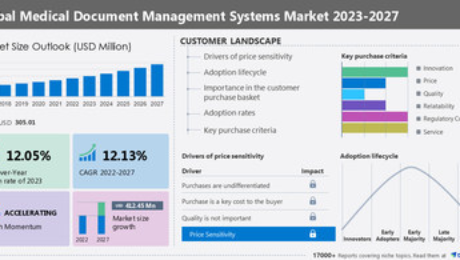
NEW YORK, Nov. 15, 2022 /PRNewswire/ — The Global Medical Document Management Systems Market share is set to increase by USD 412.45 million from 2022 to 2027. Moreover, the market’s growth momentum will accelerate at a CAGR of 12.13% as per the latest market forecast report by Technavio. The market will also record a 12.05% Y-O-Y growth rate during the forecast period.
To know more about the historic market size– Request a Free Sample Report!
Global Medical Document Management Systems Market – Parent Market Analysis
Technavio categorizes the global medical document management systems (MDMS) market as a part of the global systems software market within the global IT software market. The super parent global systems software market covers companies engaged in developing and producing applications and systems software. It also includes companies offering database management software. The global systems software market covers organizations that are engaged in developing application development and management software, cloud computing software, data center and hosting software, IT management software, mobility software, networking software, security software, and storage software. It excludes companies classified in the development and production of home entertainment software.
For more information parent market along with value chain analysis – Grab an Exclusive sample!
Global Medical Document Management Systems Market Characteristics with Five Forces–
The Global Medical Document Management Systems Market is fragmented and the five forces analysis by Technavio gives the accurate vision –
Bargaining Power of Buyers
The threat of New Entrants
Threat of Rivalry
Bargaining Power of Suppliers
For information on the impact of the five forces analysis– Click Now!
Global Medical Document Management Systems Market– Customer Landscape
The disruption threats are strategic in nature, and operational risks for suppliers have been mapped based on their negative business impact and probability of occurrence.
The potential for the customer landscape will be available with Technavio Reports – Buy Now!
Global Medical Document Management Systems Market– Segmentation Assessment
Geography Segment Overview
Technavio’s market research report entails detailed information on regional opportunities in store for vendors, which will assist in generating sales revenues. The Global Medical Document Management Systems Market as per geography is categorized into North America, Europe, APAC, South America, and the Middle East and Africa. The report provides an accurate prediction of the contribution of all regions to the growth of the Global Medical Document Management Systems Market Size and actionable market understandings.
Regional Highlights:
North America is the fastest-growing region in the global Medical Document Management Systems Market compared to other regions. 39% growth will originate from North America. The US, Canada, and Mexico are the three countries that provide the most income for the MDMS market in North America. In North America, there is a growing need for accessible, individualized healthcare systems, which has prompted more doctors and hospitals to employ MDMS products. The US and Canada are leading North American nations when it comes to the adoption of MDMS and other cutting-edge healthcare information systems.
Type Segment Overview
The Global Medical Document Management Systems Market as per Deployment segmentation is categorized into On-premise and Cloud.
Revenue Generating Segment – The market share growth by the on-premise segment will be significant during the forecast period. This is because more small and medium-sized businesses (SMEs), including hospitals and clinics, around the world are implementing on-premise MDMS. In the global medical document management systems (MDMS) market, these factors are anticipated to fuel the on-premise segment’s expansion during the course of the forecast period.
Download a FREE Sample Report that can help you to strategize your sales revenue – Get it now!
Global Medical Document Management Systems Market– Market Dynamics
Major Driver Boosting the Market
Key elements fueling the expansion of the global market for medical document management systems include MDMS’s greater efficiency and productivity. Medical document management systems (MDMS) assist in the management of patient demographic data, spend analysis, overheads, inventory management, insurance claims, patient analysis, regulatory and compliance data, license information, and emergency management.
Additionally, the program creates clinical and administrative performance data that can be used in plans for improving medical documents. It assists medical professionals with every part of company optimization, such as setting up fee schedules, managing accounts receivables, providing support, covering overhead, doing marketing analyses, and calculating returns on investment (ROI).
The program keeps track of corporate operations and finds financial abnormalities that can be reported to management for remedial action. As a result, healthcare organizations are looking for MDMS that can boost productivity and efficiency while also lowering expenses and accelerating the organization’s growth.
Major trends influencing the growth of glamping
The demand for detailed and customized reporting will drive the expansion of the global market for medical document management systems. Physicians rely on the reporting features of their software systems to give them access to accurate data and statistics that may help them gauge the effectiveness of their practices.
Daily reports from MDMS give information about unassigned credits, completed appointments, and post-op calls. To learn more about administrative activities such as prescriptions, deleted transactions, past-due accounts, unpaid claims, and credit distribution audit trails of medical records, the reports can be checked daily or weekly. Therefore, the above-mentioned factors are anticipated to propel the growth of the worldwide MDMS market.
Major Challenges interrupting the market growth
A major challenge to the expansion of the global market for medical document management systems is the threat posed by open-source MDMS. A variety of business analytics tools and applications are offered by open-source suppliers in the worldwide MDMS industry.
Many small- and medium-sized organizations (SMEs) and individual users favor open-source technologies, which are freely available on the Internet because the purchasing and licensing expenses of commercial MDMS are exorbitant.
Demand will decline due to the availability of subscription-based MDMS solutions, including cloud-based and on-premises MDMS solutions, as well as open-source MDMS solutions, and these factors may restrain the expansion of the worldwide MDMS market during the course of the projected period.
To know about other factors of market dynamics – Request a Free Sample!
Technavio suggests three forecast scenarios (optimistic, probable, and pessimistic) considering the impact of COVID-19. Technavio’s in-depth research has direct and indirect COVID-19-impacted market research reports.
Register for a free trial today and gain instant access to 17,000+ market research reports.
Technavio’s SUBSCRIPTION platform
Medical Document Management Systems Market 2023-2027: Key Highlights
CAGR of the market during the forecast period 2023-2027
Detailed information on factors that will assist the Medical Document Management Systems Market growth during the next five years
Estimation of the cloud data warehouse market size and its contribution to the parent market
Predictions on upcoming trends and changes in consumer behavior
The growth of the Medical Document Management Systems Market
Analysis of the market’s competitive landscape and detailed information on vendors
Comprehensive details of factors that will challenge the growth of Medical Document Management Systems Market vendors
Related Reports:
The Demand Side Platforms (DSP) for the Programmatic Advertising Market are projected to grow by USD 473.66 million with a CAGR of 9.48% during the forecast period 2021 to 2026. The report extensively covers the demand side platforms (DSP) for programmatic advertising market segmentation by deployment (cloud and on-premise) and geography (North America, Europe, APAC, South America, and the Middle East and Africa).
The Cloud Security Solutions Market is projected to grow by USD 8.63 billion with a CAGR of 15.16% during the forecast period 2021 to 2026. The report extensively covers the cloud security solutions market segmentation by end-user (BFSI, healthcare, retail, government, and others), component (cloud IAM, cloud e-mail security, cloud DLP, cloud IDS/IPS, and cloud SIEM), and geography (North America, Europe, APAC, the Middle East and Africa, and South America).
Medical Document Management Systems Market Scope
Report Coverage
Details
Page number
120
Base year
2022
Historical year
2017-2021
Forecast period
2023-2027
Growth momentum & CAGR
Accelerate at a CAGR of 12.13%
Market growth 2023-2027
$412.45 million
Market structure
Fragmented
YoY growth (%)
12.05
Regional analysis
North America, Europe, APAC, the Middle East and Africa, and South America
Performing market contribution
North America at 39%
Key consumer countries
US, Japan, China, Germany, and UK
Competitive landscape
Leading companies, Competitive Strategies, Consumer engagement scope
Key companies profiled
3M Co., Allscripts Healthcare Solutions Inc., Athenahealth Inc., Canon Inc., Compulink Management Center Inc., Epic Systems Corp., Exela Technologies Inc., General Electric Co., Hyland Software Inc., International Business Machines Corp., Konica Minolta Inc., McKesson Corp., Microsoft Corp., Open Text Corp., Oracle Corp., Siemens AG, Thoma Bravo LP, Thomson Reuters Corp., NextGen Healthcare Inc., and Pericent BPM and DMS Software Pvt. Ltd.
Market dynamics
Parent market analysis, Market growth inducers and obstacles, Fast-growing and slow-growing segment analysis, COVID-19 impact and recovery analysis and future consumer dynamics, and Market condition analysis for the forecast period.
Customization purview
If our report has not included the data that you are looking for, you can reach out to our analysts and get segments customized.
Table of Contents:
1 Executive Summary
1.1 Market overview
2 Market Landscape
2.1 Market ecosystem
3 Market Sizing
3.1 Market definition
3.2 Market segment analysis
3.3 Market size 2022
3.4 Market outlook: Forecast for 2022-2027
4 Historic Market Size
4.1 Global medical document management systems market 2017 – 2021
4.2 Deployment Segment Analysis 2017 – 2021
4.3 End-user Segment Analysis 2017 – 2021
4.4 Geography Segment Analysis 2017 – 2021
4.5 Country Segment Analysis 2017 – 2021
5 Five Forces Analysis
5.1 Five forces summary
5.2 Bargaining power of buyers
5.3 Bargaining power of suppliers
5.4 Threat of new entrants
5.5 Threat of substitutes
5.6 Threat of rivalry
5.7 Market condition
6 Market Segmentation by Deployment
6.1 Market segments
6.2 Comparison by Deployment
6.3 On-premise – Market size and forecast 2022-2027
6.4 Cloud – Market size and forecast 2022-2027
6.5 Market opportunity by Deployment
7 Market Segmentation by End-user
7.1 Market segments
7.2 Comparison by End-user
7.3 Hospitals and clinics – Market size and forecast 2022-2027
7.4 Nursing and home healthcare – Market size and forecast 2022-2027
7.5 Others – Market size and forecast 2022-2027
7.6 Market opportunity by End-user
8 Customer Landscape
8.1 Customer landscape overview
9 Geographic Landscape
9.1 Geographic segmentation
9.2 Geographic comparison
9.3 North America – Market size and forecast 2022-2027
9.4 Europe – Market size and forecast 2022-2027
9.5 APAC – Market size and forecast 2022-2027
9.6 Middle East and Africa – Market size and forecast 2022-2027
9.7 South America – Market size and forecast 2022-2027
9.8 US – Market size and forecast 2022-2027
9.9 Germany – Market size and forecast 2022-2027
9.10 Japan – Market size and forecast 2022-2027
9.11 UK – Market size and forecast 2022-2027
9.12 China – Market size and forecast 2022-2027
9.13 Market opportunity by geography
10 Drivers, Challenges, and Trends
10.1 Market drivers
10.2 Market challenges
10.3 Impact of drivers and challenges
10.4 Market trends
11 Vendor Landscape
11.1 Overview
11.2 Vendor landscape
11.3 Landscape disruption
11.4 Industry risks
12 Vendor Analysis
12.1 Vendors covered
12.2 Market positioning of vendors
12.3 3M Co.
12.4 Allscripts Healthcare Solutions Inc.
12.5 Athenahealth Inc.
12.6 Canon Inc.
12.7 Compulink Management Center Inc.
12.8 Epic Systems Corp.
12.9 General Electric Co.
12.10 Hyland Software Inc.
12.11 McKesson Corp.
12.12 NextGen Healthcare Inc.
12.13 Oracle Corp.
12.14 Pericent BPM and DMS Software Pvt. Ltd.
12.15 Siemens AG
12.16 Thoma Bravo LP
12.17 Thomson Reuters Corp.
13 Appendix
13.1 Scope of the report
13.2 Inclusions and exclusions checklist
13.3 Currency conversion rates for US$
13.4 Research methodology
13.5 List of abbreviations
About Us
Technavio is a leading global technology research and advisory company. Their research and analysis focus on emerging market trends and provide actionable insights to help businesses identify market opportunities and develop effective strategies to optimize their market positions. With over 500 specialized analysts, Technavio’s report library consists of more than 17,000 reports and counting, covering 800 technologies, spanning 50 countries. Their client base consists of enterprises of all sizes, including more than 100 Fortune 500 companies. This growing client base relies on Technavio’s comprehensive coverage, extensive research, and actionable market insights to identify opportunities in existing and potential markets and assess their competitive positions within changing market scenarios.
Contact
Technavio Research
Jesse Maida
Media & Marketing Executive
US: +1 844 364 1100
UK: +44 203 893 3200
Email: media@technavio.com
Website: www.technavio.com/
View original content to download multimedia:https://www.prnewswire.com/news-releases/medical-document-management-systems-market-size-to-grow-by-usd-412-45-million-from-2022-to-2027—assessment-on-parent-market-five-forces-analysis-market-dynamics–segmentation—technavio-301676832.html
SOURCE Technavio
The latest decision from ExxonMobil won't win any popularity contest, but it will make it a champion to its investors. On Thursday, the oil giant…
Taiwan Semi's expansion to the U.S. is a big deal, but there are ways to profit during construction.
On Dec. 9, the leaders of Saudi Arabia and China met in Riyadh—Xi Jinping’s first visit there since 2016. He and his counterpart, crown prince Mohammed bin Salman, agreed meet more often and signed a number of deals broadly aimed at aligning the countries’ mid-term development agendas, China’s Belt and Road Initiative and Saudi’s Vision 2030.
MOSCOW (Reuters) -Russia, the world's biggest exporter of energy, could cut oil production and will refuse to sell oil to any country that imposes the West's "stupid" price cap on Russian oil, President Vladimir Putin said on Friday. The Group of Seven major powers, the European Union and Australia last week agreed to a $60 per barrel price cap on Russian seaborne crude oil after EU members overcame resistance from Poland.
(Bloomberg) — The offer seemed too good to be true: Up to 200,000 barrels of heavy-sour crude at a $30 discount to the US benchmark. Most Read from BloombergPutin Calls Russian Nukes Deterrent Factor, Says War Risk RisingPeru’s President Accused of Coup After Move to Dissolve CongressWNBA Star Griner Freed in One-for-One Swap for Arms DealerElon Musk’s Bankers Consider Tesla Margin Loans to Cut Risky Twitter DebtWhy Did So Many US Men Quit Working? Social Status May Hold the Key, Study SaysThe
A judge recommends three ex-Wells Fargo executives pay a combined $18.5 million in fines over their alleged roles in the mega-bank's fake accounts scandal.
Since midstream operations have lower exposure to volatility in commodity prices, the outlook for the Zacks Oil and Gas – Production & Pipelines industry is bullish. Kinder Morgan (KMI), Williams Companies (WMB) and MPLX LP (MPLX) are the frontrunners in the industry.
Yahoo Finance Live anchors discuss Amazon rolling out a new tip incentive program when customers thank delivery drivers via Alexa.
An oil spill that shut TC Energy's Keystone pipeline in the United States on Wednesday could squeeze crude inventories at the country's primary storage hub and in two main refining regions, the Midwest and Gulf Coast, analysts and traders said on Friday. The Keystone line is a key artery bringing more than 600,000 barrels of Canadian crude per day (bpd) to various parts of the United States. It was shut late Wednesday after leaking more than 14,000 barrels of oil into a creek in Kansas, making it the largest crude spill in the United States in nearly a decade.
Many Americans dream of early retirement. It's even the basis for movements like FIRE, which stands for Financial Independence, Retire Early. But if you want to retire as soon as 52, you need a solid strategy to help you get … Continue reading → The post How to Retire at 52: Step-by-Step Plan appeared first on SmartAsset Blog.
Walmart Inc. has rallied from lows in May and June into late November. Prices moved above the 50-day and 200-day moving average lines in late October. The slopes of both the 50-day and the 200-day moving averages turned positive in November and we can see a buy signal from the golden cross — the 50-day line crossed above the 200-day moving average line.
ISLAMABAD (Reuters) -Pakistan's Supreme Court endorsed on Friday a settlement for Barrick Gold to resume mining at the Reko Diq project, one of the world's largest underdeveloped sites of copper and gold deposits, it said in an order. The endorsement was a condition of the settlement for Barrick to resume work on the project in the southwestern province of Balochistan, bordering Afghanistan and Iran, in which it will invest $10 billion. Chief Justice Umar Ata Bandial, the head of a five-judge panel, read out the operative part of the brief order in court.
Bank of America CEO Brian Moynihan, who has struck an upbeat tone on the economy in recent interviews, recently discussed the Charlotte-based bank's strategy for adjusting its headcount, which it is currently looking to do.
(Reuters) -Canada's TC Energy shut its Keystone pipeline in the United States after more than 14,000 barrels of crude oil spilled into a creek in Kansas, making it one of the largest crude spills in the United States in nearly a decade. The cause of the leak, which occurred in Kansas about 20 miles (32 km) south of a key junction in Steele City, Nebraska, is unknown. It is the third spill of several thousand barrels of crude on the pipeline since it first opened in 2010.
The tax-free deal on the Roth IRA may seem too good to be true, but rest assured that there are at least five good reasons for it to stay that way.
The provider of electronic signature software has been in a lengthy downtrend and still needs to prove itself.
(Bloomberg) — Silvergate Capital Corp. was dealing with the same problem many small US banks face: How do you differentiate yourself when larger competitors do everything you do, only better?Most Read from BloombergCeline Dion Brings Attention to Stiff Person Syndrome: Here’s What It IsStocks in Choppy Waters With Focus on Fed Decision: Markets WrapTesla's Troubles Are Piling Up While Elon Musk Is Distracted With TwitterMusk Twitter Leak Raises Concern About Outside Data AccessTop Money Manager
Cutting-edge aircraft and next-generation spacecraft maker Northrop Grumman has been ignoring the 2022 bear market and has been trending higher the past 12 months. The On-Balance-Volume (OBV) line shows a positive trend and confirms the price gains. The Moving Average Convergence Divergence (MACD) oscillator has stayed above the zero line for much of the past year.
Coca-Cola, PepsiCo, Coca-Cola FEMSA, Keurig Dr Pepper and Monster Beverage have been highlighted in this Industry Outlook article.
Enterprise Products (EPD) has a stable business model and is not significantly exposed to the volatility in oil and gas prices.
- Published in Uncategorized
Meeting clients' greater expectations? Unlock your higher levels of agility now… – Today's Conveyancer

Lean and agile commercial businesses are known to deliver higher profits, increase employee engagement, and more thoroughly satisfy customer needs.
There is little doubt that technology is playing a vital role in this success. To the extent that some organisations have been able to achieve 20-30% improvement in their overall financial performance. However, customers’ expectations have also changed. Similarly, in the legal business arena, where being more agile now can help you meet and even exceed your clients’ expectations.
In a blog post dated 26th August 2021, Daniel Docherty describes the change in perception which occurred when business technology was leveraged during the pandemic. Until it was no longer regarded simply as an addition to existing processes but used instead to maintain performance and growth in remote working:
“Agility has always been one of the central pillars upon which long-term, sustainable success is built, but the pace at which today’s environment changes has evolved so dramatically that agility is now a necessity rather than a luxury.
Agility underpins every aspect of business, from marketing and product development right through to how a business handles its finances and makes game-changing decisions. Gone are the days of on-premise monolithic systems, which are expensive to run, difficult to maintain and costly to upgrade. Instead, today’s organisations choose cloud-based platforms that allow for greater flexibility, agile cloud automation, and intelligent data analytics that enable them to make rapid-fire judgments and instantly change direction.”
Adobe’s 2022 Digital Trends Report is an interesting read, which illustrates how organisations are currently overcoming significant challenges with agility. Whilst in an article dated 11th May 2021 Victoria Cromwell, a Director of BARBRI indicates that the advantages of business agility also include:
In a Forbes Technology Council article, Mark Schlesinger took the view that companies with more agility aimed to complete each project in smaller steps, and in less time. Allowing for increased accuracy, and engagement. Output could be assessed, providing feedback along the way and potentially better results. Benefiting different sections of the company including operations; technology; finance; customer service and so on.
You may find the following helpful in increasing your agility:
Other ways to increase business agility may involve processes and methods with which you are not familiar. Examples of this might include:
This remains at the forefront of increasing business agility, and in turn, satisfying clients’ expectations. A few ideas on lawtech are below:
Articles on the inCase website illustrate how using this particular app has helped legal businesses not only survive lockdown by remote working but also thrive. 71% of adults say they never turn off their mobile phone, whilst 78% couldn’t live without it. Making this an essential tool for business agility in leveraging the following features:
These can be sent back within minutes, instead of taking five days or more by post, and is suitable for 99% of all documents used by law firms. Including onboarding documentation. Each electronic signature has the same legality as a wet signature.
If done manually, verifying a client’s identity is often time-consuming and adds significant cost to the case, but remains a necessity to protect lawyers and clients from identity theft or scams.
A client is notified on the app that he or she needs to complete an ID check when a file is opened. The process can then be undertaken at his or her convenience, again on the app, through a combination of document scanning and facial recognition technology. InCase is the only provider to use the NFC chip reader for document scanning on both Android and Apple phones. Enabling the cryptographically signed data on a passport chip to be read. While the facial recognition software can confirm a match between the ID photo, and a live recording of the client. Making the identification process reliable, and easy to use.
Sent instantaneously and received through the inCase app, with TLS encryption used by the banking industry. The message can carry the same attachments as an email or letter sent through the post. Such as medical reports or property guarantees.
Clients know exactly what their case involves, and the stage reached in the legal process. When an action is taken this moves the file to the next step, and the client automatically receives a push notification alert of the progress made. Without any additional input being required from the lawyer.
In an article dated October 21 2020, again on the inCase website, takes a deeper dive into clients’ experience with legal technology. How they often rate it alongside the other digital experiences they have had. Such as on Amazon. Ranking the comparison across all sectors. Not only in the legal services industry. Inevitably leading many clients to believe they will receive the same exceptional experience from your firm.
Research conducted by the Law Society has also suggested that a self-service law model, involving minimal interaction with lawyers, isn’t far away.
With this, and business agility in mind, are you doing everything you can to provide the optimal experience for your clients? Or is it time to consider increasing your agility and the legal technology you may, or may not be using? Especially when you consider the latest technology or software you most likely use every day in your own life.
These are the sort of questions your competitors are now asking themselves.
This article was submitted to be published by inCase as part of their advertising agreement with Today’s Conveyancer. The views expressed in this article are those of the submitter and not those of Today’s Conveyancer.
https://hubs.ly/H0WLMf50 
inCase™ are an “award-winning” mobile applications and software management company specialising in solutions for legal professionals.
We are a business dedicated to making continuous improvements within the legal industry using the latest pioneering technology.
inCase™ is the first mobile application dedicated to help law firms improving communication with clients.
inCase is the most innovative way to communicate with clients efficiently and securely.
With our customer services mobile app, we provide the technology, expertise and efficiencies for Lawyers to provide the very best in customer service.
Our mentality is as lawyers firstly, technology providers secondly. Our unique background means we understand the difficulties and obstacles that lawyers face on a daily basis. Along with the pressures and desires business owners hold in running their firms.
Digital Signature
Sign documents quickly with our digital signature system.
Digital Signature ID/AML
Our market leading Identity check feature provides the ultimate reassurance of your client’s identity.
Branded App
Choose our branded level and have your very own app designed for you.
Forms & Questionnaires
Send your forms to clients to complete through the app in record time. It saves the progress and allows clients to fill.
Multiple Cases
inCase can work with any discipline of law, so clients can have multiple files with you inside one app.
Client Document Upload
Clients can upload or scan documents straight from their phone, tablet or computer.
Client to do List
Keep clients organised. Create a list so they know what they need to do.
Secure Messages
Provide a communication trail for clients. It is an easy way to communicate with each other.
Process Flows
Have multiple process flows and make them bespoke to you. Set trigger points in your CMS and keep your clients fully informed.
Push Notifications Become proactive! Let clients relax knowing their phone will ‘ping’ with any update or action.
Address:
8th Floor Trafford House
Chester Road
Stretford
Manchester
M32 0RS
Key Contact
Name: Rob Hosier
Tel: 07927 512913
Email: [email protected]
Linkedin Acc: https://www.linkedin.com/in/rob-hosier/
Your email address will not be published.
document.getElementById( “ak_js_1” ).setAttribute( “value”, ( new Date() ).getTime() );
"*" indicates required fields
document.getElementById( “ak_js_2” ).setAttribute( “value”, ( new Date() ).getTime() );
Unleash your brand and boost exposure to thousands of conveyancing professionals daily by securing an advertising space on the Today’s Conveyancer website and weekly newsletter.
Today’s Media
Today’s Wills and Probate
Today’s Family Lawyer
Today’s Training
The British Wills and Probate Awards
The British Conveyancing Awards
Founded in 2010, Today’s Conveyancer is the leading news publication for conveyancers and property professionals.
[email protected]
0330 1000 839
© 2022 Today’s Conveyancer Sitemap Privacy Policy Terms of Use Cookie Policy Acceptable Use
If you receive an email purporting to come from Today’s Conveyancer or a Firm member, or if you are directed to a website which purports to be Today’s Conveyancer’s website, and you have doubts or concerns about the provenance of the email or website, before taking any action please either contact the Firm member you normally deal with or email David Opie on [email protected] and they will tell you whether the email came from us or whether it is our website.
We are using cookies to give you the best experience on our website.
You can find out more about which cookies we are using or switch them off in .
This website uses cookies so that we can provide you with the best user experience possible. Cookie information is stored in your browser and performs functions such as recognising you when you return to our website and helping our team to understand which sections of the website you find most interesting and useful.
Strictly Necessary Cookie should be enabled at all times so that we can save your preferences for cookie settings.
Cookies Used
PHPSESSID
__cfduid
moove_gdpr_plugin
If you disable this cookie, we will not be able to save your preferences. This means that every time you visit this website you will need to enable or disable cookies again.
This website uses Google Analytics to collect anonymous information such as the number of visitors to the site, and the most popular pages.
Keeping this cookie enabled helps us to improve our website.
Cookies Used
Google Analytics
Hotjar
Please enable Strictly Necessary Cookies first so that we can save your preferences!
For more information about our Cookie Policy please click here.
- Published in Uncategorized
USA Board Management Systems Industry: Future Demand, Market Analysis & Outlook upto 2029 | Omicron Impact Analysis – PRIZM News – PRIZM News

Board Management Systems Market Research Study 2023 – Overview
Board Management Systems market exhibits comprehensive information that is a valuable source of insightful data for business strategists during the decade 2019-2029. On the basis of historical data, Board Management Systems market report provides key segments and their sub-segments, revenue and demand & supply data. Considering technological breakthroughs of the market Board Management Systems industry is likely to appear as a commendable platform for emerging Board Management Systems market investors.
Get Sample Report: https://www.marketresearchupdate.com/sample/397774
The complete value chain and downstream and upstream essentials are scrutinized in this report. Essential trends like globalization, growth progress boost fragmentation regulation & ecological concerns. This Market report covers technical data, manufacturing plants analysis, and raw material sources analysis of Board Management Systems Industry as well as explains which product has the highest penetration, their profit margins, and R & D status. The report makes future projections based on the analysis of the subdivision of the market which includes the global market size by product category, end-user application, and various regions.
Top Key Players of the Market:
Azeus Systems, Loomion, HETIKUS, BoardPAC, Board Management Software, Atlassian, Process PA, kyona, Board Intelligence, BoardSpace, Brainloop, FlexxCore Technology Solutions
Types covered in this report are:
Cloud-based
On-premises
On the Basis of Application:
Small and Medium Enterprises (SMEs)
Large Enterprises
With the present market standards revealed, the Board Management Systems market research report has also illustrated the latest strategic developments and patterns of the market players in an unbiased manner. The report serves as a presumptive business document that can help the purchasers in the global market plan their next courses towards the position of the market’s future.
Check Discount on Board Management Systems Market report @ https://www.marketresearchupdate.com/discount/397774
This report contains a thorough analysis of the pre and post pandemic market scenarios. This report covers all the recent development and changes recorded during the COVID-19 outbreak.
Regional Analysis For Board Management Systems Market
North America (the United States, Canada, and Mexico)
Europe (Germany, France, UK, Russia, and Italy)
Asia-Pacific (China, Japan, Korea, India, and Southeast Asia)
South America (Brazil, Argentina, Colombia, etc.)
The Middle East and Africa (Saudi Arabia, UAE, Egypt, Nigeria, and South Africa)
Why B2B Companies Worldwide Rely on us to Grow and Sustain Revenues:
Get Full Report @ https://www.marketresearchupdate.com/industry-growth/board-management-systems-market-statistices-397774
This report provides:
In the end, the Board Management Systems Market report includes investment come analysis and development trend analysis. The present and future opportunities of the fastest growing international industry segments are coated throughout this report. This report additionally presents product specification, manufacturing method, and product cost structure, and price structure.
Contact Us:
sales@marketresearchupdate.com
- Published in Uncategorized
3000+ Accounting Pros Attend Live QB Connect Conference in Vegas: Intuit Announces Big New Features – CPAPracticeAdvisor.com

Hello. It looks like you’re using an ad blocker that may prevent our website from working properly. To receive the best experience possible, please make sure any blockers are switched off and refresh the page.
If you have any questions or need help you can email us
Accounting & Audit
In-person for the first time since 2019, more than 3,000 accountants, bookkeepers, and developers joined the company at sold-out QuickBooks Connect to build relationships, be …
Dec. 08, 2022
Tax and accounting software maker Intuit has announced new innovations to QuickBooks that are designed to drive accountant and small business success at its ninth annual QuickBooks Connect conference in Las Vegas.
In-person for the first time since 2019, more than 3,000 accountants, bookkeepers, and developers joined the company at sold-out QuickBooks Connect to build relationships, be inspired, and learn about the latest offerings from Intuit QuickBooks, the world’s leading financial technology platform that helps more than 8 million small and mid-sized businesses start up and scale up.
“We’re thrilled to be back together in-person at QuickBooks Connect with our most valued partners,” said Jeremy Sulzmann, vice president and general manager of the Partners Segment Business at Intuit QuickBooks. “This year, we reimagined our event to focus solely on accounting professionals, solution providers, and third-party developers – all of whom share our mission to help small businesses succeed. The ability to gather as a community and showcase our latest product innovations that will help our partners and their clients grow is truly special.”
New innovations highlighted at QuickBooks Connect include:
QuickBooks Commerce Accounting
A 2021 Intuit survey of U.S. product-based businesses found 84% used a combination of pen and paper, and spreadsheets to manage inventory – spending 80 to 90 hours per month on this task. With Commerce Accounting, QuickBooks allows these businesses and their accountants to save time, increase accuracy, get powerful insights, and improve financial performance.
Commerce Accounting seamlessly connects sales channels such as Amazon, Shopify, and eBay to QuickBooks, automatically bringing in orders and matching sales and fees with bank deposits to reduce the need for manual data entry. Soon, additional commerce accounting and operations capabilities such as accurately tracking inventory, cost of goods sold, performing stocktakes, and tracking sales orders across all sales channels in one consolidated dashboard also will be available. These real-time data insights on order and fulfillment status, inventory levels, top selling products and channels, and more will allow product-based business owners and their accountants to make strategic business decisions and optimize sales to build successful e-commerce businesses.
Mid-Market Solutions
QuickBooks serves the mid-market with advanced accounting capabilities, automated workflows, and deep integrations to third-party applications to create efficiencies and meet the needs of these more complex businesses.
To meet the unique needs of these growing businesses, QuickBooks has introduced new integrations and features. This includes Spreadsheet Sync, which enables two-way syncing with Excel to help customers streamline their reporting processes and enter data in bulk, and the Custom Report Builder with Chart View, which can help create clear explanations of key performance indicators. Revenue Recognition and Project Estimates vs. Actuals were also introduced to help increase efficiencies for accountants and business owners.
QuickBooks Workforce Solutions
QuickBooks Workforce Solutions is evolving to provide a complete Human Resources Information System (HRIS) platform for employers so they can easily manage each employee’s employment journey as well as their increasingly complex HR needs. New capabilities coming within QuickBooks Workforce Solutions that will broaden its HRIS functionality to serve small and mid-market businesses include:
QuickBooks Online Accountant
Providing the one place accountants and bookkeepers need to grow their practice and scale their impact across clients and services, QuickBooks Online Accountant (QBOA) helps accountants increase efficiency through streamlined and standardized workflows.
Key new features within QBOA include:
QuickBooks ProAdvisor Program
Celebrating the 25th anniversary of the program, Intuit unveiled a fully redesigned training portal created to meet the knowledge needs of the more than 600,000 active QuickBooks ProAdvisors worldwide. With a broad spectrum of training, education, and certifications, the new portal, first available for ProAdvisors in the U.S., makes it even easier to identify and find trainings that ProAdvisors need to grow their skills and knowledge as well as create personalized goals and learning paths. New content will be added on an ongoing basis to help ProAdvisors grow skills and knowledge across the QuickBooks platform and accounting industry as a whole.
To learn more about how the QuickBooks Online platform is helping accounting professionals and small businesses thrive, visit QuickBooks.com.
—- –
Photo credit: Alex Chriss, GM of the Small Business & Self Employed Group, @Intuit, . Home to @QuickBooks and @Mailchimp
Alex Chriss @acce
Accounting & Audit
Accounting & Audit
Jason Bramwell
Accounting & Audit
Mary Girsch-Bock
Subscribe for free and get unlimited access to all CPA Practice Advisor content
Subscribe
CPAPA is registered with the National Association of State Boards of Accountancy (NASBA) as a sponsor of continuing professional education on the National Registry of CPE Sponsors.
© 2022 Firmworks, LLC. All rights reserved
- Published in Uncategorized
Procede Software and DocuPhase Partner to Streamline Document Management for Heavy-Duty Truck and Commercial Vehicle Dealerships – Yahoo Finance

The integration between Procede’s dealer management software, Excede®, and DocuPhase increases efficiency and accuracy, and saves dealership staff hours of time each week.
SAN DIEGO, Nov. 4, 2022 /PRNewswire/ — Procede Software, a leading heavy-duty commercial vehicle dealer management system (DMS) and solutions provider, today announced it has partnered with DocuPhase, a Business Process Automation (BPA) and document management solutions provider, to bring end-to-end document management and workflow automation to Procede’s heavy-duty commercial vehicle customers. The companies have built an integration between their solutions that will enable users to not only digitally capture, sort, and store documents but also automate the workflows associated with many of their most common processes.
The integration between Excede and DocuPhase increases efficiency, accuracy, and saves dealership staff hours of time.
“Our ongoing commitment to our customers is to continuously bring valuable solutions through our Certified Partner network,” said Larry Kettler, CEO, Procede Software. “We are excited to partner with DocuPhase and bring our customers a way to simplify and streamline document management processes while increasing accuracy and efficiency, throughout the dealership.
Through the Excede API, Excede and DocuPhase will connect providing customers a complete, end-to-end, document management and automated workflow solution. DocuPhase uses advanced optical character recognition (OCR) to capture information in documents, then automatically sorts them and stores them in an integrated document repository. New documents can easily be added to the system via email or using drag-and-drop functionality, while existing documents can be searched for and accessed through the Excede integration.
DocuPhase also empowers users to configure automatic workflows, which increases visibility, improves efficiency, and allows employees to focus their efforts on more valuable tasks.
“DocuPhase is delighted to partner with Procede Software to accelerate adoption of document management technology by the heavy-duty truck and commercial vehicle dealerships,” said Dan Gaertner, CEO, DocuPhase. “By moving away from manual, paper-based processes and leveraging automation, dealerships can gain back-office efficiencies, operate more effectively, and save hours of time each week.”
The integration between Excede and DocuPhase is available now. Customers interested in learning more may submit a work order request through the Customer & Resources Portal (login required).
About Procede Software
Since 2001, Procede Software has been a leading provider of enterprise-level Dealer Management Solutions (DMS) for the heavy-duty truck and ancillary markets. Serving dealer locations throughout the United States and Canada, the industry’s leading dealerships trust Excede to run their business because of its full functionality across all dealership departments, high reliability, and strong integration with their OEM providers. Procede Software is a Microsoft Certified Gold Partner: Excede, its powerful DMS, leverages the strength of Microsoft® SQL technology to provide advanced Windows® and browser-based applications with real-time information.
About DocuPhase
DocuPhase is a leading provider of digital solutions designed to maximize business efficiency. Their document management and business process automation solutions eliminate mundane workflows and shorten approval processes associated with purchase orders, sales orders, invoice captures, payment approvals, vendor management, employee onboarding, and more.
With over two decades in business, DocuPhase’s innovative web-based applications have given companies across the globe the power to simplify their workflows and redirect their resources toward more strategic initiatives.
Media Contact
Jodi Wright
Procede Software
jwright@procedesoftware.com
View original content to download multimedia:https://www.prnewswire.com/news-releases/procede-software-and-docuphase-partner-to-streamline-document-management-for-heavy-duty-truck-and-commercial-vehicle-dealerships-301668594.html
SOURCE Procede Software
After falling for much of the week, the major stock market indexes were gaining ground early Thursday as investors digested the latest unemployment numbers. Last week's initial jobless claims suggest the Federal Reserve's campaign to combat inflation may finally be bearing fruit. Investors used that positive development as an excuse to buy up their favorite beaten-down tech stocks.
Wake up and smell the diesel.
The FTC is suing Microsoft to block its deal to buy Activision Blizzard.
Shares of BioVie (NASDAQ: BIVI) were soaring 23.6% higher as of 11:19 a.m. ET on Thursday. The big jump appears to be the result of a delayed positive reaction by investors after the drugmaker reported results earlier this week from a phase 2 study evaluating experimental therapy NE3107. On Tuesday, BioVie's share price tumbled after the company's Monday evening announcement of results from its phase 2 study of NE3107 in treating Alzheimer's disease and Parkinson's disease.
In this article, we will discuss the 15 best electric car stocks to buy now. If you want to explore similar stocks, you can also take a look at 5 Best Electric Car Stocks To Buy Now. The Electric Car Industry: An Analysis Electric car stocks are increasingly becoming a popular investment option as the […]Sam Bankman-Fried's ambition for celebrity endorsements might have snared the "Anti-Hero" singer, but she proved to be smarter than a lot of other famous people.
Media reports suggest that Hong Kong could relax certain restrictions aimed at preventing the spread of COVID-19.
Earlier this year, in May, claims were made that Microsoft Corp co-founder Bill Gates owned the majority of America’s farmland. While that is false, with the billionaire amassing nearly 270,000 acres of farmland across the country, compared to 900 million total farm acres, a different billionaire privately owns 2.2 million acres, making him the largest landowner in the U.S. John Malone, the former CEO of Tele-Communications Inc., which AT&T Inc. purchased for more than $50 billion in 1999, has a
Retirement-eligible salaried employees at Ford were warned about retiring this year to maximize a lump sum pension payment.
After a 13-year bull-market run driven primarily by the tech-heavy Nasdaq 100, growth stocks have tanked this year, and the index is down 30% in 2022. Stand out tech stocks Broadcom (NASDAQ: AVGO) and Datadog (NASDAQ: DDOG) have lost at least 20% of their value this year, but Wall Street still expects them to grow some 50% or more this year and beyond. Let's take a closer look at why each of these tech stocks are worth considering heading before we head into 2023.
The battery innovator is making progress on its lithium-metal batteries, but it still has a couple of years to go before it could start booking meaningful revenue.
Shares of Boeing (NYSE: BA) were up more than 4% as of 10 a.m. ET today. Bank of America's Ron Epstein raised his price target to $190 from $165, Citibank analyst Jason Gursky initiated his coverage with a buy rating, and Wells Fargo analyst Matthew Akers raised his price target to $218 from $185. The price target hikes and buy recommendations are supported by an improving environment for Boeing Commercial Airplanes (BCA).
Lincoln National (LNC) puts share buybacks on temporary hold to regain financial strength as well as cope with the substantial losses incurred in the third quarter of 2022.
Kinder Morgan (KMI) anticipates adjusted EBITDA of $7.7 billion for 2023, up from the $7.5 billion projected for 2022.
Yahoo Finance Live anchors discuss reports that GameStop is considering acquisitions following third-quarter earnings.
General Electric (GE) is plagued by persistent supply-chain disruptions, weakness in the Power and Renewable Energy segments and foreign currency headwinds.
L1 Capital International, an investment management company, released its “L1 Capital International Fund” third-quarter 2022 investor letter. A copy of the same can be downloaded here. The fund returned -0.4% net of fees in the third quarter compared to a 0.3% return for the MSCI World Net Total Return Index in AUD. The depreciation of Australian […]Shares of Nvidia have been soaring of late but this metric indicates that all is not well with the company.
Yahoo Finance Live anchors discuss the issues Salesforce is facing.
Investors searching for that feeling telling you market sentiment is shifting to a more positive outlook have been brought down to earth again. Following 2022’s market behavior to a tee, the recent rally has run into a brick wall. To wit, the S&P 500 notched 5 consecutive negative sessions over the last week with investors mulling over the prospect of a recession. Indeed, financial experts have been sounding the warning bells on the precarious state of the global economy. One of the doomsayers h
- Published in Uncategorized
Global LegalTech Market is Expected to Reach ~US$ 69.7 Bn, Growing at a CAGR of 8.9% During the Forecast Period of 2022-32. Get Latest Insights from Future Market Insights, Inc. – PR Newswire

Searching for your content…
In-Language News
Contact Us
888-776-0942
from 8 AM – 10 PM ET
News provided by
Oct 25, 2022, 10:30 ET
Share this article
The LegalTech demand in the U.S. is expected to account for nearly 67% of North America market share through 2032. Germany LegalTech Industry is expected to account for 9.5% of the Global market through 2032
NEWARK, Del., Oct. 25, 2022 /PRNewswire/ — According to the LegalTech industry analysis by Future Market Insights (FMI), the adoption of LegalTech in the market is estimated to grow with a CAGR of 8.9% from 2022-2032.
The report states that the market is expected to reach the valuation of ~US$ 29.8 Bn by the end of 2022. As per FMI, LegalTech market is witnessing major growth owing to the growing demand for analytics, compliance, and document automation.
LegalTech is an industry that implements technology and software in order to provide legal services. Primarily, these businesses rely on software and technology for billing, electronic access, accounting, reputation management, record keeping, etc. Owing to advancements in technology, new business models, and changing customer expectations, the legal sector is undergoing unprecedented upheaval.
Small legal departments are more likely to invest in document management and contract management software, while large legal departments are more likely to invest in e-billing, case management, document management software, and legal hold software, all of which witnessed a spike of 65% in spend penetration.
Get a Sample Copy of this Report @
https://www.futuremarketinsights.com/reports/sample/rep-gb-15693
Governance, compliance, and contracts management are expected to experience the most growth throughout the forecast period as a result of enterprises having to deal with many governance, regulatory, and compliance concerns.
Companies like PwC are offering advanced legal tech services. The company is focused on providing clients with more effective and thorough services and a stimulating work environment by embracing Legal Tech. For all of the practice areas within PwC’s extensive worldwide legal network, the business is concentrated on identifying and developing improved legal procedures.
Furthermore, in order to give law firms early access to their consulting, technology, legal, and investment innovations, Deloitte and PwC recently established tech incubators. Deloitte Legal Ventures, the legal technology division of the company, will make use of unique goods and services. With advanced solution and service offerings from established and upcoming players in the market, the LegalTech market is expected to witness major growth over the forecast period.
Key Takeaways: LegalTech Market
“Growing need for convenience and compliance across legal processes is expected to drive the growth of LegalTech market” says FMI analyst.
More Valuable Insights on LegalTech Market
Future Market Insight’s report on the LegalTech industry research is segmented into four major sections – solution (software (cloud-based, and on-premises) and services (integration & deployment, consulting, and support & maintenance)), type (case management, lead management, document management, contract lifecycle management, billing & accounting, and others), end-user (law firms, and corporate legal departments), and region (North America, Latin America, Europe, East Asia, South Asia & Pacific, and the Middle East & Africa), to help readers understand and evaluate lucrative opportunities in the LegalTech demand outlook.
Read Full Report @
https://www.futuremarketinsights.com/reports/legaltech-market
Competitive Landscape
LegalTech market players are focusing on various strategies for increasing their investments in research and development to support future technologies. In addition, several companies are acquiring and entering into partnership agreements with other companies to develop advanced legal tech solutions and services to serve the customers and reduce the churn rate.
Major companies operating in the LegalTech market include LexisNexis, Icertis, DocuSign, Inc., PwC, Deloitte, RPX Corporation, Casetext Inc., Themis Solutions Inc. (Clio), Everlaw, Filevine, Inc., Checkbox Technology Pty Ltd, Mighty, PracticePanther, MyCase, CosmoLex Cloud, LLC., Smokeball, Inc., and TimeSolv, among others. New players are developing cutting-edge technologies and solutions as the legal sector develops, enabling attorneys to give their clients better services. Both law firms and their clients will profit from such advanced solutions and services.
LegalTech Outlook by Category
By Solution, LegalTech Market is segmented as:
By Type, LegalTech Market is segmented as:
By End-user, LegalTech Market is segmented as:
By Region, LegalTech Market is segmented as:
Ask for Customization in the Report, Enquire Now @
https://www.futuremarketinsights.com/customization-available/rep-gb-15693
Table of Content
1. Executive Summary
1.1. Global Market Outlook
1.2. Demand Side Trends
1.3. Supply Side Trends
1.4. Analysis and Recommendations
2. Market Overview
2.1. Market Coverage / Taxonomy
2.2. Market Definition / Scope / Limitations
3. Key Market Trends
3.1. Key Trends Impacting the Market
3.2. Product Innovation / Development Trends
4. LegalTech Market – Pricing Analysis
4.1. Pricing Analysis
4.2. Average Pricing Benchmark Analysis
5. COVID-19 Impact Analysis
5.1. Impact of COVID-19 Outbreak on IT End-user
5.1.1. Pre COVID-19 Analysis
5.1.2. Post COVID-19 Analysis
5.2. Expected Recovery Scenario (Short Term/Mid Term/Long Term)
To Continue TOC…
Explore FMI’s Extensive Coverage on Technology Domain
Legal Transcription Market Size: The global legal transcription market stood at around US$ 1,988.9 Mn in 2021, and is slated to increase at a CAGR of 6.5% to reach a valuation of US$ 3,267.7 Mn by 2029.
Legal Services Market Demand: The global legal services industry is predicted to increase at a 4.6% CAGR during the forecast period from 2022 to 2032. The legal services market is estimated to garner a valuation of US$ 400 Billion by the end of 2022.
Legal, Risk and Compliance Solution Market Analysis: The legal, risk and compliance solution market is estimated to grow at a CAGR of ~7% during the forecast period of 2019-2029.
Public Safety & Security Market Growth: The market for public safety & security solutions are projected to grow at a robust CAGR of 9.4% between 2022 and 2032, totaling around US$ 1,063,396.1 Million by the end of 2032.
OTT Content Market Outlook: A CAGR of 17.4% is expected of the global OTT content market, due to the growing demand during the forecast period. It is anticipated to be appraised at US$ 434.98 Bn by 2032, up from US$ 87.46 Bn in 2022.
About Future Market Insights, Inc.
Future Market Insights, Inc. is an ESOMAR-certified business consulting & market research firm, a member of the Greater New York Chamber of Commerce and is headquartered in Delaware, USA. A recipient of Clutch Leaders Award 2022 on account of high client score (4.9/5), we have been collaborating with global enterprises in their business transformation journey and helping them deliver on their business ambitions. 80% of the largest Forbes 1000 enterprises are our clients. We serve global clients across all leading & niche market segments across all major industries.
Contact:
Future Market Insights Inc.
Christiana Corporate,
200 Continental Drive,
Suite 401, Newark,
Delaware – 19713, USA
T: +1-845-579-5705
For Sales Enquiries: [email protected]
Logo: https://mma.prnewswire.com/media/1197648/FMI_Logo.jpg
SOURCE Future Market Insights
More news releases in similar topics
Cision Distribution 888-776-0942
from 8 AM – 9 PM ET
- Published in Uncategorized
Intapp launches Intapp Documents for Corporate Legal – GlobeNewswire

May 09, 2022 09:02 ET | Source: Intapp Inc. Intapp Inc.
Palo Alto, California, UNITED STATES
PALO ALTO, Calif., May 09, 2022 (GLOBE NEWSWIRE) — Intapp (NASDAQ: INTA), a leading provider of cloud-based software for the global professional and financial services industry, announces the launch of Intapp Documents for Corporate Legal to deliver intuitive and collaborative matter lifecycle management for in-house legal departments.
Intapp Documents for Corporate Legal, developed specifically for in-house legal teams, reduces legal operations’ dependence on file-shares and email chains to manage, track, and report on legal matters across their lifecycle. The comprehensive corporate legal matter management solution enables matter-centric document management capabilities in Microsoft SharePoint and provides the tools needed for professionals to effectively file emails and access content, all from within Microsoft Outlook.
“Many corporate legal teams are on a mission to become more rigorous about how they manage and use matter-related content, in order to more efficiently deliver the service the business depends on,” said Dan Tacone, President and Chief Client Officer at Intapp. “We’re excited to launch Intapp Documents for Corporate Legal to serve this need, helping in-house legal teams increase collaboration and manage the proliferation of matter-related documents and email directly within the Microsoft tools they already use.”
Intapp Documents for Corporate Legal helps in-house legal teams:
Intapp Documents for Corporate Legal combines technology obtained by way of the Repstor acquisition with existing Intapp industry cloud solutions. As such, the solution is already used by hundreds of legal professionals globally with clients across a diverse range of sectors including financial services, biochemical/pharma, utilities, healthcare, education, professional services, and manufacturing. Additionally, Intapp Documents for Corporate Legal is supported by an extensive partner ecosystem, most recently including KPMG. Our partners have deep experience in driving transformation in legal operations globally and in accelerating transition to the cloud.
“By leveraging the combined Industry Cloud power of Microsoft and Intapp through our strategic alliances, KPMG Law is raising the productivity of legal departments to a new level,” said Philipp Glock, Partner and Co-Leader Legal Operations Transformation Services at KPMG.
To request a demo or learn more about Intapp Documents for Corporate Legal please visit: intapp.com/collaboration/documents-corporate-legal.
Or, join us at one of three upcoming events:
About Intapp
Intapp makes the connected firm possible. We provide cloud software solutions that address the unique operating challenges and regulatory requirements of the global professional and financial services industry. Our solutions help more than 2,000 of the premier private capital, investment banking, legal, accounting, and consulting firms connect their most important assets: people, processes, and data. As part of a connected firm, professionals gain easy access to the information they need to win more business, increase investment returns, streamline deal and engagement execution, and strengthen risk management and compliance. For more information, visit intapp.com and connect with us on Twitter (@intapp) and LinkedIn.
Intapp and OnePlace are registered trademarks of Integration Appliance, Inc., or its subsidiaries. Various trademarks held by their respective owners.
Media Contact
Ali Robinson
Global Media Relations Director
Intapp, Inc.
ali.robinson@intapp.com
- Published in Uncategorized