




linearcurves/E+ via Getty Images
linearcurves/E+ via Getty Images
Following a tough Q2 FY ‘23 that saw shares pummeled in part due to subdued guidance for Q3 FY ‘23 and the full-year FY ‘23, document-based storage leader MongoDB (NASDAQ:MDB) posted a strong rebound following the release of their Q3 earnings earlier today. As I write this, shares are trading north of $183 in after-hours trading, up more than 26% based on today’s market close of $144.69.
Investors are clearly very happy with MDB’s top-line result of $333.6M which crushed the ~$305M estimate. MDB also posted adjusted non-GAAP net income of $0.23/share versus the estimate of a ($0.17)/share loss.
Figure 1: MDB Q3 FY ‘23 Revenue and Non-GAAP Earnings vs. Estimates (Yves Sukhu/Seeking Alpha)
Notes:
Revenue and non-GAAP earnings estimates data from Seeking Alpha.
Beyond total sales and earnings, management offered investors quite a bit of news to cheer about, including a number of very bullish market signals:
MDB’s Atlas cloud database-as-a-service (“DbaaS”) revenue grew 61% versus the prior period and comprised ~63% of Q3 FY ‘23 revenue.
The company ended Q3 with more than 39,100 customers, reflecting ~6% growth versus ~37,000 customers following the end of Q2 FY ‘23.
MongoDB’s open source Community Server edition was downloaded more than 150 million times over the last 12 months ended October 31, 2022, reflecting greater download volume than MDB’s entire company history through the beginning of 2020.
In Q3 FY ‘23, MDB recognized more than 300,000 sign-ups for Atlas’ free-tier, reflecting a 15X increase over the last 5 years.
When we put MDB’s performance in the context of the macroeconomic conditions that the tech industry operated under exiting the summer, it is easy to understand why shares are up 26% after-hours. What a difference a quarter makes…
As with many other tech players, I love MDB as a company. I think their implied mission to turn the database market on its head, and give legacy players like Oracle (ORCL) a “run for their money”, is an important one; and perhaps even a vital one whereby players like ORCL could and should see their power/influence diminished in the marketplace.
I want to love MDB as an investment. In the past, I’ve struggled to get there. Is it time for me to change my tune?
In my last article on the firm following their Q2 FY ‘23, I described 5 concerns leading me to make a bearish call on shares. I summarize each below in a slightly different order from my original report with some additional elaboration on certain points:
1. Their technology is not necessarily a good fit for all use cases. MDB argues that since document models are a superset of all other data models (e.g. relational, graph, etc.), their platform is extensible to a variety of use cases.
Figure 2: MDB Product Presentation FY ‘23
Management is not wrong with their general suggestion, and they note MongoDB enjoys adoption across application types. But, the whole reason there is an ecosystem of database providers is because no technology solves every problem.
2. They have competition from every angle. Up and coming, smaller document storage players like Couchbase (BASE) are nibbling at MDB from the bottom while heavyweights like ORCL and Microsoft (MSFT) push from the top.
Figure 3: Most Popular Database Management Systems 2022 (Statista)
3. Their total addressable market (“TAM”) is tough to nail down. MDB’s TAM is certainly very-billions-of-dollars large and growing. But, with the database market sliced up every way to Sunday based on the subtleties of different technologies, and with the acknowledgment from the previous two points that MDB is not “all-things-to-all-people” and competition is intense, it’s not so easy to lasso an accurate estimate of their TAM and therefore future opportunity.
4. Legacy technologies are like religion. Legacy database technologies – the ones MDB wants to replace like Oracle – can be costly to maintain and develop. But, change is painful for many organizations. When a company is used to doing something a certain way, it’s incredibly difficult to change that pattern of behavior.
5. Valuation. Of course, MDB’s valuation is not as insane as other tech players. But, prior to today’s quarterly results, the firm sported a “D-” for valuation on Seeking Alpha with a P/B (trailing 12 months) of 15.29 and a P/S (trailing 12 months) of 9.26.
However, with today’s Q3 results in hand, I will argue against myself. Consider:
As mentioned, MongoDB Community Server Edition was downloaded more than 150 million times for the 12 months prior to the quarter end, and more than 300,000 Atlas free-tier accounts were opened during the quarter. Of course MDB has a lot of competition as I pointed out above because every tech company has a lot of competition. But, the volume of interest in MongoDB technologies suggests MDB is growing exponentially in terms of mindshare. That, in turn, suggests they are “winning” in the market against the competition.
A corollary to the download and Atlas account statistics above is that management may have been spot-on with their TAM assessment which relies upon IDC data suggesting a $121B market size by 2025. After all, if so many potential users are demonstrating interest in the technology, they must arguably reflect a very large TAM.
MDB turned out an incredible performance in a tough macroeconomic environment; and CEO Dev Ittycheria specifically highlighted during today’s earnings call that “cost-conscious IT decision makers” are increasingly turning to MongoDB as they modernize legacy apps and/or move to the cloud. He noted the firm as having particular traction among financial services firms – an ideal customer vertical for the business. This tells us that even the religious “stickiness” of legacy platforms can be overcome by MongoDB technology, which the firm generally positions as offering better scalability, affordability, and developer productivity. If we assume that macroeconomic conditions in 2023 (i.e. MDB’s FY ‘24) will continue to be challenging, then the company appears set to capitalize on growing interest among senior IT decision makers to retire legacy database technologies in favor of MongoDB.
Q3 FY ‘23 data could hint that MDB is at an inflection point in its growth where its next stage could be explosive. If we imagine the market opportunity to displace legacy technologies as a snowball rolling down a snow-covered mountain, perhaps MDB’s first ~decade of existence has been spent nudging that snowball downward, laying the groundwork so that they will be ready to grasp the opportunities that result when that snowball turns into an avalanche in their next decade of operation.
Is MDB’s Q3 FY ‘23 performance the sign that the firm is ready to take off like a rocket?
There is a lot to like with MDB even beyond my bullet points in the previous section; and I should have included some of these discussion points in my prior (bearish) article to be more balanced.
MDB knows very clearly who they are selling to. They are a developer-centric organization and they market to that group. For example, in their MongoDB World Product Presentation, they note the need for business users in organizations to have access to data for analysis purposes, search, etc. However, they also note that these “[constituents] who need the data (analysts, data engineers, data scientists) are not MongoDB’s target customers.” Too many tech companies waste time, resources, and money trying to sell to organizations without truly understanding who their target customer is. MDB has no issue in this regard.
They are ramping up their tooling to push more legacy migrations. MDB is introducing a software tool called Relational Migrator to facilitate migrations from relational databases (e.g. Oracle, Microsoft SQL Server, etc.) to MongoDB. The company notes the software will initially be utilized by their pre-sales team in 2023 during customer engagements, but will be eventually offered to customers directly who can then leverage the tool to (better) automate the transition from their legacy database platforms to MongoDB.
Their “lower-friction” approach to the market allows them to play across customer buckets. Mr. Ittycheria explained that MDB is winning new workload opportunities in all kinds of customer accounts, from start-ups to Fortune 500 companies. MDB’s technology and market approach make their offerings accessible to small, mid-size, and large customers. Granted, this strategy is true of many tech companies today. But, it is still a point of differentiation for MDB and other newer database players. Are you going to find a start-up leaning towards Oracle or IBM Db2 (IBM) for their database technology? Probably not…
With my bull points laid out, I wouldn’t be me if I didn’t now outline my additional areas of concern.
1. Downloads and free accounts don’t equal revenue. Developers, MDB’s target customer, are always keen to “kick the tires” of a new technology. Hence, even though MDB’s download and Atlas free account statistics are very impressive – and I tend to think meaningful – we should not get too carried away thinking the data will necessarily translate into explosive top-line and/or bottom-line results.
2. MongoDB is a database platform leader, but still lags the king. Forrester recently published their Forrester Wave for Translytical Data Platforms Q4 2022, naming MongoDB as a leader.
Figure 4: Forrester Wave Translytical Data Platforms (Forrester)
But, as we can see from Figure 4, there is still quite a large gap between MongoDB, and other leaders like Microsoft SQL Server, and Oracle. Moreover, the report scores MDB’s current offering significantly lower than Oracle on Forrester’s 5-point scale. Now, we are comparing a ~13 year-old organization versus a nearly ~50 year-old organization. We should expect a big gap; and to MongoDB’s credit, they are recognized as a leader after ~1 decade of existence. But, it implies there are nonetheless application use cases where MongoDB is not the best choice, with Forrester remarking that “…MongoDB’s [database] platform lags in extensibility…[and] reference customers had concerns around ‘handling a high volume of data’ and ‘ultra-low latency.’” Again, no technology solves every problem.
3. Legacy players will discount aggressively to protect their market share. Oracle and other legacy players are not, generally speaking, going to be displaced without a fight. Firms like ORCL, IBM, and MSFT, because of their size and maturity, can absorb large discounts to maintain and protect their market share. While I can’t name the company, I would offer that when I was selling enterprise software, one of my employers would sometimes apply discounts in excess of 90% on certain software just to protect the install base because it was considered so strategically important to the business. So, while MDB management makes overtures of ripping legacy players out of accounts, you can be sure that it is still going to be an uphill battle in 2023 and beyond as legacy providers do their best to accommodate customers from a pricing perspective.
4. I’m a little surprised Relational Migrator is only coming out now. MDB has long driven a sizable portion of its revenue from legacy migration opportunities. I would have thought they would have developed tooling to support those efforts some time ago. Although, migrations – generally speaking – are never easy and MDB may have needed time to develop software that is sufficiently sophisticated while maintaining (presumably) some degree of ease-of-use. Still, I find it curious that the tool is only coming out now.
5. It can be dangerous to follow the herd. The after-hours action which has sent MDB stock soaring may introduce a feeling of FOMO. I get that. But, I think the worst thing an investor can do is jump on a stock just because everyone else is jumping on it. Did anything change materially with MDB’s operation as a business in Q3? Well, obviously, they beat on their top and bottom lines; but let us remember they are still an unprofitable enterprise and, at the moment, there is no guidance from management on when the business will turn positive.
As mentioned, I want to love MDB as an investment. But, I find myself humming the same tune. I just can’t get there yet and still recommend the stock as a “sell”.
Management has issued bullish guidance for Q4 and for the full-year, but will not offer any forecast for FY ‘24 until March of next year.
Figure 5: MDB Q4 FY ‘23 and Full Year FY ‘23 Guidance (MDB Earnings Release Q3 FY ’23)
Customers who are using MongoDB strategically certainly won’t be moving off the technology anytime soon; and the install base alone will provide the company with opportunities to grow for years to come, as evidenced by the firm’s net retention rate of ~120% in Q3. However, as I argued, if 2023 turns out to be a challenging year from an economic point-of-view, MDB investors may find legacy players stepping up their discounting game to hold onto their market share. They, effectively, will bet on making up the “loss” when the economy recovers.
As is often the case when I make a call on a tech firm, my position is at odds with other analysts.
Figure 6: MDB Selected Analyst Ratings (MarketBeat)
Seeking Alpha authors also lean in generally bullish direction toward the company.
Figure 7: MDB Seeking Alpha Analyst Ratings (Seeking Alpha)
As with anything, I may be proven completely wrong on MDB – an outcome I would be happy to accept since, as I mentioned, I think their implied mission to unseat the incumbent database vendors may not just be important, but vital. As a prospective investor, I would welcome more data from management with respect to migration activity by quarter, as well as more insight into the growth rate of strategic workloads running on MongoDB quarter-over-quarter. I think that level of detail would provide greater clarity into the ongoing adoption (or lack thereof) of the platform.
This article was written by
Disclosure: I/we have no stock, option or similar derivative position in any of the companies mentioned, and no plans to initiate any such positions within the next 72 hours. I wrote this article myself, and it expresses my own opinions. I am not receiving compensation for it (other than from Seeking Alpha). I have no business relationship with any company whose stock is mentioned in this article.

Searching for your content…
In-Language News
Contact Us
888-776-0942
from 8 AM – 10 PM ET
News provided by
Sep 07, 2022, 10:00 ET
Share this article
TAMPA, Fla., Sept. 7, 2022 /PRNewswire/ — Accusoft, a software development company specializing in content processing, conversion, and automation solutions, and Snowbound, a leader in document viewing and conversion SDK solutions, announced today that they have entered into a definitive agreement under which Accusoft will acquire Snowbound. In the largest acquisition in its 30-year history, the transaction will significantly expand Accusoft’s presence and product portfolio.
Snowbound’s VirtualViewer® technology, supported by its powerful RasterMaster® SDK, supports numerous formats including PDF, MS Office, AFP, DWG, TIFF, email, video, audio files, and more within one universal interface. Its REST API and RESTful content handler provide a more flexible development and deployment capability enabling it to be easily integrated into most applications. In addition, the company offers connectors for IBM FileNet, Alfresco, and Pega. This acquisition will enable Accusoft to expand into new viewing and collaboration technologies offering customers a more robust web-based document viewing experience.
“Today, we celebrate the joining of two companies who have both driven significant innovation for web-based viewing, conversion, and imaging SDK technologies. I have always had the utmost respect for Snowbound’s leadership team and their employees as we have competed against one another for sales opportunities over the decades. I am honored to bring Snowbound into the Accusoft family,” said Jack Berlin, CEO of Accusoft.
“We were incredibly selective as we looked for the right acquisition partner. We were deliberate in selecting an organization with a leadership team and product portfolio that would be compatible with our own, and that would continue to grow, develop and nurture what we have built at Snowbound. We have proudly driven 26 years of innovation in the way that companies securely share, collaborate, and process documents and images. With the acquisition, our technology will expand RasterMaster’s and VirtualViewer’s Java-based feature set and allow continued empowerment to customers as they navigate the ever-changing world of digital transformation and the complexities of document management,” Simon Wieczner, CEO Snowbound.
While the acquisition is complete, Accusoft will wait until January 2023 to take full operational control of Snowbound. In the meantime, the two leadership teams will partner to close out a strong 2022 and transition the team and its assets.
For more information about Accusoft, please visit https://www.accusoft.com/.
Founded in 1991, Accusoft is a software development company specializing in content processing, conversion, and automation solutions. From out-of-the-box and configurable applications to APIs built for developers, Accusoft software enables users to solve their most complex workflow challenges and gain insights from content in any format, on any device. Backed by 40 patents, the company’s flagship products, including OnTask, PrizmDoc™ Viewer, and ImageGear, are designed to improve productivity, provide actionable data, and deliver results that matter. The Accusoft team is dedicated to continuous innovation through customer-centric product development, new version release, and a passion for understanding industry trends that drive consumer demand. Visit us at www.accusoft.com.
About Snowbound
For over two decades, Snowbound Software has been the independent leader in document viewing and conversion technology. It plays an integral role in enhancing and speeding company workflows for the Fortune 2000, including insurance claims processing, financial transactions, and more. Snowbound excels in providing customers with powerful solutions for capturing, viewing, processing, and archiving hundreds of different document and image types. Thanks to its pure Java technology and multi-environment support, Snowbound’s products operate across all popular platforms and can be integrated into new or existing enterprise content management systems. Nine of the 10 largest banks in the United States (seven of 10 in the world), as well as some of the biggest healthcare providers, government agencies, and insurance companies rely on Snowbound for their mission-critical needs. For more information, contact us at 617-607-2010 or [email protected], or visit www.snowbound.com
CONTACT:
Megan Brooks
Chief Revenue Officer
4001 N Riverside Drive
Tampa, Florida 33603
+1 (813) 875-7575
[email protected]
SOURCE Accusoft
More news releases in similar topics
Cision Distribution 888-776-0942
from 8 AM – 9 PM ET

Best appointment scheduling software for small organizations
Your email has been sent
Choosing appointment scheduling software is easy if you know how to weigh the options. This article will help you make the right choice.
Appointment scheduling software for small businesses has become increasingly necessary in recent years, and it’s easy to understand why. These programs allow small business owners to focus their time and energy on what matters most: growing and managing their businesses. Appointment-setting software does this by automating many of the tasks associated with managing appointments, such as sending reminders and notifications, tracking availability, booking events, and syncing schedules across different platforms.
SEE: Hiring kit: Technical recruiter (TechRepublic Premium)
In this in-depth guide, compare some of the top business appointment scheduling software solutions on the market and learn more about the features and benefits that come with investing in this type of small business technology.
Jump to:
Calendly
Available for individuals, teams, small and midsize businesses, and even enterprise organizations, Calendly boasts an intuitive interface, rapid adoption, fast and frictionless customer interactions, high levels of customer end-user satisfaction, and important security safeguards.
In addition, the software works with popular web browsers, features a stand-alone mobile app, integrates with customer relationship management systems, and connects to the PayPal and Stripe payment platforms.
Figure A
Calendly offers a free Basic version of its software with no time limit, while a free 14-day trial is available for its Teams plan. An Essentials subscription runs $8 per seat per month, the Professional plan is $12 per seat per month and the Teams offering costs $16 per seat per month. Those prices are for annual billing plans; slightly more expensive monthly options are available as well.

Touting a dedicated focus on small businesses, Thryv isn’t simply an appointment scheduling tool. It also offers a suite of complementary solutions for small business owners that include CRM, customer communication, reputation management, payment processing, marketing, document sharing and storage solutions. Thryv seeks to provide a complete small business management platform using a single online dashboard.
The company’s appointment scheduling software permits customers to reserve their own meetings and appointments and synchronizes with the business’s calendar software to prevent overbooking.
Figure B
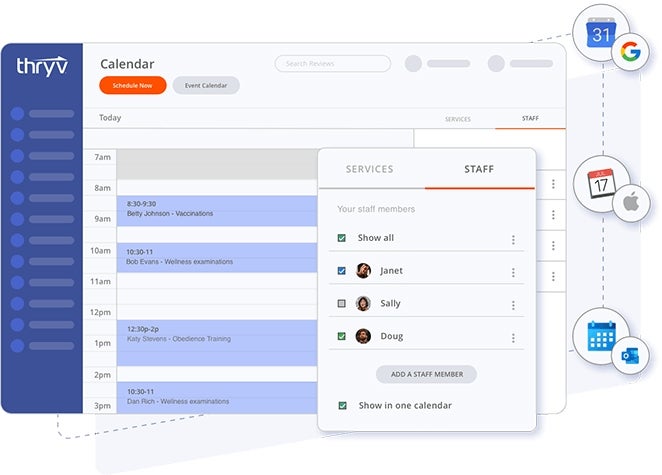
Thryv offers three subscription options: Plus, Premium and Unlimited. The Plus version supports two users and provides scheduling and appointment services; text and email features; 20GB of document storage; and payment processing using Braintree, Square, Stripe or PayPal. Exact pricing information is available upon request from the Thryv sales team.

Squarespace, known for simplifying SMB website design and e-commerce administration, also offers an all-in-one Squarespace Scheduling appointment management solution. Customers need not possess a Squarespace website to use the company’s appointment scheduling service; any web-hosting service will work. All Squarespace Scheduling plans offer calendar syncing, custom payment options, invoicing and automatic reminder email messaging.
A similar service, Acuity Scheduling, was acquired by Squarespace in 2019. The two share almost all of their features. However, Squarespace Scheduling is natively offered for existing Squarespace users and accounts.
Figure C
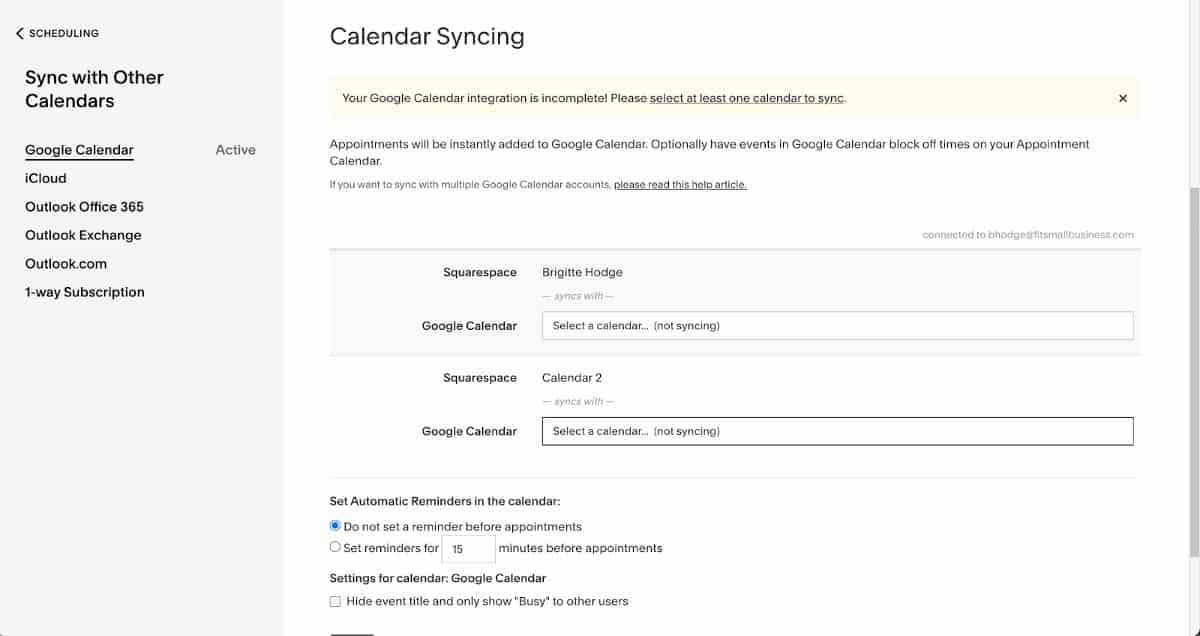
Three Squarespace Scheduling plans are available. Billed annually, the Emerging plan is $14 per month, the Growing plan runs $23 per month and the Powerhouse plan costs $45 per month.

One vendor that is familiar to several SMBs is Square, which gives many businesses the ability to start accepting credit cards. The company’s Square Appointments software integrates with its point-of-sale system to concentrate scheduling, point-of-sale features and payment processing all within a single platform.
Figure D
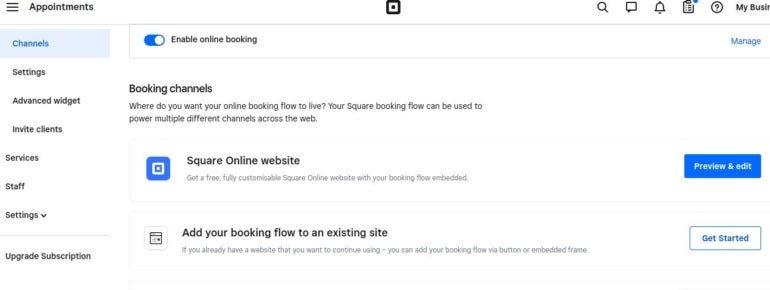
Three subscription plans are available: Free, Plus and Premium. The Free version is for use at a single location and includes an unlimited number of user accounts, access to the custom booking website and social media integrations, integrated payments, automated text and email reminders, and appointment and sales history tracking. The Plus version, at $29 per month per location, adds multiple time zone and location supports and lowers the in-person credit card transaction fee by 10.1%. Premium is $69 per month per location and adds custom permissions, multiple wage rates, and team sales and labor reporting capabilities.

Advertising itself as “free scheduling software,” Setmore offers its clients’ customers around-the-clock automated online scheduling. The solution also offers SMBs a wealth of other features for managing appointment workflows. Free trials for Setmore are available, and the company also offers 30-day money-back guarantees.
Figure E

Three pricing plans are available, with the first being free and supporting up to four users. The free version provides businesses with unlimited appointments, social media integrations, email reminders, Square payment processing, Teleport video meetings and a custom booking webpage. The Premium plan runs $5 per user per month billed annually and supports two users. The Pro plan, which supports three or more users, is $5 per user per month when billed annually.

An unusual approach, one company offers two separate but similar scheduling solutions: SimplyBook.me and SimplyMeet.me. The SimplyBook.me LTD company, a global ISO 27001 certified firm, first launched its appointment scheduling software in 2009. When the company acquired the Harmonizely CalDAV scheduling tool in June 2021, it rebranded that technology as SimplyMeet.me. The firm offers both solutions today. If SimplyBook.me proves too extensive for a business’s needs, SimplyMeet.me offers a simplified interface with fewer features.
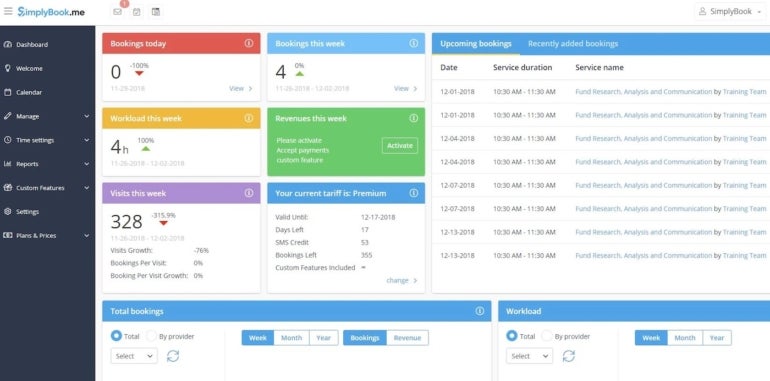
SimplyBook.me offers a free 14-day trial that includes most features and up to 50 bookings. Five subscription types are available:
SimplyMeet.me, meanwhile, offers simplified services, albeit via three different pricing plans:
In today’s fast-paced world, it’s more important than ever for small businesses to provide their customers with convenient, self-service appointment scheduling options. Appointment scheduling software permits customers to review a business’s availability and independently book appointments and meetings using an online interface or email. Such apps allow customers to reserve, change and cancel appointments and meetings without needing to call or communicate with the business directly.
SEE: Calendly vs. Acuity: Appointment scheduling software comparison (TechRepublic)
Not only does this free up valuable time for small business owners and their staff, but it also provides a better customer experience by allowing customers to schedule appointments according to their own schedules and timelines. In addition, appointment scheduling software often comes equipped with valuable features like online payment processing, automatic reminders and customer management tools.
Depending on the platform and selected features, appointment scheduling applications can integrate with a small or midsize business’s website and software systems — including email, calendars, customer relationship management and payment systems — to better enhance workflows. Workflows that are often improved by appointment scheduling software include appointment booking, customer follow-up messaging, and requesting and receiving payments.
SEE: Vendor access policy (TechRepublic Premium)
Business owners and managers can share their business’s calendaring and appointment-booking systems with the appointment scheduling software. Customers, subsequently, can access the information in real time and use their own devices to find or reschedule an appointment that also works with the business’s schedule.
At the very minimum, appointment scheduling software should have the following features:
One of the most important features of appointment scheduling software is its ability to sync with calendar software. This is important because it allows business owners to see their appointments in one central location — their calendar — along with any other meetings or appointments they might have. This can prevent double-booking and other schedule conflicts.
Another key feature of appointment scheduling software is the ability to generate a shareable link to a user’s booking page. This link can be shared via email, social media or a website. It makes it easy for potential customers to book an appointment without having to go through the hassle of filling out lengthy forms.
In addition to generating a shareable link, many appointment scheduling software platforms also allow users to embed their booking page into their website. This is a great option for businesses that want to make booking an appointment as easy as possible for their customers.
Finally, most appointment scheduling software platforms enable users to set custom working hours or availability windows. This is important because it allows businesses to only offer appointments when they are available. For example, if a business only offers appointments from 9 a.m. to 5 p.m., Monday through Friday, then they can set their availability window accordingly, so potential customers can only book appointments during those times.
Appointment scheduling software improves customer service in several ways. First, it ensures customers can easily book appointments online, 24/7. This eliminates the need for customers to call during business hours and wait on hold until they can speak to someone.
Second, it allows businesses to send automatic appointment reminders to customers before their appointments. This reduces no-shows, which is often a major issue for businesses that rely on appointments.
Appointment scheduling software can also help businesses keep track of customer information and preferences, which can be used to provide a better customer experience.
Another benefit of appointment scheduling software is increased efficiency. When businesses use appointment scheduling software, they no longer have to spend time managing appointment bookings manually. This frees up time for employees to focus on other tasks, such as serving customers and growing the business.
SEE: How to use Google Calendar appointment schedules (TechRepublic)
Appointment scheduling software can also automate many tasks associated with managing appointments, such as sending reminders and confirming appointments. This further increases efficiency by eliminating the need for employees to do these tasks manually.
Appointment scheduling software can improve profitability by reducing operating costs and increasing revenue. When businesses use appointment scheduling software, they often find that they need fewer staff members to manage appointments effectively. This reduces labor costs and helps improve bottom-line profits.
SEE: Hiring kit: Automation specialist (TechRepublic Premium)
In addition, by automating many of the tasks associated with managing appointments, businesses can free up time that can be used to generate new leads and close new sales. This helps increase top-line revenue and further improves profitability.
Appointment scheduling software has been known to help business users better manage their time. With a system in place, users will be able to see exactly how much time they have available for each appointment.
This information can help users better plan their day, so they can make the most of their time. Additionally, users will be able to avoid overbooking or double-booking appointments, which can lead to wasted time and lost revenue.
Another advantage of using an online booking system is that it offers businesses much greater flexibility than traditional methods of booking appointments, such as by phone or in person.
Online booking systems allow businesses to offer their customers a range of options for booking appointments by date, time or location. This flexibility means businesses can cater to their customers’ needs much more effectively than before.
Finally, one further benefit businesses enjoy when using online booking systems is increased exposure. By making it easy for customers to book appointments online, companies are opening up their services to a much wider audience than before. This exposure can help to boost sales and spread awareness about the company’s products and services.
Read next: Best employee monitoring software (TechRepublic)
We deliver the top business tech news stories about the companies, the people, and the products revolutionizing the planet.
Best appointment scheduling software for small organizations
Your email has been sent
Your message has been sent
TechRepublic Premium content helps you solve your toughest IT issues and jump-start your career or next project.
Looking for the best payroll software for your small business? Check out our top picks for 2022 and read our in-depth analysis.
Next year, cybercriminals will be as busy as ever. Are IT departments ready?
The company, which for several years has been on a buying spree for best-of-breed products, is integrating platforms to generate synergies for speed, insights and collaboration.
Organize a number of different applicants using an ATS to cut down on the amount of unnecessary time spent finding the right candidate.
Whether you are a Microsoft Excel beginner or an advanced user, you’ll benefit from these step-by-step tutorials.
Video games can benefit companies by giving employees a recreational outlet to build cooperation and morale. But they can also create problems if misused. This policy will help you establish the ground rules for permitting or prohibiting the use of company systems and networks for video gaming purposes. Where gaming is allowed Video gaming is …
A platform developer, someone intimately familiar with specific operating systems and hardware components, works on a company’s core platform to create and optimize all the various functions needed to establish a strong computer infrastructure. The platform developer needs to be a big picture thinker and always keeping in mind why they’re building something and who …
Virtual reality and augmented reality are concepts which have attracted plenty of interest in both consumer and business operations. Both have shown incredible potential and versatility across a wide range of applications. AR can be used as an “overlay” concept to link real-world environments to technology, such as for identifying individuals, providing GPS data or …
AlmaLinux is well on its way to becoming one of the most popular drop-in replacements for CentOS/RHEL. Anyone who has used CentOS will immediately be familiar with the operating system. Any admin who’s not used CentOS will find it as solid a platform as any other for enterprise-level computing. Although the installation of AlmaLinux is …